


 Francais
 Deutsch
 Italiano
Refine Your Search
Nevada United States 1936 stock footage and images
- Showing 11731 to 11736 of 27248 results more
more Hide
Hide
American flag carried to Oglala Sioux tribesmen at the Pine Ridge Reservation for the Rodman Wanamaker Expedition in South Dakota.
The Rodman Wanamaker Expedition of Citizenship to the Native American Indians in South Dakota, United States. Troops of U.S. 7th Cavalry enter the Pine Ridge Reservation to attend the ceremony. Soldiers on horseback enter the Pine Ridge Reservation. The leader of the expedition Dr. Joseph Kossuth Dixon explains its purpose and the symbolism of the American flag to Oglala Sioux tribesmen. The U.S. flag is raised during the flag dedication ceremony. Tribesmen in headdress and regalia stand around the flag pole. The Native American Indians show reverence to the American flag during the ceremony. A member of the Oglala Sioux signs the declaration pledging the allegiance of the Indians to the country of the United States.
1960 Presidential Election news headquarters operations; results show John F. Kennedy leading over Richard Nixon
The 1960 Presidential Election in the United States. Interiors of a building show NBC News and CBS News Election Tracking headquarters and television studio operations. Board tracking the election result returns. A man behind a camera. Many news employees inside the building. The men preparing to broadcast the results of the elections. Interiors of a television network headquarters shows men and women at tabulating machines and electronic computers. A huge crowd gathered at the Republican Party headquarters. A few men and women beside a tally board updating election results. People in the crowd looking at a board. The board showing Presidential candidates Richard Nixon's and John F. Kennedy's count of votes in states Massachusetts, Michigan, Minnesota and several other states. A woman in the crowd looking through binoculars. The figures show Kennedy leading. The moving ticker bulletin board in Times Square, New York City, is shown reading "Kennedy Overcomes Slow Start, Pulls ahead of Nixon" as the counting continues. The Times Square moving bulletin reads 'Kennedy wins Connecticut's 8 Electoral votes, Sweeps all'. A crowd cheering and shouting 'We Want Kennedy'. The bulletin reading 'Kennedy leads in 17 states with 192 electoral votes'. A CBS news worker beside a map showing the states and the position of Republican and Democratic candidates in each state. A bulletin reading 'Kennedy stage see-saw battle in Virginia'. Men inside the television network headquarters including Walter Cronkite. Close up view of a camera being used to film the television news broadcast. A board showing position of the candidates in the election.
Kennedy and Nixon comment on nuclear disarmament before summit conference during a presidential election debate in the U.S.
The third Kennedy-Nixon Presidential Debate in the United States. Douglass Cater from Reporter magazine asks Democratic candidate Senator John F Kennedy about what sort of prolonged period does he envisage before there could be a summit conference and if he thinks that there could be any new initiatives on the grounds of nuclear disarmament during that period. Kennedy answers and talks about the need of strengthening of U.S. conventional forces and increasing missile production. On the question of nuclear weapon disarmament he states that the new administration should renew negotiations with the Soviet Union. He disagrees with the present administration's efforts regarding nuclear controls and general disarmament. He states that if he would get a chance he would make efforts to provide for control of nuclear weapons testing and begin general disarmament levels. Republican candidate U.S. Vice President Richard M Nixon mentions about his speech on this subject. He disagrees with Kennedy's statement that the administration is not making any effort because this is the highest level of operations in the whole State Department which is under the President himself. Roscoe Drummond from New York Herald Tribune asks Vice President Nixon about defending Quemoy and Matsu islands. Nixon answers and states that the U.S. should not deal with dictators and should not indicate which particular area it would defend. He gives the examples of the Korean War and World War II where the U.S. made a mistake. He says that Kennedy should change his position in this regard and not encourage the Chinese Communist and Soviet aggressors to react. Kennedy says that the treaty with the Republic of China excludes Quemoy and Matsu from the treaty area. He states that the treaty only includes defending of Formosa (Taiwan) and the Pescadores. He concludes that the U.S. should meet its commitments and raise war if the Chinese Communists attack the Pescadores and Formosa.
Kennedy and Nixon talk about racial prejudice in the presidential campaign during a presidential election debate in the U.S.
The third Kennedy-Nixon Presidential Debate in the United States. Roscoe Drummond of New York Herald Tribune asks Democratic candidate Senator John F Kennedy to comment on the purpose of the secret domestic militant organization Ku Klux Klan (KKK) in the presidential campaigns. Kennedy answers that the head of the Ku Klux Klan in a statement stated that he would vote for Nixon and not him. Kennedy states that he has never suggested that Nixon has slightest sympathy and involvement with the Ku Klux Klan. Republican candidate U.S. Vice President Richard M Nixon states that it is the Americans who will choose the President. He states that elections are not any test of religion, race but test of a man. He states that Communism is the enemy of all religions and he opposes the Klan organization. He concludes, early in the civil rights movement, that if civilians believe in America they cannot have religious or racial prejudice in the presidential campaign.
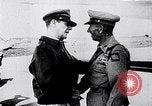
Commander of UN force in South Korea, General MacArthur, reviews forces and U.S. troops arrive in Korea.
United Nations military action at the very beginning of the Korean War. United States Army General MacArthur shakes hands with an officer on the ground in Korea. He observes United Nation defense units, aircraft and soldiers in Korea as their Commander. First United States troops walk with their gear at a railroad station in Korea. Soldier advances hand in help to other soldier. U.S. Army infantry soldier and Korean Republic soldier shake hands. Artillery, rifles, ammunition, and trucks loaded on rail train cars. A U.S. Army tank advances in South Korea. Korean people stand beside the road and watch the advancing soldiers. U.S. Army soldiers load shells and fire artillery to slow the North Korean advance. General MacArthur accepts United Nation's battle flag at a ceremony in Tokyo, Japan. Flag of the United Nations waving in the wind.
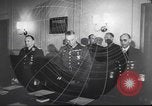
German surrender, UN founding, and Chiefs of Counsel meet before conducting Nuremberg and other trials after World War 2.
A film on preparations that are made for prosecution of axis war criminals following World War 2. Ratification of the surrender documents (from surrender two days earlier at Reims) held at Soviet headquarters in Karlshorst, Berlin, on May 9, 1945. German officers Colonel-General Hans-Jürgen Stumpff as the representative of the Luftwaffe, Field Marshal Wilhelm Keitel as Chief of Staff of OKW, and Admiral Hans-Georg von Friedeburg as Commander-in-Chief of the Kriegsmarine enter room and are seated. View of Keitel signing the surrender document. Scene change to Hall of the United Nations Conference, held in San Francisco from April 25 to June 26, 1945, with delegates from 50 Allied nations creating the United Nations. This was officially the United Nations Conference on International Organization (UNCIO). Leaders of various United Nations countries address delegates present in the War Memorial Opera House of San Francisco, including Edward Stettinius Jr of the United States. Next: A meeting of the military tribunal Chiefs of Counsel of many nations, including France, Russia, Great Britain and the United States, held in London, England, United Kingdom. They sign the International Military Tribunal Charter governing how the major war criminals from World War 2 would be tried.
CRITICALPAST.COM: About Us | Contact Us | FAQs - How to Order | License Agreement | My Account | My Lightboxes | Shopping Cart | Advanced Search | Featured Collections | Website Terms & Conditions | Privacy Policy ©2026 CriticalPast LLC.
License Agreement |
Terms & Conditions |
Privacy Policy
©2026 CriticalPast LLC.