


 Francais
 Deutsch
 Italiano
Refine Your Search
Nevada United States 1936 stock footage and images
- Showing 11905 to 11910 of 27248 results more
more Hide
Hide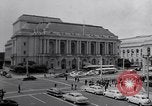
Primer Mr Shigeru Yoshida addresses and signs peace treaty with representatives of other countries in San Francisco, CA
San Francisco Peace Treaty conference with Japan, in San Francisco, California. Beginning shows the War Memorial Opera House and Van Ness Avenue. U.S. President Harry S Truman steps to a podium, at the Opera House, to address delegates at the conference. With him on the stage are Dr. Warren Kelchner, Temporary Chairperson of the Japanese Peace Treaty Conference, Governor Earl Warren of California, and Secretary of State Dean Acheson. Next, Dean Acheson is seen seated at the center of a table with Dr. Kelchner, at his right, as Soviet representative Andrei A. Gromyko steps to the microphone and speaks. (Narrator says he raises complaint about rules of procedure.) Dean Acheson removes his translating headset in frustration. Next, a representative of Poland comes to the microphone, and calls for delays. View of delegates in the audience. New Zealand representative, Sir Carl August Berendsen, takes the stand to renounce delaying tactics. Audience members applaud. Carlos P. Rómulo, of the Philippines, speaks in support of the treaty. John foster Dulles, of the United States, steps to the podium to speak for the treaty. Next, Japanese Premier, Shigeru Yoshida, referring to notes in a roll of paper, endorses the treaty. Audience applauds. Secretary of State Acheson is seen signing the treaty for the United States, followed by representatives of: Australia; Cambodia; Great Britain; Ceylon; France; Indonesia; Philippines; and Pakistan. Next, the Japanese delegation comes forward, and Prime Minster Shingera Yoshida, signs the historic document. Closeups of ordinary Japanese from all walks of life. Japanese people commuting to work.
Scenes of New York City buildings and of the New York World's Fair in 1940
From the Ford Motor Company produced film, "Scenes From the World of Tomorrow" documenting the 1939-1940 World's Fair in New York City. View of buildings of the New York World's Fair of 1940. The Brooklyn Bridge. Aerial view of Manhattan Island, New York City. Skyscrapers of New York City including the Chrysler Building and the Empire State Building. New York Harbor and ships in the harbor. View of the buildings of the New York Worlds Fair in the distance in Flushing Meadows-Corona Park, as seen from high in a skyscraper of New York City. The Fair's Trylon and Perisphere stand out. People walk along the sides of fountains and waterways at the fair. Crowds milling about, bands marching, dancers performing. Flags of many nations flying on the flag poles. Celebration of the 150th anniversary of George Washington, as the first President of the United States and a statue of George Washington. A bus moves on the street. Fountains and a small bridge near a waterway. Pavilions of nations of England, Japan, and Italy. The USA building and some of the buildings of U.S. States including Maine and Florida. Fountains and waterways of the fair. Woman and two girls eat ice cream cones. A Raymond Loewy - designed S1 experimental streamlined locomotive created for the Pennsylvania Railroad. Pavilions of American Telephone & Telegraph and of United States Steel Corporation, also of Westinghouse, Goodrich, Chrysler, and General Motors.
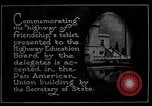
Pan American Highway Commission presents a commemorative plaque at the Pan American Union in Washington DC
Delegates of the Pan American Highway Commission present a gift after a month-long tour of the United States in 1924. Ceremony at the Pan American Union in Washington DC. Tablet is unveiled inscribed with the title 'Highway of Friendship', and presented as a gift to the Highway Education Board. The first line of the tablet reads, "Commemorative of the Official visit of the Pan American Highway Commission to the District of Columbia and the states of North Carolina, Kentucky, Illinois, Minnesota, Wisconsin, Michigan, Ohio, Pennsylvania and New Jersey June 2 to July 3, 1924. The happiness and prosperity of the people of the United States have been greatly enhanced by your definite program of Highway education...." U.S. Secretary of State Frank B. Kellogg accepts the tablet and speaks to those gathered.
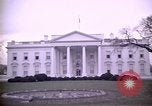
King Saud of Saudi Arabia, Richard Nixon, Walter George and Joseph William Martin Jr. at a dinner at the White House in Washington DC.
King Saud bin Abdulaziz Al Saud of Saudi Arabia visits Washington DC during royal visit to the United States. King Saud attends state dinner hosted by the United States President Dwight D. Eisenhower at the White House. King Saud arrives at the White House by car. He is escorted by trusted counselors, members of the royal family, cabinet officers and diplomats, to a State Dinner at the White House. U.S. Vice President Richard Nixon, in formal attire, enters the White House. U.S. Envoy to the North Atlantic Treaty Organization and former Senate Foreign Relations Committee head Walter George arrives at the White House. Additional members of His Majesty's suite, arrive at the White House. U.S. House of Representatives Minority Leader, Joseph William Martin Jr. arrives. American-Arabian Oil Company executive Red Davies greets Saudi visitors.
President Ronald Reagan gives a speech on the Defense Budget at the White House in Washington DC.
U.S. President Ronald Reagan at the White House in Washington DC. President Ronald Reagan gives a speech on the Defense Budget and on the need for increased defense spending. He speaks about the Defense Program America needs. President Reagan states that the American security should be prepared for all situations. He presents various comparison charts depicting weapons of the Soviet Union versus the United States. An animation shows 'Intercontinental Missiles'. Intermediate Range Weapons from 1978-1982. An animation shows the difference in production of submarines, artillery and weapons between the United States and the Soviet Union. Labeled reconnaissance photograph shows the Soviet Communications Intelligence Facility in Lourdes, Cuba. Aerial reconnaissance photos of the Soviet Weaponry Sandino Airfield in Nicaragua. An airfield under construction in Grenada. President Reagan in his speech states that the American military force should be ready to respond to any emergency situation. An animated graph shows the percent of budget from 1960-1980 dedicated to defense versus social services, with defense spending falling proportionally as spending on social programs increased. At the end of the speech President Ronald Reagan asks for America's prayers and support.
U.S. President Roosevelt emphasizes on increasing expenditure on Army during his annual message to the Congress,Washington D.C.
Congress hears U.S. President Franklin D Roosevelt's annual State of the Union message in Washington D.C. President Roosevelt talks about how no one expects the United States to send American youth again to fight on the soil of Europe (to be involved in World War 2) and he asserts that is still the United States position "for nobody expects such an undertaking." He recalls that President George Washington warned against entangling foreign alliances. He calls on congress to levy sufficient additional taxes to meet emergency spending needs for national defense (due to threat of war). Members of the Congress clap during President's State of the Union speech.
CRITICALPAST.COM: About Us | Contact Us | FAQs - How to Order | License Agreement | My Account | My Lightboxes | Shopping Cart | Advanced Search | Featured Collections | Website Terms & Conditions | Privacy Policy ©2026 CriticalPast LLC.
License Agreement |
Terms & Conditions |
Privacy Policy
©2026 CriticalPast LLC.