


 Francais
 Deutsch
 Italiano
Refine Your Search
Nevada United States 1936 stock footage and images
- Showing 11917 to 11922 of 27248 results more
more Hide
Hide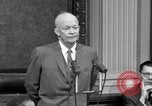
U.S. President Dwight Eisenhower answers queries of newsmen during his 130th press conference in Washington DC, U.S.
U.S. President Dwight Eisenhower during his 130th press conference in Washington DC, United States. Donald J. Gonzales, a newsman, says that when the President said he was unaware of the possibility of a Soviet statement on ending nuclear weapon tests, the U.S. Secretary of State John Foster Dulles said just on the previous day that this has been discussed in the previous days. The pressman asks the President for his reaction to the Soviet announcement. The President replies that he did not say that he was unaware of anything about it but did not have any proof that it was going to occur. He says that he cannot say anything more than what the Secretary said after complete discussions. The President further says that they had discussed this as a possibility on their own side, that is unilateral abandonment of tests and decided that it was not good for the United States at that time. Pressmen seated during the conference. Another pressman, Henry N. Taylor, gets up and puts forward a query to the President. He asks that last week the President had told them that he was convinced any nuclear test could be detected if there was a test ban. Yet the President, in the response to Russia, says test bans could be evaded in secrecy. The pressman asks the President if he could clear it. President Eisenhower says that the U.S. Secretary of State Dulles might have said that they are not certain there have not been tests, particularly underground tests or so small and in remote regions where there would not be debris and instruments would not be sensitive enough to pick them up. The President says he does not believe that explosions can happen in huge megaton character and not have evidence of it. Cameramen taking pictures. The President shakes hands with the officials and meets the pressmen.
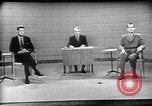
Senator John F. Kennedy and Vice President Richard Nixon face off in their first Presidential debate, in Chicago Illinois.
The first Kennedy-Nixon Presidential Debate in Chicago, Illinois. Moderator Howard K. Smith introduces the candidates-- Republican candidate U.S. Vice President Richard M. Nixon and Democratic candidate Senator John F. Kennedy. He talks about the opening and the closing statements to be given by the candidates. He talks about the questions which the panel of correspondents would ask the candidates. Senator Kennedy begins his statement. Kennedy talks about the direction of freedom for the Americans. He discusses domestic issues and the kind of society people live in. He talks about the strengths and the progress rate of the Americans. He urges people to make their country more powerful in every field. He feels disappointed about the unused steel-mill capacity, low rate of economic growth and poor educational system. He says he's not satisfied when he sees men like Jimmy Hoffa in charge of the largest union in the United States, and still free. He insists on overall infrastructural development and improvement of hydro power production where he says the Soviet Union has a lead. He states that every American should enjoy his full constitutional rights and they should meet their responsibilities. He says African American and Puerto Rican babies have much lower chances in education, work ,and advancement in the United States, and that this needs to change. He states that the government should provide effective programs and social security system for its citizens.
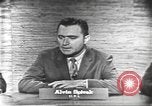
Richard Nixon and John Kennedy answer reporters' questions during a presidential election debate in Washington DC, U.S.
The second Kennedy-Nixon Presidential Debate in Washington DC, United States. Alvin Spivak of United Press International asks Republican candidate U.S. Vice President Richard M. Nixon to comment on his intentions in the field of civil rights. Nixon answers and states that progress is to be made in the field of employment by giving statutory authority to the Committee on Government Contracts. He states that in the field of schools, provisions should be laid whereby the federal government would give assistance to districts who want to integrate their schools. He speaks about presidential leadership. He concludes and says that the civil rights of the Americans should be recognized in order to protect the country from communist rule. Democratic candidate Senator John F Kennedy points that Nixon hasn't discussed what would be his policy on implementing the Supreme Court decision of 1954 and what would he do and what would be his leadership in providing fair employment, housing and education. He concludes by saying that the president must establish a moral leadership. Harold R. Levy of Newsday asks Kennedy to comment on what the President should do in racial discrimination events such as Little Rock Nine or the lunch-counter sit-ins. Kennedy says that he thinks that a president operates in different areas as a legislative leader, an executive leader and a moral leader and his functions differ in each area. He talks about the government contracts. He speaks about the standards set by the Americans which the Communists don't set. He comments on the case of Little Rock and says the U.S. President should go with the Supreme Court's decision. Nixon comments on the matter of the Committee on Government Contracts being mentioned by Kennedy. He talks about the functions of the Democratic Congress. He states that actions are required along with hopes. He concludes and says that in the field of executive leadership, U.S. president must lead and act as he talks.

1920 Democratic Party National Convention, Cox and Roosevelt (FDR) campaigning atop ticket
Franklin Delano Roosevelt, Vice-Presidential candidate, walking with James M. Cox, the Democratic Presidential candidate for the 1920 election. Supporters shake hands with Roosevelt and Cox. Scenes from floor of 1920 Democratic Party National Convention in San Francisco. Signs say “Philippines”, “Michigan”, “District of Columbia”, “Ohio”, “Missouri”, and other US states and territories in the 1920 Democratic Party National Convention in San Francisco, California. Female Democrat supporter enthusiastically raise her arms. The woman political activist cheering at the Democratic Party National Convention in San Francisco, California. Signs with the name of US states and territories at the democrat National Convention. Franklin D. Roosevelt give speeches and smiles as he campaigns as the democratic Vice President candidate for the 1920 United States election. Democrat supporters’ parade in San Francisco showing their support for James M. Cox. A scene from a Marion, Ohio parade supporting James M. Cox and Franklin Delano Roosevelt campaigning for 1920 election. Brass band playing. Franklin D. Roosevelt and James M. Cox wave at supporters. Women, wearing hats and white dresses, and white sashes with word "Marion" on them marching in support for the democratic Party. Franklin D. Roosevelt and James M. Cox smile and wave at supporters. Eleanor Roosevelt and her children with pet dog, a German Shepherd, at Hyde Park. Eleanor Roosevelt smiles. Crowded Democratic Party campaign before 1920 Presidential election. Franklin D. Roosevelt speaks to crowd, campaigning for the Democrat Party. Democratic supporters cheer. Franklin Delano Roosevelt in car. Franklin D. Roosevelt takes his hat off as greeting, a man with roses in car with Roosevelt. Roosevelt greets his mother and goes inside their house, the Springwood estate at Hyde Park (4097 Albany Post Rd, Hyde Park, NY 12538, United States). Roosevelt speaks to the people of his hometown, Hyde Park New York. Franklin D. Roosevelt shakes hands with Hyde Park, New York residents. Franklin D. Roosevelt with wife, Eleanor Roosevelt. Franklin D. Roosevelt with his children.

An exercise to train combat troops in arctic warfare.
Alaskan Command paratroopers with units from other Strategic Army and U.S. Air Force units join Princess Patricias Canadian Infantry. United States Air Force plane goes aloft in Alaska. View of pilot in cockpit. Alaskan Command paratroopers in the plane. Paratroopers jumping from the planes and sky filled with parachutes. United States Army tanks moving on snowfield. View of U.S. Army helicopter. U.S. Army aircraft takes off. View of aircrafts in sky.
General Eisenhower greets King George VI at the First Army Headquarters in Verviers, Belgium (WW2)
King George VI of the United Kingdom and United States Army General Dwight D Eisenhower at the First Army Headquarters in Verviers, Belgium during World War II. Lieutenant General C. H. Hodges, General Dwight D. Eisenhower, U.S. Army Lieutenant General Omar N Bradley, and a United States Army Air Force General await the arrival of King George VI. Officers converse with each other and look up at the sky. A sedan drives up to a building. United Kingdom King George VI gets out of the car. He is greeted by General Eisenhower.
CRITICALPAST.COM: About Us | Contact Us | FAQs - How to Order | License Agreement | My Account | My Lightboxes | Shopping Cart | Advanced Search | Featured Collections | Website Terms & Conditions | Privacy Policy ©2026 CriticalPast LLC.
License Agreement |
Terms & Conditions |
Privacy Policy
©2026 CriticalPast LLC.