


 Francais
 Deutsch
 Italiano
Refine Your Search
Nevada United States 1936 stock footage and images
- Showing 11941 to 11946 of 27248 results more
more Hide
Hide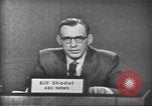
John F Kennedy and Richard Nixon contrast costs of their party platforms during a presidential election debate in the U.S.
The third Kennedy-Nixon Presidential Debate in the United States. Douglass Cater of Reporter magazine asks Democratic candidate Senator John F Kennedy to comment on costing of party platforms calculated by U.S. Vice President Nixon. Kennedy states that he believes in a balanced budget and an unbalanced budget is warranted during a recession or a national emergency. He comments on the cost of his budget and compares it with that of Nixon. He talks about high interest-rate policy that has added huge amounts to interest on debt. He talks about a different monetary policy to reduce the interest-rate burden. He talks about the bill passed by the Congress for the medical care for the aged. He says that more money would be spend on aid to education, housing and defense in his programs. Republican candidate U.S. Vice President Richard M Nixon comments on Kennedy's medical care for aged program under social security. He talks about the cost of his agricultural program and points out resulting rise in food prices. He concludes and states that following Kennedy's program would lead to inflation.
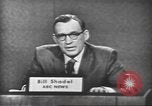
John Kennedy and Nixon talk about steps to improve U.S. economic growth during a presidential election debate in the U.S.
The third Kennedy-Nixon Presidential Debate in the United States. Roscoe Drummond of New York Herald Tribune asks Republican candidate U.S. Vice President Richard M Nixon to comment on declining economic growth and what steps he would take to improve it. Nixon answers that he is not satisfied with the economic growth of the U.S. He compares the nation's growth rate during the Truman Administration and the Eisenhower Administration. He urges for the development of private enterprise sector of the economy. He talks about his program of tax reform which would stimulate more investment in U.S. economy. He talks about the upliftment of the distressed areas and full utilization of resources of those areas. He talks about the adequate use of talents of the Americans and their civil rights. He concludes and states that there has been a continuous development of American economy in the past years. Democratic candidate Senator John F Kennedy states that Nixon has pointed a rise in food prices in his proposed agricultural program which is not true. He comments on the statement given by Nixon on aiding distressed areas and education. He says that the bills of these program have been opposed by the administration. He talks about the lowest rate of economic growth during this administration.
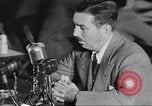
The testimony of Walt Disney Studios owner Walt Elias Disney before the House Committee on Un-American Activities.
Owner of Walt Disney Studios Walt Elias Disney at hearings of House Committee on Un-American Activities (HUAC) in the United States. Walt Disney Studios owner Walt Elias Disney answers upon being questioned about having any conversations with organizer Herbert Sorrell relating to communism and states that Mr. Sorrell mentioned about the funding of 1937 strikes against major studios. Walt Disney gives his personal opinion about infiltration of labor unions by Communists, and about the Communist Party, and says he does not believe it is a political party. He also expresses his views about the bills pending before the committee to outlaw Communist Party and further states that American labor unions should be kept clean and should not be affected by communism.
U.S. President Franklin D Roosevelt addresses the nation and pleads for democracy in the U.S.
U.S. President Franklin D Roosevelt addresses the nation. Roosevelt seated at a desk in his office in the United States. He states that democracy has disappeared in many nations because of the unemployment, insecurity and government weakness and confusion. He further states that the democratic institutions can be preserved in the U.S.
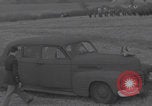
Winston Churchill and General Eisenhower visit 101st Airborne at Welford airfield, Berkshire, England (WW2)
British Prime Minister Winston Churchill and United States General Dwight D. Eisenhower meets Brigadier General Maxwell D. Taylor and inspect the United States 101st Airborne Division in England during World War II. A staff car with the British and American flags arrives on the Welford airfield, Berkshire, England. General Dwight D Eisenhower and British Prime Minister Winston Churchill alight from the staff car after an attendant opens the car door. Prime Minister Churchill and General Eisenhower meets with military officers as they walk in the airfield. Prime Minister Churchill salutes and shake hands with Brigadier General Maxwell D. Taylor. A band plays while Prime Minister Churchill and General Eisenhower review the 101st Airborne Division troops with its Commander, Brigadier General Taylor. Two soldiers hold flags. Prime Minister Churchill, Generals Eisenhower and Taylor review the troops by walking amongst them. General Eisenhower uses binoculars to watch paratroopers jumping from C-47 planes during a mass demonstration. Hundreds of paratroopers with parachutes fall to the airfield. Prime Minister Churchill and General Eisenhower get in a car. Army vehicles driving away.
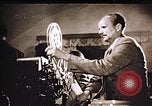
Segment of U.S. Information Agency (USIA) film dealing with outreach to others. This segment deals with use of motion pictures
Segment of film about U.S. Information Agency (USIA) use of motion pictures abroad. A man threads film into a motion picture projector. Glimpses of audiences in several different countries as they watch movie showing on screen. A film introductory slate is shown reading:" U.S.I.S. United States Information Service, presents." Closeups of faces of two bearded men watching a film. Film slate reads: "United Nations Report on Prisoners of War." The film shows Chinese prisoners of war, marching to a United Nations POW camp during the Korean War. Views large tents erected in camp, with "PW" written on one tent. Another view shows a large sign laid out on the ground reading: "POW Camp-3." Chinese POWs march through entrance of a camp and are guided by American soldiers standing beside a military ambulance.
CRITICALPAST.COM: About Us | Contact Us | FAQs - How to Order | License Agreement | My Account | My Lightboxes | Shopping Cart | Advanced Search | Featured Collections | Website Terms & Conditions | Privacy Policy ©2026 CriticalPast LLC.
License Agreement |
Terms & Conditions |
Privacy Policy
©2026 CriticalPast LLC.