


 Francais
 Deutsch
 Italiano
Refine Your Search
Nevada United States 1936 stock footage and images
- Showing 11989 to 11994 of 27248 results more
more Hide
Hide
U.S. President Eisenhower briefs press about his 2 1/2 week trip to nine countries during a press conference in Washington DC
U.S. President Dwight Eisenhower's 175th press conference in Washington DC, United States. Several correspondents from different nations arrive for the President's 175th press conference. Men prepare cameras mounted on tripod stands at the back of a hall. President Eisenhower with an official walks past the newsmen seated in the hall. The President makes an announcement of his two and a half weeks' trip starting from December 4, 1959. The newsmen taking notes. The President says that he would be visiting nine countries and would be making brief informal visits to Rome, Ankara, Karachi, Kabul and would be in New Delhi for the inauguration of the American Exhibit at the World Agricultural Fair on December 11. He says he will visit Tehran and Athens on his way to Paris for the Western Summit meeting. He gives details of the 3 main days. December 4 - when they would be developing legislative program for the coming year, December 11 - the beginning of the World Agricultural Fair, and December 19 - when he would be in Paris for a meeting. A newsman asks the President the purpose of this extensive visit. The President states the importance and need of being the first U.S. President to make an extensive visit to a strategic continent like Asia. He expresses his interest in visiting India and millions of people who are struggling to raise their standard of living. He says that he will visit Pakistan, Afghanistan, Iran and other nations on the way. The President further says that he hopes to build in that region of Asia and in many other parts, a better understanding of the United States. A correspondent asks the President whether Mrs. Eisenhower and his family members would be joining him for the visit. The President says that some of his family members would be joining him but may be not his wife.
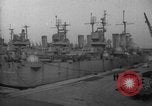
Chile Flag is raised to fore top of the USS Brooklyn and USS Nashville docked at Philadelphia Naval Base in Philadelphia.
Activities aboard a ship docked at Philadelphia Naval Base in Philadelphia. Ships in Reserve Fleet Basin. USS Brooklyn (CL-40) light cruiser in the foreground. Stern view of USS Brooklyn and USS Nashville (CL-43). Camera pans over ships, including the heavy cruisers USS Louisville CA 28, USS Augusta CA 31, and USS Portland CA 33, in the Philadelphia Navy Yard. United States and Chile Naval officials with State Department representatives on deck of USS Brooklyn. Navy band plays. American flag lowered and the Chilean Flag is raised aboard the USS Brooklyn. Chilean flag raised aboard the USS Nashville. United States Navy Rear Admiral Roscoe E Schuirmann hands ships papers to Chilean Ambassador Felix Nieto Del Rio. Chilean flag fly at masts of the USS Nashville and USS Brooklyn. Chilean officers inspect. Ambassador Del Rio and Vice Admiral of the Chilean Navy, Immanuel Holger come up gangway of USS Brooklyn. Rear Admiral Schuirmann greets them. Yni Louis Rivas Voisin and Yoeman Felix Labbe of the Chilean Navy raise flag aboard USS Brooklyn.
Joseph T McNarney,Georgy K Zhukov and Alphonse P Juin attend the Joint Allied Control Commission conference in Germany.
Joint Allied Control Commission Conference in Berlin,Germany. Joint Allied Control Commission Conference in session to resolve the conflicting economic and political policy. Members of board and representatives of four nations General of the United States Air Force Joseph T. McNarney,Marshal of the Soviet Union Georgy Konstantinovich Zhukov and Marshal of France Alphonse Pierre Juin attend conference. United States Secretary of State James Francis Byrnes addresses German civilians on Vital policy at Stuttgart in 1946. U.S. Ambassador Robert P. Murphy,Senators Arthur Hendrick Vandenberg,Matthew Connelly and General Joseph T. McNarney seated at speaker's stand.
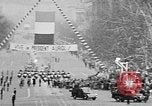
Secret service agent stay close to President to protect him during a public gathering in Washington D.C.
Activities of the United States secret service agents in Washington D.C., United States. Visit of French President Auriol, in 1947. Secret Service mingle and occupy vehicles at edge of gathering. Motorcade leaving White House with Secret Service agents riding on outsides of cars. In crowd secret servicemen are on an alert for the protection of the President or foreign head of State. They operate on a two way radio and keep a record about the route and timings when the motorcade will approach the crowd. During public gathering secret service agents stay close to U.S. President Harry S Truman. They watch individuals and maintain vigilance for unusual movements, or activities. Phalanx of agents escorts President's motorcade through the streets.
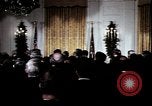
President Nixon makes remarks before signing the National Cancer Act of 1971 at the White House in Washington DC, U.S.
Signing of the National Cancer Act of 1971 in the East Room of the White House in Washington DC, United States. U.S. President Richard Nixon walks up to a microphone in the East Room. The President makes remarks. He speaks about the threat of cancer in the United States which killed many people during World War II and after that. He further speaks about the national commitment to the attempt of finding a cure through the National Cancer Act. President Nixon states that the Congress is totally committed to provide funds to ultimately eradicate cancer which is a major cause of death. He speaks that national commitment is different from government commitment because the national commitment involves all voluntary activities. A crowd applauds as President Nixon walks over to a table to sign the National Cancer Act.
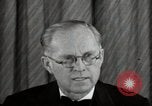
Joseph Kennedy strongly opposes American intervention in World War II during his speech in Washington D.C.
Speech by former U.S. Ambassador to UK, Joseph Kennedy, in Washington D.C., United States during World War II. Kennedy speaks against American intervention in World War II and states that outcome of this war will not bring prosperity to the United States.
CRITICALPAST.COM: About Us | Contact Us | FAQs - How to Order | License Agreement | My Account | My Lightboxes | Shopping Cart | Advanced Search | Featured Collections | Website Terms & Conditions | Privacy Policy ©2026 CriticalPast LLC.
License Agreement |
Terms & Conditions |
Privacy Policy
©2026 CriticalPast LLC.