


 Francais
 Deutsch
 Italiano
Refine Your Search
Nevada United States 1936 stock footage and images
- Showing 115 to 120 of 27246 results more
more Hide
Hide
Tourists visit Brodie, a ghost mining town, in Mono County, California
Tourists visit Bodie, a ghost town, during a tour in the High Sierra region between Yosemite and Lake Tahoe in California, United States. A car heading towards Bodie, a ghost town (formerly a mining town) in the Bodie Hills east of the Sierra Nevada Mountain range in Mono County, California, United States. View of abandoned houses in Bodie. James “Jim” S. Cain, the landlord of Bodie, stands imposingly in front of an abandoned house. Jim Cain welcomes the tourists to Bodie. A cabin house where United States President Herbert Hoover once lived in during his time as a mining engineer in Bodie. Jim Cain assists a man into the Yosemite Transport System (YTS) stage, tipping his hat to say “good-bye” to tourists leaving. The U.S. Hotel, one of the larger structures in Bodie, is seen in the background.
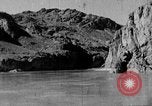
Boulder City built to house employees engaged in Boulder dam excavation and construction.
Documents the excavation and construction of the Boulder Dam (Later named Hoover Dam). Boat in a river at the Black Canyon. A man points to the map of United States. Water floods in agricultural district. River in a deep valley between cliffs. Map points out Black Canyon of the Colorado River, on the border between Arizona and Nevada. Deserts of South West. Excavating mountains by truck. Cargo train runs on track. Men work in factories. Industrial equipment. Engineers and surveyors at construction site. Small town (Boulder City) built to house employees. Various buildings of town. Building housing the officers of Pacific administration. Traffic on street and gardens outside houses. White cottages in town. Cooks prepare food in kitchen. Men served in large dining hall. Passenger trucks loaded with workers, moves for dam site. Workers leave trucks at dam site.
A map locates the flood affected areas in Ohio and the high and low pressure areas in the Ohio river during floods of 1937.
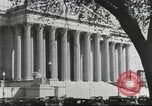
View of the United States National Archives Building (700 Pennsylvania Avenue, NW Washington, DC 20408-0001) in March 1936. in Washington, DC. Washington DC escapes damage from the great Potomac River flood. Next scenes cover damage caused due to a flood in Ohio, United States in January 1937. View of a weathervane in stiff winds. The level of the Ohio river rises. The flooded tributaries of the river. A map locates the flood affected areas. It depicts the high and low pressure areas. Map depicts heavy rains continuing for 20 days from January 6 to January 26, totaling 16 to 20 inches in the affected area.
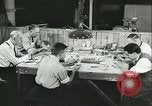
WPA workers build a massive scale model of New York City; also WPA art, library, and theater programs
Works Progress Administration (WPA) projects in New York City during the Great Depression. Skilled architects, draftsmen, and artists work for the WPA on a massive scale model of New York City, built in cooperation with New York University (this model predates the famous Panorama of New York City model built for the 1964 World's Fair). An artist is seen leaning over part of the model painting one of its features, which include detailed roads, bridges, buildings, and waterways. A hand lifts a building and measures its base with a ruler. Cartographic Survey WPA workers are seen creating a relief map of Staten Island for educational use. Men and women artists, including sculptors, are seen creating new sculptures funded by WPA. A man carves a bust in an art studio or class. Another man carves a relief stone commemorating Dewitt Clinton. A man stands in a Free Library and looks at books. Two women on a park bench look at books from the WPA Free Library holdings. A skilled artist is seen laying out and buildings stained glass windows for the United States Military Academy at Westpoint in New York. Stained glass panels depicting George Washington and soldiers are seen. A series of the George Washington stained glass windows is seen in place, with the artist applying final touches. Men work on the Federal Theater Project. Billboard signs advertising various WPA funded theatre productions in 1936 are shown, including Jefferson Davis, The World's Greatest Circus, Taking the Air, The Mikado, Macbeth, All American Minstrels, Battle Hymn, and Horse Eats Hat.
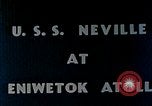
Bombing by the U.S. troops, Landing Craft Vehicles lowered and Landing Craft Personnel circle in Eniwetok Atoll.
Battle of Eniwetok during World War II. United States Ship Battleship USS Nevada (BB-36) at Eniwetok Atoll (sometimes spelled Enewetak or Eniewetok) in the Marshall Islands. Stern view of hospital ship USS Solace (AH-5) in the pacific. Bombardment by the United States forces. Water splashes due to bombardment. Officer of United States looks at the artillery bombing by telescope. Troops on deck. Landing Craft Vehicles (LCV) are lowered from ship. Troops on LCV. Landing Craft Personnel (LCP) circle in the water.
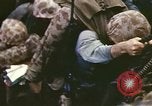
Marines load in LCVPs to move towards the Philippines coast as naval vessels fire at the coast during World War II.
United States Naval fleet off the coast of the Philippines during World War II. U.S. Marines climb over the side of cargo nets and into an LCVP ( Landing Craft Vehicle Personnel). The marines go over the side of a ship into the LCVP. A four barrel 5" 38 caliber naval gun aboard a destroyer fires. A United States destroyer of Fletcher class bombards the coast. 5" 38 caliber naval gun fires. The destroyer bombards the beach. An LSMR (Landing Ship Medium, Rocket) fires rockets. Shells explode on the beach. A United States battleship of Nevada class camouflaged by Thayer method bombards the beach. 5 inch and 40 mm guns fire at the beach. Crew loads and fires a 3"50 caliber gun. Explosions occur. An LCS ( Landing Craft Support) near the beach. The destroyer of Fletcher class bombards the beach. Aircraft fly over the convoy of ships. Sky lookouts on the bridge of a ship. Camouflaged destroyer and a heavy cruiser of Baltimore class bombards the beach. Twin mounts on a cargo ship bombard the beach. A man with a long glass leans against a signal lamp towards the beach.
CRITICALPAST.COM: About Us | Contact Us | FAQs - How to Order | License Agreement | My Account | My Lightboxes | Shopping Cart | Advanced Search | Featured Collections | Website Terms & Conditions | Privacy Policy ©2026 CriticalPast LLC.
License Agreement |
Terms & Conditions |
Privacy Policy
©2026 CriticalPast LLC.