


 Francais
 Deutsch
 Italiano

Refine Your Search
Nevada United States 1936 stock footage and images
- Showing 121 to 126 of 35683 results more
 Hide
Color Sound
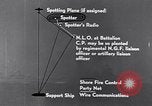
Coordinating naval gunfire during U.S. invasion of Okinawa in World War II. Destroying enemy caves and hideouts
Animation graphic describing how land sea and air information was coordinated to enable precise targeting of enemy positions by naval gunfire during the U.S. invasion of Okinawa, Japan in World War 2. U.S. minesweepers enable capital ships with heavy guns to safely operate close to enemy targets. Views of heavy naval gunfire. Advance of the Marine 3rd Amphibious Corps. U.S. troops, advancing slowly, routing out Japanese defenders dug in to caves and holes throughout Okinawa. Naval heavy guns were called upon to destroy these caves. Detailed live images include: Mine sweepers off Okinawa, sweeping for mines; heavy cruiser USS San Francisco, CA-38, under a head of steam and using signal lights; battleships fire at Okinawa; A bow view of a Tennessee Class battleship; battleship USS Nevada, BB-36, fires its main battery; closeup of a Cleveland Class light cruiser's main aft battery firing at Okinawa; stern view of the heavy cruiser USS Pensacola, CA-24, fires her aft main 8-inch/55 main battery; U.S. Marines on the march and blowing up caves; battleship USS New York, BB-34, fires her main battery; time 03:36 shows a Cleveland Class light cruiser firing its forward main 6-inch battery; time 03:30 shows the USS New York, BB-34, again; various naval guns fire and explosions on Okinawa are shown; time 04:08 shows the forward main deck, looking aft, of the USS Nevada, BB-36, with a Tennessee Class battleship in the background.
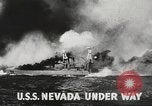
Wreckage of Japanese aircraft and wounded United States sailors after the attack on Pearl Harbor during World War II.
A film about the attack on Pearl Harbor in Honolulu, Hawaii by Japanese bombers during World War II. Mix of dramatized and actual footage of the attack. USS Nevada (BB-36) underway during the Japanese attack. Japanese bombers in flight. Bombs explode around USS Nevada in Pearl Harbor. A U.S. sailor fires a machine gun at Japanese bombers. Ships attacked by Japanese bombers. Smoke billows up from the explosions. Clouds of black smoke rise from burning battleships in Pearl Harbor. Wreckage of Japanese aircraft in Pearl Harbor. Wreckage and parts of downed Japanese aircraft on land and in water. A dead Japanese pilot floating in water and his aircraft lifted from the water with a ship crane. A Japanese two-man midget submarine. Views of the 2-man mini submarine, a type A Ko-hyoteki-class submarine, number 19, on a beach of Oahu. U.S. officers and troops inspect wreckage after the bombings. Wreckage of U.S. aircraft. Wounded U.S. sailors and soldiers being shuttled by medical staff for care. Wounded lying on litters and more being transported in for care.
U.S. President Franklin Roosevelt addresses citizens of Chicago; scenes from 2nd Italo-Ethiopian War and Spanish Civil War
U.S. President Franklin D Roosevelt warns of an increasing danger of armed conflict (increasing danger of war leading up to World War 2). Roosevelt's motorcade on the streets of Chicago. A large crowd gathered to get a glimpse of the President. Confetti rained on the motorcade. Soldiers salute as the motorcade passes by. Policemen on motorbikes lead the motorcade. People gathered at the venue to hear the President's speech. A board advertises candy bars 'Baby Ruth, Butterfinger" in the background. President Roosevelt with officials on stage. He addresses the crowd. Excerpts from his speech are interspersed with scenes of war and conflict elsewhere in the world during the late 1930's. Roosevelt speaks of recent events of "international lawlessness" including in the last few years "unjustified interference in the internal affairs of other nations." Scenes that follow include aerial bombings, naval attacks, and war: Scenes of war carnage during the Second Italo-Ethiopian War of 1935-1936: Ethiopian soldiers on horseback cross a bridge, Italian forces fire artillery from a hill, aerial view as aircraft drop bombs. Italian soldiers pass a burning, smoldering building and overtake an Ethiopian position, with many Ethiopian soldiers lying dead. Ethiopian citizens in area of a war torn village. Bomb damage and war casualties on the street. Italian soldiers collect dead bodies and load them onto a truck. A ship quickly sinking after attack by a submarine. Scenes from battle during the Spanish Civil War in 1936 or 1937. Spanish nationalist and rebel soldiers engage in a battle in a village. Spanish prisoners are marched. Nationalist soldier fires machine gun from a balcony emplacement. Dead body on a road. Soldiers behind a barricade fire at opposition and carry wounded on stretchers. President Roosevelt concludes his speech with, "America hates war. America hopes for peace. Therefore, America actively engages in the search for peace." People applaud.
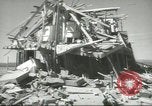
Soldiers assess damage from atomic explosive test shot,"Apple Two," during U.S. Army exercise Desert Rock 6.
Views of various structures and objects after being exposed to atomic explosive test shot "Apple 2" during U.S. Army Exercise Desert Rock VI. A wooden frame house splintered by the blast. A low concrete structure, relatively intact. An overturned Army vehicle. An unsheltered low-wing monoplane, number NG 489851, with skin stripped from its horizontal stabilizer and wing tips. A P-47 aircraft appearing relatively intact. A badly damaged two-wheel trailer. A relatively unscathed auxiliary power unit on a stabilized trailer. Vehicles reduced to rubble. Radar unit and accompanying truck and power unit, seemingly OK, but dish antenna may be damaged. Three soldiers stand around an M2HB heavy machine gun knocked from its stand. A B-29 bomber sits on a ramp with a sign in front of it warning of radiation. A ground crewman sprays the bomber down with a pressure hose to decontaminate it by washing off radioactive particles. A soldier rides a jeep out to check radiation readings on a vehicle that had been exposed. Troops walk back from ground zero and undergo personal cleaning with brooms and checks by geiger counters. A soldier being checked, including his boots. Soldiers sweeping dust from M48 tanks used in the exercise. A soldier being "interviewed" by another, about means of coping with atomic weapons on the battlefield. A formation of soldiers marching, led by one carrying a Corps of Engineers Guidon with the number 14 on it. [Note: According to the U.S. Department of State, Office of the Historian, from February 18 to May 15, 1955, the United States conducted Operation Teapot, a nuclear test series at Yucca Flat and Frenchman Flat on the Nevada Test Site in the continental United States. During the test period 14 nuclear shots and 1 non-nuclear shot were detonated. Several thousand scientific, military (army, air force, navy, marines), and civilian contract personnel participated in the organization, planning, and execution of the test series. Military exercises undertaken during and following the shots took place under the name Desert Rock 6.]
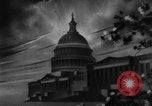
Workers fill out applications for social security accounts under the Social Security Act,1935 in the United States.
Applications for social security accounts under the Social Security Act,1935 in the United States. Display of a calendar. After the enactment of the Social Security Act, 1935 on 24 November, 1936, workers sign applications to apply for Old Age Retirement Benefits for the first time. A United States Post Office building. A man fills out an application for a social security card, at the post office. Five ways to return filled applications include handing them to a shop foreman, secretary of labor union, letter carrier or depositing them directly at a post office or dropping in local mail box. After returning the application the workers receive Social Security Account Numbers from the Social Security Board. They receive monthly income for life when they retire at the age of 65 years.
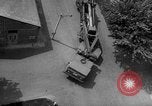
America test fires the M65 atomic cannon in the Nevada Test Site; 1953 East German uprising and Trieste Crisis in Europe
Major events of the year 1953. The first atomic artillery test fired in United States on May 25, 1953. The M65 atomic cannon moving in the Nevada Test Site (specifically Frenchman Flat). A mushroom cloud rises after the M65 Atomic Cannon, sometimes called Atomic Annie, is fired and atomic bomb explodes. The M65 atomic cannon test is done as part of the Upshot–Knothole series of nuclear tests. East German uprising of 1953 (“Volksaufstand vom 17. Juni 1953”). Riots in East Germany against the increase in work quotas and withholding of American food. East German police escort a man away during a riot. People protest in streets as police try to crush the revolt. A stack of StarLac boxes bound for East Germany with sign in front. Sign reads “First Food Relief Shipment to East Germany by M.S.A. United States Lines S.S. American Inventor”. East Germans line up to receive food relief from the United States. An East German woman receives a food aid pack from the United States. The Trieste Crisis of 1953. Sign in front of a house reads “Trsta ne damo”. Officials inspect a car in the United Nations Security Council-controlled Free Territory of Trieste. Students riot in the streets of Trieste over the issue of Adriatic area between Italy and Yugoslavia. (Cold War period.)
CRITICALPAST.COM: About Us | Contact Us | FAQs - How to Order | License Agreement | My Account | My Lightboxes | Shopping Cart | Advanced Search | Featured Collections | Website Terms & Conditions | Privacy Policy ©2026 CriticalPast LLC.
License Agreement |
Terms & Conditions |
Privacy Policy
©2026 CriticalPast LLC.