


 Francais
 Deutsch
 Italiano
Refine Your Search
Nevada United States 1936 stock footage and images
- Showing 13261 to 13266 of 27248 results more
more Hide
Hide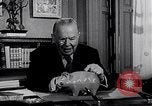
Hollywood actor Charles Coburn urges people to buy U.S. Savings Bonds on behalf of the U.S. Treasury Department
American Film and Theater Actor, Charles Coburn at desk in an office in United States. He puts a coin in a piggy bank and shows a large replica of American Hundred Dollars Bond. He urges people to buy U.S. Savings Bond on behalf of the U.S. Treasury Department.

A family loads a Model-T Ford car in front of a house and drives away
United States. A Ford Model-T pulls up and stops in front of a house. A family come out from house. A man, woman, and two girls in dresses get into the car. Other people standing on the front porch of the house wave goodbye to the leaving family. The car drives away toward they road.
Men and women sailors join and serve in the U.S. Coast Guard, and citations for those who gave up their lives in battle.
'Battle Stations' depicts life as a United States Coast Guard. Medals lie on citations for gallantry in action during the landing on Tulagi Island. Images of U.S. Coast Guard cutters at sea and soldiers in battle as the citations are read out. U.S. CG troops during a parade. Sailors with rifles. They march with the U.S. flag. CG cutters in heavy seas. Sailor watches through binoculars. A sailor at the deck gun, another sends a semaphore signal. The Congressional Medal of Honor lies on a citation for heroism and gallantry in action during the evacuation of a battalion on Guadalcanal. Bodies of U.S. Coast Guard sailors wrapped in U.S. flags. Sailors salute as bodies are loaded. Women take the oath as they join the U.S. Coast Guard as U.S. Coast Guard SPARS (US CG Women's Reserve). Training Station: New SPARS recruits arrive as graduates leave the station. Recruits on bunk beds, during training, getting uniforms, on bicycles, and attending classes. Class of SPARS graduates receiving diplomas. Narration by Ginger Rogers and James Cagney.
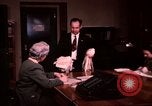
Technicians use various machines to measure properties of knitted fabric.
Domestic science research work by the Bureau of Human Nutrition and Home Economics Service (United States Department of Agriculture). Chief of the Bureau Dr. Hazel K Stiebeling talks about research in the field of textile and clothing. A man brings samples of knitted fabric to women working at a table. A woman lays the samples out. A technician uses a machine to test the fabric for elastic recovery, breaking strength, air permeability, moisture absorption. She tests stretch and comeback by applying tension with weights. A machine used to show how much rubbing a fabric can stand.
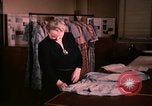
Researchers design functional house dresses and perform experiments for care of clothing.
Domestic arts and sciences and home economics research work by the Bureau of Human Nutrition and Home Economics Service (United States Department of Agriculture). Chief of the Bureau Dr. Hazel K Stiebeling talks about research in the field of textile and clothing. A woman researcher examines a garment on a table. Another researcher uses a machine to measure strength of various button holes. A machine is used to measure stitch strength. Fashion designers and tailors work on functional house dresses and aprons. The clothing specialist works out an idea with muslin on a dress from. She tries out the design on a live model. A designer cuts a pattern and another readies it for a final test. A functional house dress designed by the Bureau. Care of clothing: Testing of various soaps and detergents. A woman reaches for home laundry detergent in a cabinet. Women use a machine designed to soil fabric samples uniformly in order to compare detergents and soaps. Women cut the fabric into strips, light reflection. A researcher prepares the samples for laundry. She puts the samples into the laundrometer.
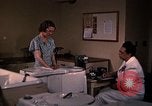
Researchers test household equipment like washing machines, electrical ovens and home freezers.
Research work by the Bureau of Human Nutrition and Home Economics Service (United States Department of Agriculture). Chief of the Bureau Dr. Hazel K Stiebeling talks about domestic science research in the field of household equipment. A researcher put clothes into a washing machine. Another woman takes notes. Fabric sample are uniformly soiled, cut and sown onto muslin. The researcher records temperature while putting the clothes in. A woman checks the amount of dirt removed by measuring the reflected light before and after the laundry. Cooking: A woman researcher develops a standardized cake recipe to test baking performance of an electric oven. She lays the batter in pans into the oven. Judges measure the upper and lower limits of browning compared to a reference cake. Engineering test of home freezers in a laboratory. The researchers load freezer with filled cartons. Some have thermocouples inserted. A researcher checks meters and time clocks for current, energy consumption and freezer motor measurements. Researchers compare the amount of two fuels used to cook a farm family meal. (Some scenes with camera closeups have the look of 1940s and 1950s era "housewife" or homemaker scenes)
CRITICALPAST.COM: About Us | Contact Us | FAQs - How to Order | License Agreement | My Account | My Lightboxes | Shopping Cart | Advanced Search | Featured Collections | Website Terms & Conditions | Privacy Policy ©2026 CriticalPast LLC.
License Agreement |
Terms & Conditions |
Privacy Policy
©2026 CriticalPast LLC.