


 Francais
 Deutsch
 Italiano
Refine Your Search
Nevada United States 1936 stock footage and images
- Showing 13267 to 13272 of 27248 results more
more Hide
Hide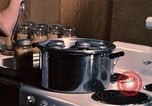
Space requirement tests and approval of housing plans as a part of the housing research.
Research work by the Bureau of Human Nutrition and Home Economics Service (United States Department of Agriculture). Chief of the Bureau Dr. Hazel K Stiebeling talks about housing research. Domestic science tests on space requirements for kitchen work in the experimental housing laboratory. A researcher checks for the amount of space required to do an efficient job of home canning. An architect completes the perspective drawing for a farm house. The Regional Committee selects a group of plans. Architects and draftsmen prepare the working drawings. Architects and housing specialists check the drawings for functionality.

Home Economics and Family Economics functions, research, surveys, and publications; views of late 1940s homemakers
Research work by the Bureau of Human Nutrition and Home Economics Service (United States Department of Agriculture). Chief of the Bureau Dr. Hazel K Stiebeling talks about family economics research. Family Economics staff at work in downtown Washington. A staff member reads letters inquiring about money management techniques from families in the U.S. A staff member shows a homemaker mother how to use a food plan. They work out a weekly market list. A teacher gives a lesson in meal planning and food buying to high school seniors. Policy makers use family economic material on milk consumption during a meeting. A representative of the Bureau on a food survey. She talks to a woman at her doorstep, surveys the food in a kitchen. Information on food composition is recorded and evaluated on a sheet. A family eats a meal planned by the family economists. Dr. Hazel K Stiebeling displays various domestic arts and sciences publication for homemaker, housewife, and teachers that include food and housing research results. Other educational material includes information for the press, radio scripts, charts, film slides, motion pictures, and television programs.

Jill presents 'GI Jive', a jive music section on the 'By Request' program for the American soldiers abroad (WW2)
A female WAAC (Women's Army Auxiliary Corps) presents 'By Request' for the Army Navy Screen Magazine' in the United States during World War II. She reads out a request for music from Ameriacn soldiers in the Pacific Theater. The 'GI Jive' section presented by Jill. She talks to the GIs, plays a jive tune for them and asks them to keep writing in. Pictures, sketches, letters, photographs and other memorabilia sent by GIs from various war fronts. Jive tune plays in the background.

Space research about the ionosphere from the ground by the National Bureau of Standards.
Film entitled 'Scatter Radar', from The National Bureau of Standards, United States Department of Commerce. Depicts space research from the ground. The globe rotating. A satellite antenna moves into position. Radio instruments. Red optical instruments used to study the sun. Clouds in the upper atmosphere. Animation: Ionosphere reflects radio waves to the planet. A smoke of cloud rises during the launching of a rocket. An artists' conception of the Van Allen Radiation Belt above the Earth's ionosphere discovered by Explorer I and Pioneer III. A satellite orbits the globe. Men watch as a rocket is erected and fired. A scientist at the National Bureau of Standards works on a formula. A man at the controls of a scatter radar fro space research. Animation: Ionized and neutral particles as well as free electrons that permit long distance communication. free electrons reflect radio energy. Radio waves penetrate the ionosphere. A scientist at the Ionosonde model C4 to measure electron density variations. Electron density model on the monitor. Two Oxygen atoms. An electron detaches and becomes a free electron. Radio waves pass by, the electron and waves oscillate and scatter energy. Animation: Need to excite electrons sufficiently so that their energy radiated can be detected from the ground. The process requires a powerful transmitter, large antenna, and a sensitive receiver.

Communication waves and the relation between power transmitted and received in Space Communications
United States Air Force training film about Space Communications and the related problems and developments. Animation: Planets, remotely controlled unmanned space research vehicles in space. Space communication links between the vehicles and Earth. Radio waves are reflected, refracted and absorbed. An antenna radiates waves that are dispersed. Communication and light waves on the frequency spectrum. Groundwave and Skywave transmission explained. Skywave transmission reflected back to Earth by the ionized layers in the Earth's upper atmosphere. Bouncing of signal in optimal conditions. Spacewave travels from transmitting to receiving antenna, and travels unaffected through the ionosphere into outer planetary space. Depicts laws that govern Line of Sight transmission: Relation between power transmitted and power received, and ideal and regular conditions. Explains the factors involved in the relation between the power transmitted and received. Comparison of communication and light waves. Inverse Square Law explained. The law applied to Space Communication: Signal generated from point source, energy dispersed in shape of sphere, energy spreads over expanding spherical area. Outlines a practical approach to strengthen received power: Directing the radiating energy, and enlarging area of the receiving antenna.
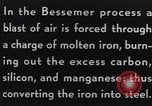
Manufacturing steel using the Bessemer process (WW2)
Manufacture of Steel during World War II in United States. Bessemer converter seen in tilted position being charged with molten iron from a ladle, under control of crane operator. Bessemer converter operator manipulates lever to cause converter to tilt up and air to blast through the molten iron. This burns excess carbon, silicon and manganese and converts the iron into steel. Molten steel is poured into molds. which are removed after steel solidifies. Hot ingots are moved on rail cars to a place, where they attain a uniform temperature and are ready for rolling. Ingots stored in pit.
CRITICALPAST.COM: About Us | Contact Us | FAQs - How to Order | License Agreement | My Account | My Lightboxes | Shopping Cart | Advanced Search | Featured Collections | Website Terms & Conditions | Privacy Policy ©2026 CriticalPast LLC.
License Agreement |
Terms & Conditions |
Privacy Policy
©2026 CriticalPast LLC.