


 Francais
 Deutsch
 Italiano
Refine Your Search
Nevada United States 1936 stock footage and images
- Showing 13327 to 13332 of 27248 results more
more Hide
Hide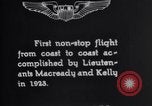
U.S. Army Air Service Lieutenants John A. Macready and Oakley G Kelly fly non-stop, coast-to- coast across the U.S.
U.S. Army Air Service fliers, Lt. John A. Macready and Lt. Oakley G Kelly, are seen boarding their Fokker T-2 and taking off from Roosevelt Field, Hempstead, Long Island, New York. They are embarking on the first non-stop coast-to-coast flight across the United States. Their airplane seen in flight.
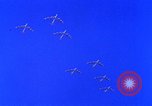
The role of USAF bombers, submarines and Intercontinental Ballistic Missiles in maintaining world peace during Cold War.
The role of USAF bombers, submarines and Intercontinental Ballistic Missiles (ICBM) in maintaining world peace especially in the Mediterranean, Vietnam and Berlin during the Cold War. View of formation of United States Air Force Boeing B-52 Stratofortress bomber aircraft flying overhead in a blue sky. View from low flying aircraft of a U.S. Navy Polaris submarine cruising in ocean waters. A USAF Intercontinental Ballistic Missile being raised slowly upward from a silo into a launch-ready position. View from ground of large number of American paratrooper soldiers dropping from sky and landing on a field, including wide views and close-up views of parachutes and paratroopers landing. A U.S. Army paratrooper organizes his parachute and equipment immediately after landing. Aerial view of U.S. Navy warships cruising in the Mediterranean Sea. View from inside a U.S. Army helicopter in flight in Vietnam. Soldiers observe terrain out open door. Sign "You are leaving the American Sector" seen at Checkpoint Charlie of the Berlin Wall separating West Berlin and East Berlin. American and Soviet soldiers seen on each side of the checkpoint. An American tank parked at the checkpoint. (Vietnam War period).
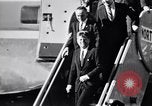
President John F Kennedy steps down from Air Force One plane at an American airport and greets people. Various crowd scenes with the President
United States President John F Kennedy steps down from Air Force One aircraft at airport in Billings, Montana and meets American citizens gathered there. He meets two Native American Indian men in ceremonial dress. He shakes hands with a group of Boy Scouts and with people gathered for his arrival. Scenes show several gatherings of crowds greeting the President, including at a college academic graduation ceremony.
Various gasoline, oil, and fuel saving measures during war time in World War 2.
Public service announcement for patriotic citizens encouraging fuel conservation during World War 2 in the United States. Scenes of a ship burning in sea. A man operates a machine and people see the work going on. Scenes of pipelines. A man comes out of a building and meets a man in dungarees. A big ship comes to a port. Scenes of tanker and oil depots. A man takes fuel pipe to an aircraft. Men working on boilers converting oil heating to coal heating to conserve fuel. Smoke coming out from a chimney. A man adding insulation in a home attic to conserve energy. A needle in a temperature meter indicates hot water temperature and narrator encourages limiting use of hot water. A man inserts nails on a door. A man applying caulk sealant as weather stripping. A man washes his face and shaves over a home sink. An early model automatic clothes washing machine in use. A thermometer on a wall. A man and woman dress and get ready, adding more clothing to stay warm so they do not need to heat too much. Scene of various home radiators and hands near controls of radiators. A man lights fire. A man turns off a knob.
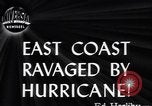
Destruction in coastal northeast USA from the 1944 "Great Atlantic Hurricane" (First example of a named hurricane in the US)
Views of The Great Atlantic Hurricane lashing at northeast United States areas (after having already hit the North Carolina Outer Banks), and views of the aftermath and early cleanup following the storm. Regions shown include Atlantic City, Long Island (where it came ashore as a category 3 hurricane on September 15, 1944), New York City suburbs, and parts of New England. High surf flooding boardwalks and coastal cities. Trees bent over and snapped in high winds. People walking with difficulty in the high winds. Streets of towns submerged in water. Coastal docks destroyed and large boats scattered high onto shore areas. Trees, poles, and wires downed over roads and homes. Entire homes moved off of their foundations and placed down the street. The "Great Atlantic Hurricane" was the first example of a named hurricane by the Miami Hurricane Warning Office, which later became the National Hurricane Center. The name was meant to reflect the hurricane's size and intensity.
Igor Sikorsky speaks about a passenger plane.
A man works on a plane in United States. Igor Sikorsky speaks about a passenger plane. He claims it to be the largest. Pan Am Clipper S-42.
CRITICALPAST.COM: About Us | Contact Us | FAQs - How to Order | License Agreement | My Account | My Lightboxes | Shopping Cart | Advanced Search | Featured Collections | Website Terms & Conditions | Privacy Policy ©2026 CriticalPast LLC.
License Agreement |
Terms & Conditions |
Privacy Policy
©2026 CriticalPast LLC.