


 Francais
 Deutsch
 Italiano
Refine Your Search
Nevada United States 1936 stock footage and images
- Showing 13675 to 13680 of 27248 results more
more Hide
Hide
Aviation history; historic early flight scenes; first hand accounts from persons who knew and worked with the Wright brothers.
Views of traffic on a city street around the turn of the 20th century. A mix of horse and buggies and motorcars and bicycles. People waiting for a trolley car. Reenactment of persons using an early telephone and of early filmmakers at work with camera on motion picture film. The Wright brothers home at 7 Hawthorne Street, West Dayton, Ohio. The Wrights' former housekeeper, Carrie Grumbach, recalls December 17, 1903, a telegram arriving about the Wright brothers successful first powered flight. Glimpse of Wright brothers machine shop. Charlie Taylor, who had worked in their shop, speaks of being pleased at their accomplishment. View of the Wrights flying gliders at Kitty Hawk, North Carolina. Charlie Taylor describing how he machined and built the motor for the Wright brothers airplane. Glimpse of that motor or a facsimile. Men positioning the Wright brothers airplane for launching, and French citizens gathered to watch a demonstration of their airplane in France. French aviation pioneer, Henri Farman with two other men in his Voisin-Farman I airplane. They begin takeoff. Closeup of Brazilian aviation pioneer, Alberto Santos-Dumont. Other early aircraft in flight. A Wright Flyer passing over the Fort Myer drill ground in Virginia. An Army balloon in the background. Retired United States Air Force Brigadier General, Frank P. Lahm, walks across the tarmac on an airport and speaks for interviewer (unseen). He speaks about the difficulty the Wright brothers had in convincing the U.S. Army of the value of their airplane. He tells that in December, 1907, Wilbur Wright was finally granted an interview with the Board of Ordnance and Fortifications, which led to a contract, in 1908, with the Signal Corps. Moving imagesof Orville Wright and assistants bringing a Wright Flyer to Fort Myer, Virginia, to conduct flight trials for the Army. Views of the airplane being flown all around the area, watched by spectators. (This footage is a mix of 1909 footage where the aircraft shows two half-rounds of canvas in the front elevator, and 1908 footage, taking off and flying, where the aircraft has a single half-round of canvas in the front elevator.) After landing on the 9th of September, 1908, then, Lieutenant Lahm, accepts Orville Wright's offer to fly with him. Lahm climbs aboard the airplane, sits next to Orville Wright, and they are seen taking off and flying about for six minutes and forty seconds. (Lahm is the first. military officer to ever fly in an airplane.) The next scene shows the wreck of a Wright Flyer, in which Army Lieutenant Thomas Selfridge was killed and Orville Wright injured, on September 17, 1908.
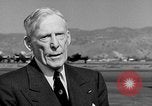
Former U.S. Army Lieutenants Lahm and Foulois recall their flights with Orville Wright in 1909
A film about the history of aviation in the United States. Retired Air Force Brigadier General, Frank Lahm talks about his first flight, as an Army Lieutenant, with Orville Wright on the Wright Flyer airplane, in July, 1909.Then, Retired Major GeneralBenjamin Foulois recalls how, as an Army Lieutenant, he flew the final cross-country and speed test flight from Fort Myer to Alexandria , Virginia, and back, again, with Orville Wright on 30th July, 1909. Film then shows that event, on July 30, 1909. Lt. Benjamin D. Foulois is seen climbing aboard the Wright Flyer airplane to accompany Orville Wright on the final cross-country and speed test required by the U.S. Army before it would purchase any aircraft. View of the Wright Flyer taking off with Wright and Foulois. Spectators watch in the background. View from another perspective of the aircraft taking off from Fort Myer, Virginia. View of the Wright Flyer being moved by several soldiers after landing back on the Fort Myer drill ground. (In his comments about this, Foulois notes that the flight set three world records: flying ten miles cross-country; attaining altitude of 600 feet, and speed of 42.5 miles per hour.)
Highlights in life of Henry Ford from 1863 through circa 1920
A 1950 film depicting highlights in the life of Henry Ford, the founder of the Ford Motor Company, in the United States. The Henry Ford Museum Clock Tower and Greenfield Village. Children enter the museum. Pictures of Henry Ford on a quadricycle. Henry Ford with others working in a workshop. A picture of Henry Ford and Thomas Edison with their spouses. A picture of Henry Ford sitting near a fire place. Sketches depict the Battle of Gettysburg of 1863. A dramatization : Exteriors of the house of William Ford. William Ford runs up a flight of stairs as his wife Mary Litogot Ford gives birth to Henry Ford. Scene shifts to the boy Henry Ford going out of his home to play. Young Henry Ford working with various mechanical gadgets. Henry Ford with William Ford in a horse drawn wagon. Henry Ford runs and climbs on a steam engine. He goes out from the house for work. He works in a jewelry shop. Henry Ford works in the night. A clock on a wall. Henry Ford with his quadricycle. He rides his qudricycle. Farmers work in a field. Workers use various machinery for construction. People assemble parts of Henry Ford quadricycle. Development of faster production methods using specialization. Ford Model T cars on an assembly line.
Men push hand cars into a tunnel and erect concrete blocks in position during a water tunnel construction in the U.S.
Under water tunnel construction. A power plant water tunnel construction for the Ford Motor Company in the United States. Workers talk standing at the entrance of the plant. Cars at the entrance of the plant. Men push loaded and unloaded hand cars into and out of a tunnel. Workers roll concrete blocks on a car into the tunnel. They attach a block to a crane. The crane moves the block into position for an erector to pick it up. The erector picks up the block and swings it into place in the roof of the tunnel.
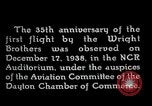
Edward Andrew Deeds, Henry Ford, Orville Wright and Charles F Kettering present at first flight commemoration event
The 35th Anniversary celebration of the first Wright airplane flight in the United States. Seats occupied in a NCR auditorium. U.S. Army Colonel Edward Andrew Deeds, Founder of Ford Motor company Henry Ford, Aviator Orville Wright, and Inventor Charles Franklin Kettering seen sitting on stage. Still photograph of Orville Wright and Wilbur Wright.
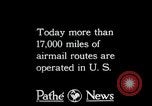
Air mail operations in 1928. Orville Wright helps three small boys launch their balsa wood gliders.
Air Mail Service in the United States. Mail trucks at the center of an airfield. Aircraft, including De Havilland DH-4; Boeing Model 40; Curtiss JN-4 Jenny; Travel Air 5000 ; and Ford Ford 5-AT-B trimotor, parked in a circle around the mail trucks. Mail being transferred from a truck into empty front cockpit of a two-place biplane. The side of a truck reads 'Air Mail Service'. A Travel Air 5000 transport (CAA registry C2614, NAT'S No. 16) on the field. Side of the aircraft reads 'Nat U.S. Mail Express'. The aircraft taxis on the field. The aircraft takes off. Early model air mail aircraft in flight over a large city. Orville Wright seated and wearing a tuxedo. Orville Wright posing indoors, and then standing in front of a residence, with three young boys who hold balsa wood model gliders. The boys launch their wood gliders by means of rubber bands, with some help from Wright.
CRITICALPAST.COM: About Us | Contact Us | FAQs - How to Order | License Agreement | My Account | My Lightboxes | Shopping Cart | Advanced Search | Featured Collections | Website Terms & Conditions | Privacy Policy ©2026 CriticalPast LLC.
License Agreement |
Terms & Conditions |
Privacy Policy
©2026 CriticalPast LLC.