


 Francais
 Deutsch
 Italiano
Refine Your Search
Nevada United States 1936 stock footage and images
- Showing 13681 to 13686 of 27248 results more
more Hide
Hide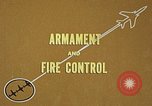
The armament and fire control system of U.S. F-105B Thunderchief fighter bomber being explained.
Different features of the U.S. Air Force F-105B Thunderchief fighter bomber. An animated and actual footage explains the armament and fire control system of the F-105B. A pilot climbs into U.S. Air Force RF-84F Thunderstreak. A rear view of the aircraft as it taxis. Insignia of the United States. Tthe bomb pylon as the bomb is being released. RF-84F in flight as the bomb is dropped. Explosion on the ground. A jet aircraft in flight and vapor trails comes out from the engine. The F-105B in flight and the bomb bay opens. Bomb bay shows special weapon being dropped. The number printed on the side of the weapon is '28-5 and T-5'. A ground tent firing of F-105B armament. The F-105B taxis on a taxi strip. The aircraft climbs rapidly after the take off.

Men are taught different safety measure like how to tie a square knot and a granny knot while working in mines in the U.S.
A documentary titled 'Safety in the Mine' depicts the safety measures to be taken by the workers in mines in the United States. Men practice artificial respiration on pretend "victims" to resuscitate them after suffocation in a mine. A man opens and displays first aid packages. A man demonstrates how to tie a square knot and a granny knot.

The funeral and interment of President Franklin D. Roosevelt.
President Franklin D. Roosevelt, looking frail, after his election to a 4th term, late in 1944. Newspapers announce his death, on April 12, 1945. View from high above, of funeral procession for Franklin D. Roosevelt. Crowds of mourners line sidewalks in Washington, DC, along the funeral route. Members of the military, in the crowd, salute as the flag-covered coffin of the President passes. Military pallbearers carry the coffin into the White House for a funeral service in the East Room. On April 15, 1945, Pallbearers carry Roosevelt’s coffin to a gravesite at the Roosevelt family home, Springwood, in Hyde Park, New York. Eleanor Roosevelt at President Roosevelt’s gravesite (4097 Albany Post Rd, Hyde Park, NY 12538, United States) with her children, including sons, James and Elliott, both in military uniforms.

Animation shows the function of upper and lower link attached on a cable as enemy airplane hits the cable (WW2)
A World War II training film depicts the use of barrage balloon to damage enemy airplanes flying at low altitude during a war in the United States. Animation shows the function of upper link attached in the wire cable as an enemy airplane hits the cable. Animation shows the function of the lower link as the airplane hits the cable. The flying cable is cut. The parachute opens. The balloons attached with wire cables in sky. The results of the cable armament operation. An enemy airplane burns. Soldiers look at the airplane as it burns. The soldiers retrieve the balloon. A soldier folds the links of cable. Another soldier holds a link in his hand.
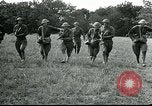
Army soldiers in training at a base in the U.S. during World War I
U.S. soldiers training in the United States during World War 1. Several soldiers run across a field, towards the camera. Two of them carry light machine guns. A bugler leads a group of soldiers towards a mess tent where they are served food,into their mess kits. They eat standing, at long tables. Army Post Brass band marches and plays. Horses and mules in a corral at Army post.

1917 Enfield Rifles in final stages of production during WW I.
1917 Enfield Rifles (U. S. Rifle, Model of 1917) being manufactured in the United States at one of 3 arms plants (Winchester, Remington, or Eddystone) during World War 1 (between the Spring of 1917 and the Spring of 1919). Film shows assemblers hand fitting parts, a worker adjusting the front sight for proper "zero" in a machine vise, and "Proof" firing before final inspection and acceptance. (Note: At the peak of production, the 3 arms plants were turning out 10,000 rifles per day.)
CRITICALPAST.COM: About Us | Contact Us | FAQs - How to Order | License Agreement | My Account | My Lightboxes | Shopping Cart | Advanced Search | Featured Collections | Website Terms & Conditions | Privacy Policy ©2026 CriticalPast LLC.
License Agreement |
Terms & Conditions |
Privacy Policy
©2026 CriticalPast LLC.