


 Francais
 Deutsch
 Italiano
Refine Your Search
Nevada United States 1936 stock footage and images
- Showing 14839 to 14844 of 27248 results more
more Hide
Hide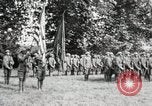
The soldiers of U.S. 5th and 6th Marine Regiment are decorated by General Pershing in France.
U.S. 5th and 6th Marine Regiment in Chateau-Thierry,France during World War I. U.S. troops stand at attention. Flags of United States and France. The troops stand in a squad. U.S. General John Joseph Pershing decorates the soldiers. General Pershing is escorted by U.S. officers. The General shakes hands with the soldiers. The troops march with guns on their shoulders. They are reviewed by General James Harbord, McAndrew and Bundy at Chateau-le-trousse.
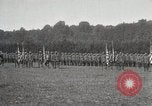
U.S. General Hunter Liggett reviews the U.S. 2nd Division and U.S. General Ely and General Hunter decorate troops in France.
U.S. General Hunter Liggett reviews the U.S. 2nd Division forces in Dolcourt, France during World War I. U.S. Second Division troops stand in a squad. The troops hold a United States flag and a U.S. Marines flag. The soldiers stand at attention. A military band plays different instruments. General Liggett reviews the division. The General and a U.S. officer salute. The military band in the background. The troops march with guns on their shoulders. A U.S. officer stands and looks. General Hunter, U.S. Gen. Hanson Edward Ely and a French officer decorate Second Division troops in Chateau-Thierry. A medal is pinned up on the uniform of a U.S. soldier. Horse carts behind the troops.
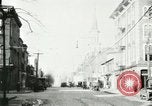
National Theatre, Statue of Lincoln, various equestrian statues and street car traffic on streets in Washington DC.
A business street in Washington DC shows automobile, pedestrian and street car traffic. A man walks along a dirt road, houses and a civil war cannon. Exterior view of the National Theatre building. A street car or trolley passes between the camera position and the National Theater. A mansion and the Department of Agriculture building. The Emancipation Memorial statue of Lincoln with a kneeling slave, in Lincoln Park. View down Pennsylvania Avenue with various buildings visible including the Washington Star (newspaper) Building, old post office and the United States Capitol. The William Tecumseh Sherman equestrian monument in Sherman Square. The General Philip Sheridan equestrian statue on Sheridan Circle in Washington DC. The house of Stephen Decatur which was built in 1814. Cars move on a road. The Brevet Lt. General Winfield Scott equestrian statue at Scott Circle.
President Warren G. Harding enters a car in Washington DC.
United States President Warren G. Harding in Washington DC. A building, a car on a road and a park. A crowd gathered on the street to greet the President. President Harding with others enter a car. Cars move on a road in front of a building. The British Embassy (1300 Connecticut Ave NW Washington, DC 20036, USA). Buildings, statues, and historic houses in Washington DC. Men walk on a street and enter a house.
Children are taught traffic rules by policemen at the Police Department in County of Nassau, New York.
A flag of United States waves on a flag pole in front of the Police Department County of Nassau County in New York. A woman police officer hands out diploma certificates in driving to a line of 8 year old boys and girls. The children are taught driving at the age of eight. Children get onto bicycles and small electric cars in the "Safety Village" established by the police force to teach children about driving. A young boy in an electric car buckles his seat belt. The children are seated in electric cars and are given instructions by the policeman to drive down the road of the village and make a right turn. Traffic signals in the background. The children drive the electric cars and follow the signals. They are taught to make the right moves at the right time. A signal reads 'Walk'. A woman police officer keeps instructing them. Children ride bicycles. All of the children are taught to use hand signals to signal their turns. Other children play the role of pedestrians in the Safety Village. A boy gives signal of right turn before the turn comes so that he can control the bicycle. A sign reads 'Stop'. The children stand in a line. The police officer gives instructions. Children ride bicycles and drive electric cars. A traffic signal.

Newspaper printing process in the early 1970s for The Detroit News. Shows early use of computers in newspaper production.
Overview of steps in the writing, production, packaging, and delivery of the daily Detroit News newspaper, in Detroit, Michigan, United States. Reporters and writers in a newspaper press room work on early Cathode Ray Terminals or CRT computers. A reporter writes and edits a story on a cathode ray terminal computer. The completed copy is sent at the speed of light through a computer to an automated composing room. The electronic signals are being converted into coded tapes. The hole punched tapes are seen being printed by machines and then the tapes are fed into an automated type setting machine. A man at the newspaper printing press lifts prepared typeset from a tray. A stereotype man makes a final cardboard mat of each completed page proof, which is seen being pressed through a large roller and then fed into a press plate machine for final casting. 60 tons of lead is used to stamp out the cylindrical press plates. Close up view of the cylindrical press plates being fed through machines. Men in the press room collect the final plates that are transported to them on a moving conveyor belt system. A man oils and inks the plates and loads them into a machine where they are ready to roll. View of the newspaper printing underway. Close up view of newspaper printing press operating at high speed with newspapers rolling. View of giant paper rolls being moved into position on a conveyor system providing raw paper for the newspaper, used at a rate of 500 tons per day. The press men read the news and relax, as the paper continues to roll through the presses on a non stop computerized control track. Final stacking of newspapers is performed by machines, making them ready for delivery. The newspaper is ready and is on the way to be delivered to the citizens. The news papers are loaded into a shipment van bearing a sign that reads "The Detroit News."
CRITICALPAST.COM: About Us | Contact Us | FAQs - How to Order | License Agreement | My Account | My Lightboxes | Shopping Cart | Advanced Search | Featured Collections | Website Terms & Conditions | Privacy Policy ©2026 CriticalPast LLC.
License Agreement |
Terms & Conditions |
Privacy Policy
©2026 CriticalPast LLC.