


 Francais
 Deutsch
 Italiano

Refine Your Search
Nevada United States 1936 stock footage and images
- Showing 151 to 156 of 35683 results more
 Hide
Color Sound
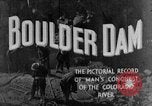
Initial processes in the construction of Boulder Dam in the Black Canyon of the Colorado River in the United States.
The beginning of the construction of Boulder Dam (later the Hoover Dam) on the Colorado River in the United States. Rocks on the side of the river. A boat in the river. A map shows the course of the Colorado River through different states of the country. The river causes floods in towns and farming districts of California. The dam site in the Black Canyon, where the river forms a boundary between Nevada and Arizona. A map shows the dam site. Materials at the dam site. Trains bring supplies. Power lines to the dam site. Men assemble materials for construction work. Men at a survey. Workmen come to the dam site in trucks from other states.
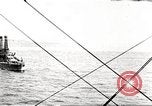
Battleships and numerous other fleet vessels are seen in aerial views off the U.S. coast
Aerial views taken from a biplane at several altitudes over American battleships and other U.S. Navy ships off the west coast of the United States. Guy wires of aircraft wings clearly visible. Low altitude flyby (in order) of the Battleships USS Nevada (BB-36), USS Arizona (BB-39) and USS Idaho (BB-42), then the USS California (BB-44) and USS Pennsylvania (BB-38).
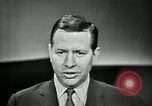
Major events of the 1930s include Wall Street crash, kidnapping of Lindbergh child, Hindenburg disaster, Spanish Civil War, etc.
'Retrospect' about the events that led to the present pattern of life in the United States. Host Douglas Edwards, an American television anchor speaks about the past events in America. Crowd of unemployed men gathering in bread lines after the 1929 crash and subsequent Great Depression. A man near a box of apples. The U.S. President Franklin Delano Roosevelt addresses a gathering. The kidnapping of Charles Augustus Lindbergh, Jr., the son of the aviator Charles Lindbergh in 1932. Bruno Richard Hauptmann, a German carpenter who abducted the child during the trial. The congressmen at the formation of the Lindbergh Law. Newspapers describe the apprehension or death of notorious mafia gangster criminals, such as Dutch Schultz and Baby Face Nelson. Huey Pierce Long, Jr. a American politician addresses people. Emperor Haile Selassie of Ethiopia appeals to the League of Nations, after his country is attacked by Italy under Mussolini. Adolf Hitler stands. Troops of the German army parade. Scenes from the Spanish Civil War in 1936-1937 as Spanish national forces battle against fascist rebel forces. Spanish Troops fire 75mm field artillery pieces. Bombs being dropped on the buildings. Spanish soldiers marching during the civil war. The Hindenburg disaster takes place on May 6th 1937: The German airship LZ 129 Hindenburg catches fire over the Lakehurst Naval Air Station in Manchester, New Jersey. Amelia Earhart the first woman aviator to fly solo holds flowers and is surrounded by people. She went missing in 1937. Cowboy philosopher Will Rogers, alone and with U.S. Vice President John Nance Garner and with aviator Wiley Post (who had patch over one eye). King Edward VIII of Great Britain, abdicating the throne for "the woman I love." People at the German-American Bund Nazi sympathizing gathering including the subduing of objectors on stage, in Madison Square Garden, New York. British Prime Minister Neville Chamberlain, returning from meeting with Adolf Hitler in Munich in 1938. View of Adolf Hitler. German tanks on parade in World War II. an array of artillery guns on display. Railway guns being fired in WW2.
Captain of U.S.Battleship reads orders. USS Arkansas steams under Brooklyn Bridge in NY
Crew is assembled in formation on deck of a U.S. Nevada Class battleship as the Captain reads his orders. Triple guns in turret are visible in foreground. In unrelated scene, likely viewed from the Brooklyn Bridge, in New York City, the USS Arkansas (BB-33) is being assisted by numerous tug boats as it makes its way out to sea. Final scene shows sailors feeding their pet goat (mascot) aboard a U.S. Naval vessel. (Ford Motor Company, 1923)
A map locates the flood affected areas in Ohio and the high and low pressure areas in the Ohio river during floods of 1937.
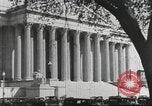
View of the United States National Archives Building (700 Pennsylvania Avenue, NW Washington, DC 20408-0001) in March 1936. in Washington, DC. Washington DC escapes damage from the great Potomac River flood. Next scenes cover damage caused due to a flood in Ohio, United States in January 1937. View of a weathervane in stiff winds. The level of the Ohio river rises. The flooded tributaries of the river. A map locates the flood affected areas. It depicts the high and low pressure areas. Map depicts heavy rains continuing for 20 days from January 6 to January 26, totaling 16 to 20 inches in the affected area.
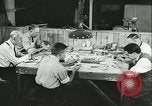
WPA workers build a massive scale model of New York City; also WPA art, library, and theater programs
Works Progress Administration (WPA) projects in New York City during the Great Depression. Skilled architects, draftsmen, and artists work for the WPA on a massive scale model of New York City, built in cooperation with New York University (this model predates the famous Panorama of New York City model built for the 1964 World's Fair). An artist is seen leaning over part of the model painting one of its features, which include detailed roads, bridges, buildings, and waterways. A hand lifts a building and measures its base with a ruler. Cartographic Survey WPA workers are seen creating a relief map of Staten Island for educational use. Men and women artists, including sculptors, are seen creating new sculptures funded by WPA. A man carves a bust in an art studio or class. Another man carves a relief stone commemorating Dewitt Clinton. A man stands in a Free Library and looks at books. Two women on a park bench look at books from the WPA Free Library holdings. A skilled artist is seen laying out and buildings stained glass windows for the United States Military Academy at Westpoint in New York. Stained glass panels depicting George Washington and soldiers are seen. A series of the George Washington stained glass windows is seen in place, with the artist applying final touches. Men work on the Federal Theater Project. Billboard signs advertising various WPA funded theatre productions in 1936 are shown, including Jefferson Davis, The World's Greatest Circus, Taking the Air, The Mikado, Macbeth, All American Minstrels, Battle Hymn, and Horse Eats Hat.
CRITICALPAST.COM: About Us | Contact Us | FAQs - How to Order | License Agreement | My Account | My Lightboxes | Shopping Cart | Advanced Search | Featured Collections | Website Terms & Conditions | Privacy Policy ©2026 CriticalPast LLC.
License Agreement |
Terms & Conditions |
Privacy Policy
©2026 CriticalPast LLC.