


 Francais
 Deutsch
 Italiano

Refine Your Search
Nevada United States 1936 stock footage and images
- Showing 20431 to 20436 of 35683 results more
 Hide
Color Sound
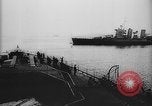
Franklin Delano Roosevelt retrospective - FDR with Winston Churchill, Chiang Kai-shek and Joseph Stalin at different events in different continents.
Life of the President of the United States Franklin Delano Roosevelt in the United States. U.S. President Franklin D Roosevelt is greeted by British Prime Minister Winston Churchill aboard HMS Prince of Wales during the Atlantic Conference for signing of the Atlantic Charter off Newfoundland in 1941. The ship approaches the harbor. Soldiers present arms aboard a ship. Prime Minister Churchill and President Franklin D Roosevelt talk. President Franklin Roosevelt addresses U.S. Congress with declaration of war after the Pearl Harbor attack by Japan in World War 2. The President signs a document. President Roosevelt reviews troops in Casablanca. The troops march. Franklin Roosevelt salutes troops. Vehicles driven in the foreground. Cairo: Franklin D Roosevelt and Winston Churchill with the Chairman of the Nationalist Government of China Chiang Kai-shek. Tehran : Franklin D Roosevelt, Winston Churchill and General Secretary of the Communist Party of the Soviet Union Joseph Stalin pose. United States: The exteriors of the White House. People enter White House. President Franklin Roosevelt with Vice President Harry S. Truman at the 1945 inaugural ceremony. Yalta : President Franklin D Roosevelt, Winston Churchill and Joseph Stalin pose. Franklin D Roosevelt addresses a conference. (World War II period).
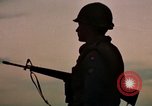
Visual saga of the American Soldier from 1945 to 1970: WWII; Korea; Berlin Crisis;Cuban Missile Crisis; Red China
Review of conflicts involving U.S. from World War 2 to 1970. A U.S. soldier with rifle and binoculars, on guard. German Chancellor Adolf Hitler speaks in Germany to mass audience. German mobilization and blitzkrieg. U.S. troops firing small arms on island in Pacific, battling Japanese. U.S. soldiers on half-track firing artillery. Explosive destruction of Nazi swastika and Eagle symbol on top of building in Zeppelin Field, Nuremberg, Germany. General Douglas MacArthur stands as Japanese General signs surrender documents aboard USS Missouri, ending World War II. Times Square in New York City on Victory over Japan Day (VJ Day) marking end of World War 2. American troops firing artillery and small arms in Korean War. Soviet leader Nikita Khrushchev speaking at the United Nations. Newspaper headlines about postwar Berlin Crisis. Soviet missiles on display in military parade in Red Square in Moscow, Russia, Soviet Union. Soviet General Georgy Zhukov and Nikita Khrushchev, at Kremlin, reviewing the parade. Cuban President Fidel Castro giving a speech. A newspaper headline reading: "Khrushchev orders removal of missiles" ending the Cuban Missile Crisis. Soviet cargo ship with covered missiles on its deck. Red flag with image of Lenin and message: 'Partido Communista Dominicano' and a crowd chanting support for the Communist party in the Dominican Republic. Communist Chinese people marching with massed flags in the People’s Republic of China. Chairman Mao Zedong waving to a crowd of young supporters and Red Guards in China as they chant. A United States soldier in South Vietnam during Vietnam War looks through binoculars and then walks carrying his M-16 rifle. A map of Vietnam.

Military purposes for which biological warfare can be used to reduce a nation's capacity for making war.
A training film on medical defense against biological warfare in the United States. Aircraft in flight leave vapor trails. Military purposes for using biological warfare shows U.S. Navy ships in a harbor in the United States. A U.S. military training center. An isolated airfield with aircraft on a flight line. U.S. soldiers rush into a pillbox. Affected soldiers enter a hospital. The soldiers at the banks of a lake. Biological warfare agents can be selected from the group of organisms like bacteria, viruses and fungi.
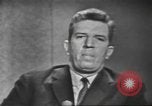
Kennedy and Nixon comment on the Indochina War, Quemoy and Matsu islands, and U-2 flights during their third debate.
Nixon and Kennedy debate questions regarding relations with Communists during the third Kennedy-Nixon Presidential Debate in the United States. Douglass Cater of Reporter magazine asks Republican candidate U.S. Vice President Richard M Nixon to comment whether there was a valid criticism of his statement of foreign policy. Nixon answers and states that the criticism is not valid. Regarding Indochina, he says that the U.S. would not have tolerated Indochina falling under Communist domination. And as a result of that the civil war there ended. He states that he supports the President's position and thinks that the President was correct in ordering the U-2 flights. Referring to Quemoy and Matsu he states that he objects to the constant reference to surrendering these islands. Democratic candidate Senator John F Kennedy disagrees with Nixon's statement on Indochina and states that reason Indochina was preserved was the Geneva Conference. On the question of the U-2 reconnaissance aircraft flights he states that he has never criticized them and never suggested stopping of espionage. On the question of keeping the Communists in doubt about the U.S. defending Quemoy and Matsu he states that the U.S. should meet its commitments to Formosa (Taiwan) and the Pescadores. He concludes by saying that he disagrees with Nixon as Nixon is extending the administration's commitment.
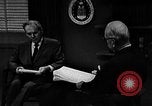
During an interview in the US, Lt. Gen. Ira Eaker talks about the urgency and the efforts of European air forces to win.
An interview of United States Air Force Lieutenant General Ira Eaker conducted by Dr. Maurer in the United States. General Eaker talks about why had he said that the United States Army Air Force was inferior to certain European air forces in the beginning of World War II. He said that European air forces were in operation during the war. He says that very few people in the U.S. had visualized that the country would get involved in the war. European Air Forces were in urgent need of advanced air forces and further efforts to win against the enemy. U.S. was not in the same position. Their aircraft production was also limited.
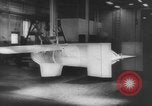
Flying bombs rocket launching with radar system (WW2)
A GB-4 glide bomb in a hanger, suspended from the ceiling. A robot bomb, possibly V-1, launching from a catapult ramp. A United States Air Force bomber drops GB-4 glide bomb during World War II. United States army air men use a television screen with radar system to direct the GB-4 glide bomb to its target. POV view target via GB-4 glide bomb camera. GB-4 glide bomb seen at ground level gliding to target and exploding. United States soldiers preparing a V-2 rocket for launch in the desert in the United States. Men working on radar system. V-2 firing room engineer gives the "go" signal for launch. V-2 rocket lift off in the desert. Scientists in radar control room at Fort Evans. Soldiers at controls of early field radar control system. Large radar console with circular CRT display. A United States soldier repairs radar console. Various types of radar antennas and dishes moving while in operation.
CRITICALPAST.COM: About Us | Contact Us | FAQs - How to Order | License Agreement | My Account | My Lightboxes | Shopping Cart | Advanced Search | Featured Collections | Website Terms & Conditions | Privacy Policy ©2026 CriticalPast LLC.
License Agreement |
Terms & Conditions |
Privacy Policy
©2026 CriticalPast LLC.