


 Francais
 Deutsch
 Italiano

Refine Your Search
Nevada United States 1936 stock footage and images
- Showing 20443 to 20448 of 35683 results more
 Hide
Color Sound
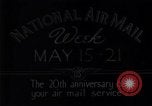
Men load mail bags on a plane.
Opening slate advertises "National Air Mail Week. May 15-21. The 20th Anniversary of your air mail service!" Men load a DC-3 airplane with mail bags at an airport in the United States. Transport truck brings more mail and men load the bags. 1918 Map of United States showing Air Mail connection between New York and Washington. 1923, 1928, 1933 and 1938 maps show further connections to cities such as Chicago, Salt Lake, San Francisco and other destinations. Brief view of International routes between Asia and the United States, and from the United States to South America. Men load mail bags on a plane. The DC-3 plane takes off. Dirigible in background. Closing slate, "Don't Forget. National Air Mail Week."
Dramatization depicts production, black marketing of gas coupons and citizens' responsibilities in supporting World War 2 gas rationing.
'No Alternative' dramatizes citizens' responsibilities in supporting gas rationing in the United States. Dramatization: Group of men seated playing card game. Tom interrupts a poker game to lecture on rationing, after Bob offers an illegal gas coupon to Frank. He talks about the production of automotive gasoline, increasing price and limited production of crude oil. Uses of crude oil: U.S. airmen and soldiers use crude oil to fuel aircraft and tanks. A U.S. aircraft drops bombs made with the use of crude oil. Workers produce synthetic rubber from crude oil at a plant. U.S. Navy ships, merchant fleets, railroads and war industries use crude oil. Tom explains how "black market" coupons cause shortages that affect war industries and military activities. Dramatization depicts safe breakers breaking into a ration board and stealing gas coupons worth 11 million gallons. Gasoline used by farmers in tractors, to take produce to the markets, finished ammunition, guns and tanks to the railroad stations so that they can be sent to the front. Tom points out ways to make rationing work and save gasoline including: formation of car pools, scorning illegal coupons, identifying coupons with the user's license number.
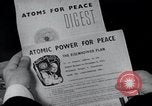
Voice of America broadcasts President's speech and USIS "Atoms for Peace" exhibits are presented worldwide
President Eisenhower of the United States addresses United Nations on December 8, 1953 about atomic bomb and atomic weapon dilemma in the nuclear age (part of Atoms for Peace initiative). Operators in radio transmission control rooms note down readings. View of time clocks of various places in the world including Honolulu, New York, London, Moscow, Calcutta, Bangkok and Tokyo displayed. The Voice of America broadcasts program in different languages by announcers. Scene of a family sitting in a living room as they listen to the president's speech on a console radio. People work at typing, printing, and translating the speech. USIA motion pictures service prepare newsreel of president's speech. A man views air mail of USIA films. Exterior views of several different United States embassy buildings worldwide. A guard standing outside the building. A Public Affairs Officer at the U.S. embassy in Japan, in Tokyo, meets with U.S. Ambassador to Japan Robert Murphy. USIA members seated around table for meeting, and, in Washington DC, creating publications about the Atoms for Peace program. People seated in a USIA library in Brazil read books and various USIA materials. Architects design 30 foot high Atoms for Peace exhibits. An exhibit being setup in a foreign country (possibly in North Africa). Exterior and interior views of the West Berlin, Germany Atoms for Peace exhibit. Prime Minister Jawahar Lal Nehru in India is seen arriving in a jeep to view the Atoms for Peace exhibit in India. Prime Minister Nehru inside the exhibit hall watching a presentation. In Japan, a woman operates remote-controlled robotic hands to hold radioactive materials, at a demonstration for Japanese citizens. In a city in Italy, a view of a mobile van unit carrying an Atoms for Peace exhibit. Scenes from a film "A is for Atom" that was translated into 30 languages and shown all over the world. Wide view of the Kremlin in Moscow, Russia, Soviet Union. A Russian radio commentator speaking at a microphone. Propaganda dramatization showing the Russian announcer attacking American plans for Atoms for Peace.
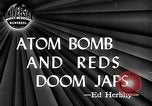
Allies demand the unconditional surrender of Japan in World War II. Entry of Soviets and use of atomic bomb ends the war.
Representatives of three nations, seated around table at Potsdam Conference held at Cecilienhof in Potsdam, Germany. British prime minister, Clement Attlee; President of United States, Harry Truman; and representative of Soviet Union, Joseph Stalin at the Potsdam Conference, July 1945. They deliver an ultimatum of unconditional surrender to Japan. Swarms of B-29 bombers and Aircraft Carrier Task Forces destroy Japanese homeland. Planes on carrier decks.Navy Grumman carrier-based TBF aircraft dropping bombs.. Destruction of ships at sea. Mushroom cloud due to atomic bombing. Chart depicts the power of one atomic bomb. Britain's 'grand slam' bomb, most destructive conventional bomb ever produced. Doctor Ernest Orlando Lawrence, inventor of the cyclotron (atom smashing machine). A man works at the Cyclotron at the University of California, Berkeley. General Leslie Groves, head of the project speaks. He is seated with Dr Vannevar Bush, government director of science and research, and Dr Richard Tolman, technical expert. Quantities of uranium shipped from Alberta, Canada are used in bombs. The atomic bomb process (Manhattan Project) is developed in widely separated areas; scenes from Hanford Project plant in Richmond, Washington. Project personnel exit cars and enter into the search area before starting their work day. Lieutenant colonel Franklin T Matthias with the army corps of engineers, appointed to the Hanford Project. Sign of 'Oak Ridge' in Tennessee. Largest of the three atomic bomb plants located near the Tennessee Valley Authority (TVA) dam. Employed personnel in atomic bomb plants are seen going to work. Man and woman employees at the plan read and smile at a Knoxville Journal newspaper in August 1945 with news headline "Power of Oak Ridge Atomic Bomb hits Japs" after the atomic bomb was dropped in Hiroshima. View of dense prefabricated home communities to house large number of Oak Ridge plant workers. View of families setting up their houses in trailer towns after the prefabricated homes were full. People come out from the Henebry's Jewelers and supermarket, among stores setup to meet the needs of the quickly built city. Scenes changes to show view of Soviet leader Joseph Stalin at conference. Russian artillery and troops in a parade at Red Square in Moscow, Russia (these parade scenes are from the May 1, 1945 May Day parade, just days before Germany's surrender). President Harry Truman reports on the latest developments regarding the war with Japan. He states that the United States is prepared to destroy every productive enterprise in Japan and the U.S. shall completely destroy its power to make war. He warns of an attack by the U.S. due to the rejection of the July 26th ultimatum at Potsdam. He warns that Japan "should expect a rain of ruin from the air; the like of which has never been seen on this earth." Truman notes that it will be followed by an unprecedented sea and land invasion of Japan.
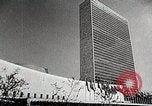
Celebration of the Liberation of Paris, and Americans returning to college, farms, and work after World War 2
Exterior views of United Nations headquarters building in New York City. World map showing NATO member countries shaded dark. Series of shots of American voting in elections, with views of American citizens entering voting booths and placing ballots in voting boxes. Distant view of U.S. Capitol building in Washington DC with an American flag flying in the foreground. Following Presidential election of 1952, Dwight D Eisenhower takes oath of office as President in January 1953, surrounded by other dignitaries at Eisenhower's inauguration. Scenes from end of World War 2 with U.S. Army forces in Paris and happy celebrating French people welcoming the U.S. military and other Allied forces. Close up view of faces of U.S. Army troops marching beside Arc de Triomphe in Paris. Parisians cheer and smile. A French woman kisses an American soldier. Aerial view of Statue of Liberty in New York as a troop ship is arriving in New York Harbor with soldiers returning from World War 2. Soldiers disembark the troop carrier ship. Cunard sign on gang plank. Young American men enrolled in American colleges. A college square area. Inside, a professor instructs college students in class. American students work in a University science laboratory with beakers, vials, burners, and microscope. Young veterans of the war who have returned to be farmers are seen on their farms working. American farmer works in field with a tractor. Views of various church buildings and church spires in American towns and cities. American men,women and children in church and clergy at altar circa 1950.
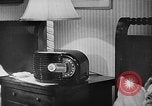
America's actions as World War II breaks out in Europe and Japan attacks China in Asia
Americans in bed listen to radio announcing beginning of World War 2 in Europe. French troops deploying to Maginot Line fortresses and firing their heavy guns. German heavy artillery firing. A rail gun firing. Pollsters gather American opinions about the war.Congress convenes in Special session. President Roosevelt requests changes in Neutrality Act. Senator Gerald P. Nye of North Dakota argues against and Senator Elbert D. Thomas (Utah) argues for changes in neutrality. Pollsters seek American's opinions. U.S. Congress ends arms embargo. The ship SS American Farmer (United States Lines) underway in the ocean. Animated map of Asia and views of Japanese forces bombarding China. Chinese civilians fleeing bombardment. Japanese soldiers executing two Chinese men. Dead Chinese civilians. American housewife being asked opinion about Chinese-Japanese conflict. Japanese ships load U.S. scrap iron, as some Americans protest. Dean Acheson, Assistant Secretary of State explaining U.S. law and decision to stop all exports to Japan in Summer 1941.
CRITICALPAST.COM: About Us | Contact Us | FAQs - How to Order | License Agreement | My Account | My Lightboxes | Shopping Cart | Advanced Search | Featured Collections | Website Terms & Conditions | Privacy Policy ©2026 CriticalPast LLC.
License Agreement |
Terms & Conditions |
Privacy Policy
©2026 CriticalPast LLC.