


 Francais
 Deutsch
 Italiano

Refine Your Search
Nevada United States 1936 stock footage and images
- Showing 20455 to 20460 of 35683 results more
 Hide
Color Sound
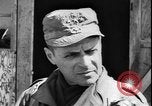
General Ridgway takes over as the Supreme Commander of the UN forces in Korea amidst a mixed opinion back home.
United States President Harry S. Truman dismisses General Douglas MacArthur during the Korean War. General Matthew B. Ridgway takes over as the Supreme Commander of the U.S. and UN forces in Korea after General MacArthur's dismissal. United States Capitol in Washington D.C., United States. Various Congressmen express their opinion over the issue of the dismissal of General MacArthur. Representative Morgan supports President's decision to dismiss General MacArthur. Senator Ferguson from Michigan speaks against the decision to dismiss him. Whereas Senator Hill believes that the matter must be judged on its merit rather than on politics.
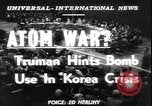
Truman hints potential of atomic bomb use in Korea; At UN, Korea questions Chinese delegates about Chinese aggression in Korea
Korean War and the World politics of the times. United States President Harry S. Truman during an address in Washington D.C. states that United States believes in a peaceful world order. He also hints of nuclear weapons use in Korea if peace is threatened. United States forces in Korea face the Red Chinese armies. Artillery being fired and explosions occur at the front. At the United Nations Security Council meeting in New York representative of Republic of Korea questions the Chinese delegates regarding the Chinese aggression on Korea. United States delegate Warren Austin also expresses worry over the fate of world peace in the light of Korean War.
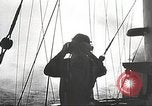
An inattentive sailor results in a ship being struck by a Japanese submarine torpedo (WW2)
A training film about the importance of standing watch duty for U.S. Navy sailors aboard a ship during World War II. Mix of dramatized and period footage. Enactment shows a lookout standing watch aboard a ship as he sights the periscope of an enemy submarine underway at sea. The lookout reports about the submarine to an officer. The officer looks through binoculars and gives out orders. U.S. Navy sailors called to battle stations are seen running under decks to assume positions. Torpedo from submarine detected coming toward ship. Captain gives evasive maneuver order. The Captain looks over the bridge of the ship as the torpedo misses ship. Depth charges being fired from the deck of the ship, and also rolled off the deck into the ocean, directed at the submarine. Explosions occur at sea from the depth charges. The submarine is destroyed. A sailor shows a Japanese and a Nazi German flag painted aboard the ship recording enemy vessels sunk. Next scene is a dramatized scene inside a Japanese submarine showing what would have happened if the crew member on watch was day dreaming and not paying attention. A member of the Japanese submarine crew looks at a ship through the periscope. Point of view shot through Japanese periscope of U.S. Navy ship coming into torpedo firing range. Submarine captain orders torpedoes fired. View of torpedo running in water toward U.S. Navy ship. American sailor aboard the ship executes an order a bit late and the ship gets struck by the Japanese torpedo. Dramatized scenes of Navy crew members abandoning ship and struggling in ocean waters. The sailors in water cry out for help. Dramatization of a dead sailor rising from the sea and speaking about the need to be alert while on standing watch. An inattentive and lazy sailor standing watch in contrast to an alert sailor. A ship underway at sea and sailors sleep in their bunk beds. Dead sailor calls standing watch a sacred duty.
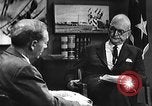
During an interview in the US, Lt. Gen. Ira Eaker talks about daylight precision bombing and B-17 Flying Fortress aircraft.
An interview of United States Air Force Lieutenant General Ira Eaker conducted by Dr. Maurer in the United States. General Eaker talks about daylight precision bombing, British and U.S. night and daylight bombing. He says that a few United States Army Air Force B-17 Flying Fortresses Could survive against several German aircraft. He further states that if they reduced the number of these aircraft by razing factories, then they didn't have to worry about German bombers.

Americans voting and electioneering in national election on November 7, 1944, during World War II.
On November 7, 1944, during World War 2, citizens of Marblehead, Massachusetts, United States, are seen entering the Old Town House (built in 1727) to cast ballots in 40th quadrennial presidential election (in which incumbent President Franklin D. Roosevelt is running for an unprecedented 3th term). Scene shifts to inside a polling place, where voters stand in booths to privately mark their ballots. Others are seen depositing their marked, folded paper ballots in a collection box, as they finish voting. Closeups of several aged voters. One, an African American man, the narrator says is old enough that he was sold as a slave early in his life. Scene shifts to a full-blooded Native American Indian voter in Maryland, entering his polling place to cast a ballot. An old man who is a United States Civil War veteran, is shown sitting on a bench in a park in Los Angeles California, with friends. He holds a newspaper and wears a Civil War Union cap. A U.S. soldier wearing field uniform and steel helmet, looks at a bulletin board containing State-by-State voting information. A Technical Sergeant marks his paper ballot and leaves to mail it. A soldier takes an oath confirming legitimacy of his ballot as he turns it in at a military collection site. Sign in commercial establishment window of a U.S. town declares "Election Today." A bank window sign reads: "this Bank will observe Election Day, Tuesday, November 7th, a Legal Holiday." Sign in Bar window reads: "Bar Closed during Election Hours, Tuesday, Nov.7, 1944. Will Open at 9 PM." Republican political party workers advertise for their Presidential candidate, Thomas E. Dewey. Democratic political party workers drive a truck towing a trailer office plastered with advertisements for their candidate, Franklin Roosevelt. Republican and Democratic party voter information booths are seen next to one another where advertise their respective candidates to passersby on the sidewalk. A voting place identified by white wash sign on a window, and another, in a rural setting, by a sign pointing to it on a fence post. More signs and voters showing sentiments for their candidates. One displays a picture of Dewey on his car. A woman wears a large Roosevelt button on her sweater. Views of more imaginative signs for candidates and for ballot issues. People discussing ballot issues on the streets.
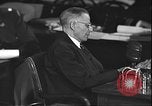
General Short speaks about the Japanese attack on Pearl Harbor occurring without notice, during an investigation.
Joint Congressional Investigation of the Pearl Harbor attack in the United States. Officials gather in the court room. Officials seated at their desk and Retired U.S. Army Major General Walter Short addresses them about the Pearl Harbor attack. He states that no mention was ever made by the Japanese for the attack on Hawaii. The United States had no idea to be prepared for the Japanese air raid on Pearl Harbor. On December 7th 1941. The United States Army was not notified about the attack even at that time. (World War II period).
CRITICALPAST.COM: About Us | Contact Us | FAQs - How to Order | License Agreement | My Account | My Lightboxes | Shopping Cart | Advanced Search | Featured Collections | Website Terms & Conditions | Privacy Policy ©2026 CriticalPast LLC.
License Agreement |
Terms & Conditions |
Privacy Policy
©2026 CriticalPast LLC.