


 Francais
 Deutsch
 Italiano

Refine Your Search
Nevada United States 1936 stock footage and images
- Showing 20563 to 20568 of 35682 results more
 Hide
Color Sound
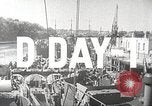
Allied invasion force departs England en route to France for invasion of Normandy, in World War II.
D-Day minus 1 (June 5, 1944) U.S. Invasion craft jammed into harbor at Weymouth, England, the day before D-day, during World War 2. Troops sitting on deck of LSI(L) 88, drinking coffee and playing dice game. One soldier looking through binoculars, at an English woman,in doorway of her flat, who is looking back through her binoculars. Several other women in the flat complex are hanging laundry out to dry.The American soldier cups his hands and tries to call out to the woman.One of his friends joins in the fun. Scene shifts to Formation of U.S. B-26 bombers in flight. A city is viewed from a bomber, with smoke rising from bomb bursts. Formation of U.S. B-17 bombers escorted by P-47 fighters. Scene shifts back to troops at port of embarkation, where large group is seen at a Catholic mass being held on a pier by U.S. chaplain.LCI(L)s numbers 49, 89, and 93, are seen tied up in background. A U.S.Coast Guard officer briefs his crewmen. Several of the invasion fleet ships begin moving out of the harbor. A U.S. Navy Captain, conversing with Major General Clarence R. Huebner, Commander, U.S. 1st Infantry Division, on deck of a ship. Buckley-Class Destroyer escort, in camouflage paint, is seen with other other escorting warships. Barrage Balloons fly aloft. View from LCI(L) departing pier in Weymouth. Several others preparing to depart as well. LCI(L) 498 is seen closeby. Columns of invasion craft underway. Captain Miles Imlay,USCG, deputy commander, Assault Group O-1, and Commander of Flotilla 10, on the bridge of his flagship, LCI(L) 87. The U.S. Attack transport USS Samuel Chase (APA-26) is seen. Soldiers loading rounds into an ammunition belt. Crew members on an invasion ship man an antiaircraft gun (as friendly aircraft fly overhead). An 83-ft Coast Guard rescue cutter. U.S. Battleships. Soldiers napping on deck of the USS Samuel Chase. Below decks, a Coast Guard Commander joins others being briefed with help of a mockup of the Normandy coastline.
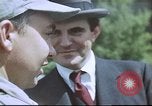
Lt. Gen. Jacob Devers and Maj.Gen. Ira Eaker escort British civilian official in visit to an airfield in England.
U.S. Lieutenant General Jacob L. Devers, Commander of U.S. Army Forces in Europe, and Major General Ira Eaker, Commander of the U.S. 8th Air Force, escort a British official visiting an air base in the UK. The official speaks momentarily with U.S. ground crewman. Then a U.S. Lieutenant Colonel escorts him in a walk around a B-17, named "Delta Rebel" while the Generals and others stand nearby.(Captain Robert K Morgan, Pilot of the "Memphis Belle" is a member of the visiting party.) The British Official has an extended dialog with escorting officer. All members of the visiting party begin climbing aboard a C-45 aircraft. Change of scene show the party walking from the C-45 past an honor guard. General Devers greets several Air Corps officers standing in a line. He is followed by the British official, with his Lt. Col. escort. Generals Devers and Eaker speak with the Lt. Col. escort and then General Eaker walks with the official to a waiting car (appears to be a 1938 Packard sedan). The official enters the car and drives away, followed by American staff car and another vehicle.
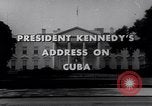
President John F. Kennedy address from White House about Cuban build up of nuclear ballistic missiles.
President John F Kennedy addresses the people of United States about recent events in Cuba during the Cuban Missile Crisis. Cameras and press in front of Kennedy in the White House. President Kennedy sits at table with flags in the background. Kennedy tells about the news of Soviet nuclear weapons being stockpiled by the Cuban Government. The U.S. government has evaluated the threat and now Kennedy gives details about both medium and intermediate range ballistic missiles seen in Cuba. Kennedy lists some areas within America that are in range of Cuban missiles He also notes that the Cubans are preparing jet bombers. Kennedy makes note of a 1947 pact with the Soviets, and notes also some personal talks with the Soviets in September. He notes his talks with Russian Foreign Minister Andrei Gromyko as well. He states that use of nuclear weapons is a threat to peace. He notes that the U.S. has no desire to dominate any country but declares Cubans action to be provocative.
President Woodrow Wilson and other dignitaries draw draft slips at New York Herald's office in New York, during World War I.
U.S. President Woodrow Wilson talks at New York Herald's office in New York, United States, in World War 1. Headlines of the newspaper 'The New York Herald'. Draft slips enclosed in gelatin capsules are put into a glass bowl. Woodrow Wilson's eyes are covered with a blindfold. Wilson draws a draft number from the bowl. Other dignitaries also draw draft numbers one by one in the same fashion. The draft slips read and result declared. Man writes results on a New York Herald's Bulletin Board. People gather in large numbers to see the results. Men raise their hats and cheer after knowing the results. U.S. flags hung outside New York Herald's building. (WWI; WW1)
101st Airborne Division troops and equipment are loaded onto C-119Fs aircraft during Operation Swift Strike in North Carolina.
Operation Swift Strike in North Carolina. Troops and equipment of the U.S. 101st Airborne Division are loaded onto U.S. Air Force C-119Fs Flying Boxcar transport aircraft. USAF B-57 Canberra bomber aircraft in flight. USAF KC-135A Stratotanker aerial refueling aircraft takes off. Men work at communications console and plot boards. USAF F-105s Thunderchief fighter aircraft peel off. USAF F-100Ds Super Sabre and RF-84F Thunderstreak fighter aircraft peel off. F-100 and RF-84F aircraft in flight overhead. F-100 aircraft in steep climb. C-119Fs aircraft take off and retract landing gear. C-119Fs in flight drop paratroops. USAF Chief of Staff General Curtis Emerson LeMay,USAF Major General Maurice Arthur Preston and U.S. Army Lieutenant General Thomas J. H Trapnell watch from spectator stands. USAF C-130 Hercules transport aircraft drop heavy equipment. Paratroopers descend and land on ground. Troops deploy and move equipment by Army mule. USAF C-123s Provider transport aircraft land and unload troops. Jeeps full of troops move past a line of parked C-123s.

The completion of graduation of cadets at the West Point Military Academy in New York.
A U.S. Army Second Lieutenant narrates his experiences as a West Point cadet in the United States. The beginning of the narrator's fourth year at the West Point Military Academy in New York. A sign reads: 'The Warrior Nations of History'. Cadets seated in a class room. An officer explains to them about ancient and modern weapons and equipment used by soldiers. Framed photographs of West Point dignitaries on a wall. The photographs include those of U.S. Army Generals David D. Eisenhower, Douglas MacArthur, William Westmoreland and John J. Pershing. An airplane parked at a field. Soldiers stand nearby. The narrator serves as a platoon leader in a regular army unit. The narrator seated in his room with another cadet. He writes a letter to his parents on the completion of four years of cadet life. Past events show the narrator standing as a fresher with other plebes in formation. The parents of the narrator and other people watch the plebes. The plebes take an oath of allegiance.
CRITICALPAST.COM: About Us | Contact Us | FAQs - How to Order | License Agreement | My Account | My Lightboxes | Shopping Cart | Advanced Search | Featured Collections | Website Terms & Conditions | Privacy Policy ©2026 CriticalPast LLC.
License Agreement |
Terms & Conditions |
Privacy Policy
©2026 CriticalPast LLC.