


 Francais
 Deutsch
 Italiano
Refine Your Search
Nevada United States 1936 stock footage and images
- Showing 20893 to 20898 of 27248 results more
more Hide
Hide
Franklin Delano Roosevelt’s campaigning activities for the Democratic Party as Governor of New York
Franklin Delano Roosevelt (FDR) poses with fellow Democratic party mates Alfred E. Smith and John W. Davis. Crowds cheering during the Democratic Party National Convention in New York City. Supporters carry signs with the names of US states and territories such as Massachusetts, Florida and Vermont. Supporter in Democratic Party National Convention carry poster of Alfred E. Smith. View of 1928 Democratic Party National Convention in Houston, Texas. Supporters carry signs bearing the US states and territories names. Alfred Smith smiles and takes off his hat. Alfred E. Smith, Franklin D. Roosevelt and other Democratic Party officials meeting. View of New York State capitol building in background of Albany New York street scene. Franklin D. Roosevelt working on his desk as Governor of New York State. Franklin D. Roosevelt surrounded by supporters. Franklin D. Roosevelt speaks with supporters, including Mrs. Edith Altschul Lehman sitting on the armrest of his chair during the inaugural ball. Syracuse, New York State Fair motorcade. Franklin D. Roosevelt in Syracuse State Fair motorcade with his mother, Sara Delano Roosevelt. Franklin D. Roosevelt have lunch at an outdoor restaurant in Syracuse, New York.
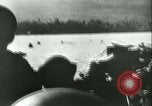
Signal Corps weekly film reports sent to Photographic Center and used in training films for U.S. troops during World War II.
The role and contribution of the U.S. Army Signal Corps in combat and war. Amphibious landings of the first wave of Allied troops including Signal Corps Units in Normandy, France on D Day during World War 2. The Joint Assault Signal Companies (a Signal Corps Unit that accompanies the soldiers on every beach landing) go ashore in Normandy. Soldiers in landing crafts approach the beach. Landing crafts anchored along the shore line. A U.S. flag on the beach. Crafts approach the beach. U.S. Army Signal Corps combat photographers using motion picture cameras to film the battle that ensues on the beach and in the fields. Gun fire and explosions in the battlefield, filmed by combat cameraman. Allied aircraft in flight. Airmen load weekly film reports of the war in all Theaters made by Signal Corps officers from a van into an aircraft. The films are sent to the Photographic Center in New York. A soldier assembles the films. Technicians organize and arrange the films. They place the film reels onto racks. The film content is used to make training and orientation films for the U.S. troops. Troops watch the films in order to cut down the training period, and stay informed about the order of event in other Theaters of Operation. The films include 'Why We Fight' and 'The Fighting Men' series. Clips and recordings from these films.
Plan for Peace, 1947. Public information film about U.S. Army Universal Military Training Project
Firing of a V-2 rocket from White Sands, New Mexico. An XP-84 jet aircraft on a test flight in California. Scenes of devastation in Hiroshima and Nagasaki. An atomic bomb test conducted in Bikini Atoll, Marshall Islands. Large smoke cloud rises. Americans expressing disgust with war and confidence in ability to protect against it in future. Newspaper headline about Armistice ending World War I on November 11, 1918. Victory parade in New York City. Close up view of Adolf Hitler as he speaks forcefully to a German audience. V2 rocket being launched in Germany. German Messerschmitt Me 163 Komet rocket plane in flight. Map depicting uranium deposits world wide. An XB-36 bomber in flight with landing gear extended. A huge formation of various warplanes in flight, high overhead. A wartime tank assembly plant. American army troops on parade. A United Nations meeting in session. Peaceful scenes of American soldiers in Hawaii before World War II in the Pacific. Hawaiian Hula dancers. Japanese carrier-based Aichi D3A1 dive bomber in flight during attack on Pearl Harbor, December 7, 1941. Bombed U.S. warships and facilities in Pearl Harbor. American Army officer and civilian discussing wisdom of maintaing large standing army. Army recruits are seen in the U.S. Army Universal Military Training Experimental Unit at Fort Knox, in 1947. They are seen in quarters, studying; taking part in sports (baseball); and attending religious services in a base chapel. Several trainees in a field tent, working with numerous tape decks in some kind of military communications activity.
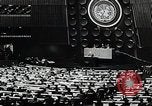
Atoms for Peace. UN approves formation of IAEA. Nuclear scientists gather in Geneva Switzerland
UN General Assembly seen meeting in 1954 as it approves an International Atomic Energy Agency (IAEA). U.S. Ambassador Henry Cabot Lodge II, and French ambassador, Henri Hoppenot, speaking. Finn Moe, of Norway, speaking. View of the city of Kjeller, Norway. Flags of Norway and the Netherlands at joint atomic laboratory. Scientists with various pieces of scientific equipment inside the facility. Indian ambassador, Krishna Menon, speaking at the United Nations. Atomic laboratory and a Government Teachers' Training College, in India. Indian scientists in a laboratory. Indian lecturer speaks to students. Brazil's Professor Ernesto Leme speaks at the UN. The city of Sao Paulo, Brazil. The University of Sao Paulo. Rio de Janeiro, Brazil. The Center for Physical Research. Clock tower of Brazil Central Station in Rio. Sutan Sjahrir,of Indonesia at the United Nations. An animated map shows nations interested in atomic energy. The UN Headquarters building on the East River in New York. A person looking through a microscope. Foreign scientists attending indoctrination courses at the U.S. Argonne National Laboratory. Diplomats sign agreement between the U.S. and Philippines on July 27, 1955, for the Philippines to lease uranium for a research nuclear reactor, and to receive technical assistance. Views of Geneva Switzerland in August 1955, including street views with pedestrians, and tram or streetcar on city streets. Exterior of Palace of Nations, then interior view with atomic science conference in progress. Indian nuclear physicist, Homi Jehangir Bhabha, presiding over conference of scientists and university representatives from 73 nations, including, inter alia, John Cockcroft, of Great Britain; Otto Hahn, of Germany; Willard Libby, of the U.S.A.; Vladimir Vexler of the Soviet Union; and Niels Bohr of Denmark. Views of exhibit hall at the conference, and displayed models of nuclear reactors, uranium ore refining exhibits, and accelerators. U.S. President Dwight Eisenhower views swimming pool reactor, while visiting the exhibit hall. Site work and construction underway in Meyrin, Geneva, Switzerland for a research laboratory for the European Organization for Nuclear Research (CERN - Conseil Européen pour la Recherche Nucléaire). Sitework seen for a facility of Euratom in Europe (European Atomic Energy Community). View of early sitework in Manila for an Asian nuclear center in the Philippines under the Colombo plan, for training personnel in nuclear science and technology.

Control system in the tail section of a high angle controllable bomb or Azon Bomb.
High angle controllable bombs or the Azon Bombs (VB-1 and VB-2) of the U.S. Army Air Corps. An Azon Bomb covers aerial route to strike at a target. Azon Bomb kept in a laboratory. Airmen removes the tail section which contains control units. Airman checks the movement of glide controllers in tail section by control unit. Attaching tail to an Azon Bomb placed on a cart. (World War II period).
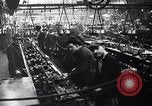
Labor Union movement grows significantly, but labor strife also continues during 1930s in the U.S.A.
Men work assembling transmissions on an automobile production line. John L. Lewis, President of the United Mine Workers Union, giving a speech supporting formation of the Congress of Industrial organizations (CIO). Group of workers gather to listen to a union speaker. Many wear miners hats. Cheering Union workers march in street carrying posters reading: "Long-Live the C.I.O." and "Forward with C.I.O." Leaders of the early C.I.O., Sidney Hillman, President of the Amalgamated Clothing Workers of America (ACWA); Philip Murray, Vice President of the C.I.O.; and John L. Lewis, C.I.O. President, circa 1938. David Dubinsky, President of the International Ladies' Garment Workers' Union (ILGWU); along with Sidney Hillman, and John L. Lewis, are seen mingling with clothing workers. View of a steel mill from workers' residential street on a snowy day. Steel worker in a mill. Deckhand and an engine man aboard a merchant ship. Roustabouts and riggers at an oil well. Nonferris metal miner in rail car. Worker in tire factory. Electrical worker. Union leader speaking to group of workers carrying banner reading: "Shirt workers, Local 128 Allentown, Pennsylvania Joint Board." Labor organizers passing out leaflets to workers leaving a factory. Labor discussions with workers at lunch tables. Draftsman preparing labor organization protest signs calling for "Sanitary Conditions" and "Fair Play." Working women singing a union song. Union workers marching and carrying signs for various causes. Man riding a bicycle displaying sign:"Don't Scab." Car overloaded with people with sign: "Come To Lafollette Labor Rally Monday, July 5, 1937." ACWA workers of Local 95, Atlas Plant. UMWA members of Lafollette, Tennessee. Miners playing cards and playing musical instruments. Miners on strike below in mine for 5 days, cheer leader. Poster encouraging Americans to travel and visit in the USA. Police with batons or billy clubs and military units repel, combat, beat, and arrest striking and protesting workers during labor disputes. Scenes of military uniformed men throwing tear gas grenades into crowds of workers as workers disperse. People assisting injured protesters. Police firing various weapons at protesting workers during labor protests and strikes in San Francisco. U.S. Army soldiers arresting a civilian and throwing tear gas grenades.
CRITICALPAST.COM: About Us | Contact Us | FAQs - How to Order | License Agreement | My Account | My Lightboxes | Shopping Cart | Advanced Search | Featured Collections | Website Terms & Conditions | Privacy Policy ©2026 CriticalPast LLC.
License Agreement |
Terms & Conditions |
Privacy Policy
©2026 CriticalPast LLC.