


 Francais
 Deutsch
 Italiano

Refine Your Search
Nevada United States 1936 stock footage and images
- Showing 20935 to 20940 of 35682 results more
 Hide
Color Sound
Wilbur H. Durborough, America's famous Press photographer, goes to Germany during World war I
Closeup scenes show Wilbur H. Durborough-America's famous press photographer, seated behind the steering wheel of a 1911 Alto touring car parked on a street in Chicago, Illinois, getting ready to depart for Germany, during World War 1. Sitting behind him is his assistant cameraman, Irving G. Ries. Both have goggles pushed back on their foreheads. and both smoke cigars. Some spare tires are seen behind Mr. Ries. As camera moves back, they are seen surrounded by numerous friends and well-wishers as they prepare to depart from Chicago. Next, Durborough is seen standing on the bridge of the Holland-America steamship, S.S. Nieuw Amsterdam, with ship's Captain Jan Baron, who is on lookout for mines and submarines. Captain Baron passes his binoculars to Mr. Durborough. Captain Baron and Mr. Durborough stand on the deck looking at some documents. Lifeboats on davits behind them are ready for emergency. Durborough drives his car from the ship terminal onto a street in Rotterdam, with Captain Baron standing on a running board. The car is loaded down with luggage and equipment. He drives away as the Captain and others wave goodbye. Displaying an American flag on the hood, Durborough arrives at the German border. Dutch officials examine the car's contents, including a look into the engine compartment. Next, Durborough is stopped by German border guards, who examine his passport and greet him in a friendly manner. Durborough is seen in the offices of U.S.Ambassador James W.Gerard, as he describes his plans for visiting. He is honored by a visit from Prince of Reuss of German General Staff, Prince Max of Baden and Count Von Bernstorff- son of German Ambassador to the United States, who are seen chatting with him, before entering their car to depart.
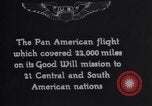
President Coolidge present pilots with citations after the successful goodwill mission.
Brief scenes from the U.S. Army Air Service Pan American good will flight that covered 22,000 miles on a goodwill mission to 21 Central and South American nations, during 1926-1927. A view of the hangar area and flight line of Kelly Air Field in Texas, as one of the five Loening OA-1 Amphibious aircraft, on the mission, takes off from the runway on Dec. 21, 1926. Five of the aircraft in formation over a large city. U.S.President Calvin Coolidge presents the aircrews with citations for the Distinguished Flying Cross, at Bolling Field, Washington, D.C., on May 2, 1927.
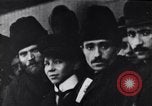
Accomplishments of the Amalgamated Clothing Workers of America, and later challenges of the Civil Rights movement in America
Turn of the Century immigrants to the United States pose aboard ship. Some wear fez hats. View of clothing industry workers at sewing machines in early 1960s. Picture of Sidney Hillman and his wife, circa 1910. Older garment worker cutting cloth. Clothing or garment factory workers punching a time clock in the early 1960s. Men operating sewing machines. A cutter marking cloth from a pattern. A man sewing button holes on clothing. Old pictures of earlier garment workers. More modern view of unionized clothing workers at sewing machines. A cutter using a machine to cut multiple layers of fabric. Supervisors discussing a sample of sewn product. numerous views of men and women sewing garments. Flashback to earlier times of workers marching to demand a union contract. Union member distributing literature at a factory gate. Small group of union picketers on sidewalk. Union leader speaking to group of women workers in Southern town. Union organizer with bloodied head, smoking cigarette. Striking Workers (mostly women) standing in group outside employment office of Tuf-Nut Garment Manufacturing Company in Little Rock,Arkansas. The striking women being arrested by policemen. Change of scene to closeup of Alabama State policeman smoking cigar. Civil rights marchers during demonstration in Birmingham Alabama on May 7, 1963 during the "Birmingham Campaign" or "Birmingham Movement". Fire fighters in fire engine pumper truck stops near police on street in town and sets up fire hoses to spray high powered water directly at African American civil rights marchers. Civil Rights marchers soaked by high powered water hoses. One protestor or demonstrator tries to run away from the fire hose and is grabbed by two white police men. A protestor takes cover behind a telephone poll as a firehose is directed toward him. A black man converses with two women on a snowy street. Civil Rights marchers of the African American Southern Christian Leadership Conference carrying signs during a demonstration. People fill the area around the reflecting pool by the Lincoln Memorial during the March on Washington for Jobs and Freedom on August 28, 1963. A man and his daughter share time together on a snowy day. Children sledding in the snow. People ice skating on lake in Central Park, New York City. Closing views of early immigrants to the U.S.A.
The Philippines under Japanese occupation, liberation by allied forces, Philippine Independence ceremony.
The Philippines under Japanese occupation, liberation, and subsequent granting of independence by the United States in World War 2. Bodies of Filipino and United States soldiers killed during the Japanese invasion of the Philippines. Captured American, Filipino, and Australian soldiers raise their hands after the Fall of Corregidor. United States General Jonathan M. Wainwright negotiating the surrender of The Phillipines with Japanese General Masaharu Homma in 1942. Brigadier General Lewis C. Beebe and Major Thomas Dooley are seen to Wainwright's left. An American warship firing during the United States Pacific campaign to defeat Japanese occupying forces in the Pacific. United States soldiers get off an amphibious landing craft during the U.S. retaking of the Philippines. United States General Douglas MacArthur arrival in Leyte Gulf with a retinue consisting of Philippine President-in-exile Sergio Osmeña, Lieutenant General Richard Sutherland, Philippine Brigadier General Carlos P. Romulo, Major General Courtney Whitney, Philippine Sergeant Francisco Salveron and CBS Radio correspondent William J. Dunn in Palo, Leyte, the Philippines- a fulfillment of his promise to return to the Philippines. General Douglas MacArthur speaking at the Independence Day ceremony in Manila on July 4, 1946. “America never wavered in that purpose. America today redeems that pledge.” Says General MacArthur. United States Senator Millard Tydings, the co-sponsor of the Tydings–McDuffie Act (a law that provides independence to the Philippines after a 10-year transition as a Commonwealth) attends the ceremony. Paul V. McNutt, the United States High Commissioner of the Philippine Commonwealth (later the first United States Ambassador to the Philippines), reads the United States President Harry Truman's official proclamation of Philippine Independence. Filipino elites and United States dignitaries watch the ceremony in the Independence Grandstand (a temporary structure built in front of the Rizal Monument). Manuel Roxas being sworn in as the first President of the Philippines after gaining independence from the United States. The Philippine national anthem, Lupang Hinirang, plays in the background. High Commissioner McNutt lowers the United States flag from the flagpole as President Manuel Roxas raises the flag of the new Republic of the Philippines. A celebratory parade following the Independence ceremony takes place, which includes floats from various provinces in the country. A float with signs reading: "Let's Produce and Rebuild,". "Mountain Province" float with women wearing formal Filipino Baro’t Saya gowns. "The City of Manila" float with soldiers. "The University of the Philippines" (UP) float featuring two women dressed as allegorical figures and sign saying, “The University of the Philippines At the Service of the State”. "The Division of City Schools" float features two Filipinos in traditional attire in front of a Statue of Liberty model. A float, likely belonging to the National Library of the Philippines, with children and a huge book model. The Chamber of Commerce Philippines float contains a machine gear model and small models of an aircraft and a ship. American soldiers marching, carrying the United States flag. A military marching band play. Filipino soldiers marching with the Philippine flag. Military aircraft in flight above the Independence Grandstand in Manila.

Military parades in France and Germany, German personalities in Berlin
The Swiss flag hangs on the railing overlooking Geneva, Switzerland. Leaders of Germany, France and United States are seen. Former United States President Herbert Hoover and Prime Minister Albert Sarraut of France are each seen stepping from their respective cars. Military parades are conducted in various European countries including France and Germany. The French flag waves on top of a building. The French national anthem “La Marseillaise” is played by a band. French soldiers marching in a parade. German marching band plays music during a parade in Berlin, Germany. Building construction is seen taking place in Berlin. Street scenes in Berlin shows a train approaching Friedrichstrasse station, the Capitol am Zoo (Budapesterstrasse 42-46,. Berlin 10623) in Charlottenburg. A man closes the cabinet door of an Autoruf or taxi stand. German novelist Thomas Mann speaks to a woman. German artist Käthe Kollwitz speaking. German notables are seen, including the boxing champion, Max Schmeling. German film director at work. Views of the LZ 127 Graf Zeppelin airship.

Federal Agents destroy alcohol mash at an illegal alcohol manufacturing plant in Frazer, Pennsylvania.
Illegal alcohol manufacturing plant in Frazer, Pennsylvania, during Probhibition period in the United States. U.S. Federal Agents walk into the alcohol manufacturing plant and destroy the still, alcohol bottles, and mash up the used alcohol preparation. A truck parked outside the unit. Men carry containers and stock from the unit. Men destroy containers with axes and hammers in the ground.
CRITICALPAST.COM: About Us | Contact Us | FAQs - How to Order | License Agreement | My Account | My Lightboxes | Shopping Cart | Advanced Search | Featured Collections | Website Terms & Conditions | Privacy Policy ©2026 CriticalPast LLC.
License Agreement |
Terms & Conditions |
Privacy Policy
©2026 CriticalPast LLC.