


 Francais
 Deutsch
 Italiano
Refine Your Search
Nevada United States 1936 stock footage and images
- Showing 20941 to 20946 of 27248 results more
more Hide
Hide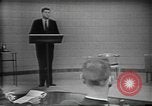
Kennedy talks about federal government assistance for farm surpluses during a presidential election debate in Chicago.
The first Kennedy-Nixon Presidential Debate in Chicago, Illinois. Charles Warren from Mutual News asks Democratic candidate Senator John F Kennedy about the need of assistance by the federal government for farm surpluses. Kennedy answers and states that the federal government supports farmers, as farmers cannot control their market because they lack bargaining power. He states that the overall economy depends on the agricultural economy. He talks about the interdependency of agriculture with other sectors. He further talks about farm policy, support price mechanism and tax load from the Treasury for the farmer. He says the policy for balancing effective supply and demand can only be carried out through governmental action. Republican candidate U.S. Vice President Richard M. Nixon presents his views and states that he disagrees with Kennedy that the farmers need more governmental control. He blames that the farmer is in problem because of the government which asks the farmer to produce surplus to meet emergency. He tells about holding up of farm income by paying the farmer in kind and indemnifying the farmer.
President Harry S Truman awards Congressional Medals of Honor at the White House to Carl Sitter and Reginald Myers
President Harry S Truman awards Congressional Medals of Honor at the White House in Washington DC. A gathering at the White House. Officials and awardees with their families. The recipients are Marine Captain Carl Sitter (standing left of the President when all three men are together) and Reginald Myers (standing right of the President). The President awards the Medal of Honor to each of the two officers. The officers shake hands and pose with the President. Officers with their families after receiving the Medals. Sitter holding his son and pictured with his wife. Myers' wife, Margaret, and daughter, Susan, and son, Scott. Myers holding his son, Scott. Major Myers was awarded the Congressional Medal of Honor while serving as Executive Officer, 3rd Battalion, 1st Marines, in the vicinity of HAGARU-RI, KOREA, November 29, 1950, while commanding a group of 80 men who were stragglers and missing from other units during the Korean War. Major Myers' makeshift unit successfully denied the Chinese Communists the possession of EAST HILL, which dominated the key crossroads in the withdrawal -- attack in another direction -- by U.S. Marines and Army units from the Chosin Reservoir. Captain Sitter's unit relieved Major Myers' unit in the same battle. Sitter received e medal for his actions as a commanding officer during a two-day battle at Hagaru-Ki, Korea in November 1950. The fighting lasted 36 hours, and Sitter endured grenade burns to his face, arms and chest. He refused to evacuate as the fight continued. More than half of his company was killed, wounded or captured, but a successful defense of the area was mounted by U.S. soldiers.
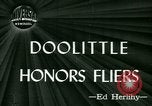
General Doolittle and General Spaatz honor the USAAF389th Bombardment Group for completing 200 heavy bombardment missions during World War II in Europe
Ceremony honoring the USAAF 389th Bombardment Group, on completion of 200 missions in the European theater during World War 2. U.S. Lieutenant Generals Carl A. Spatz, Commander of the U.S. Strategic Air Forces in Europe, and James Doolittle, who is about to assume command the 8th Air Force, stand together with officers representing several World War 2 Allied nations. A large formation of B-24 Liberator bombers flies overhead. Closeup of two soldiers looking up at the formation. Aerial view of the B-24 formation, from an accompanying aircraft. A color guard with the American flag. Representatives of various Bombardment Squadrons stand holding their unit flags. General Doolittle makes brief remarks on the merits of the 389th Group, which draw chuckles from the audience, including a smiling Soviet officer, Standing to the far left in the picture, behind Doolittle. (He has been identified as Major Timofey Samarin, assigned as Air Force assistant to the Soviet Ambassador, and also as Military Attache to the United Kingdom.)
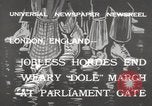
Unemployed people march on the roads to London, England.
Unemployed men and women from Scotland, Wales, Midlands and the South march to London during the Great Depression. Signs seen include, 'Scotland vs. London,' 'National Hunger March,' 'Revolutionary United Mineworkers of Scotland,' and 'We are Against Starvation.' Slate at head of film reads, 'Jobless Hordes End Weary Dole March at Parliament Gate.' Sign in background within village reads, 'The Castle Restaurant.' Research suggests this is the The Castle Restaurant on Norwich Road, Caister-on-Sea, Great Yarmouth Norfolk, NR30 5JN This section of film ends with views of Parliament Building and Clock Tower in London. (Background to the next section of film: In Ireland a so-called Outdoor Relief Strike, supported by the Falls and the Shankhill united, Catholics and Protestants, was launched by the unemployed of Belfast. On Oct 3, 1932, 60 thousand attended a torchlight meeting at the Customs House in Belfast Ireland, to protest relief levels. Sporadic looting and rioting ensued in the following days and more mass demonstrations were planned for Oct 11th.) Film picks up on Wednesday October 5, 1932 as the Royal Ulster Constabulary (RUC) attempt to maintain order. A series of street scenes is shown in which the RUC has begun patrolling. Officers are seen patrolling in Lancia armored car No. 105, with a machine gunner on top. Another Lancia armored car (No. 33) patrols near a park at the corner of Stage Street, Belfast. Boys are seen running across cobblestone streets where they have piled up stones for use in rioting. An RUC Crossly tender truck, carrying several police officers, drives along a Belfast street. View of an empty street where piles of stones and slates obstruct the roadway. Pedestrians appear to be going about their daily affairs as usual. (The primary mischief makers seem to be youths.) Final scene is that of a funeral. (In the course of the week's troubles, two of the rioters were shot dead by the RUC.) A horse-drawn hearse carries at least one. But behind it is a group of pallbearers also carrying a coffin. The street behind is filled with masses of mourners.
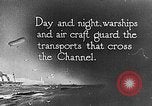
British warships protecting shipping and convoys in the English Channel during World War I
British Royal Navy efforts to protect shipping and convoys in the English Channel during World War 1. Boats are seen behind a breakwater on coast in United Kingdom, during World War 1. A British two-stacker I- class destroyer underway with black smoke pouring from its funnels. British soldiers with weapons and personal gear at a rail yard, with train in background. They descend stairs to a pier and board a crowded troop ferry ship. Two troop ferries underway in the English Channel. View of the British Monitor ship, "Marshal Soult" mounting two 15-inch guns. British soldiers loaded aboard two troop ships departing the United Kingdom (one is a side-wheeler). Women on the pier waving goodbye. A British gunboat underway. View from stern of a boat putting out a good wake. A dirigible low over the water and a steaming warship seen in background. Workmen marching across the mole protecting the German submarine (U-boat) base at Zeebrugge, Belgium (Slate says before it was blown up by the British). (World War I; World War 1; WWI; WW1)
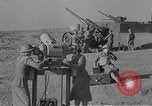
Women of British Auxiliary Territorial Service operate kinetheodolite and march
British women of the Auxiliary Territorial Service (A.T.S.) engaged with coastal artillery unit. Two women are operating a Kinetheodolite, next to a woman communicating on a field telephone. Antiaircraft guns and crews are in position beind them. An obsolete biwing aircraft is catapulted out over the water as a practice target for the shore battery, which commences firing. A contingent of women (ATS) marching on a road, followed by regular British soldiers. Officers review the marching units as they pass. (World War II period).
CRITICALPAST.COM: About Us | Contact Us | FAQs - How to Order | License Agreement | My Account | My Lightboxes | Shopping Cart | Advanced Search | Featured Collections | Website Terms & Conditions | Privacy Policy ©2026 CriticalPast LLC.
License Agreement |
Terms & Conditions |
Privacy Policy
©2026 CriticalPast LLC.