


 Francais
 Deutsch
 Italiano

Refine Your Search
Nevada United States 1936 stock footage and images
- Showing 21001 to 21006 of 35682 results more
 Hide
Color Sound

A large Joint American-French ceremony at Kerfautras cemetery, Brest, France, honoring fallen in World War I
A U.S. Navy brass band plays a dirge as they march slowly into Kerfautras cemetery, on q path from the main entrance on rue Massillon, in Brest, France, during World War 1. They are followed by a contingent of sailors with shouldered arms, carrying an American flag and marching slowly. They are followed by a funeral coach pulled by two horses and escorted by U.S. Naval officers. Bringing up the rear is another contingent of U.S. sailors, marching slowly and not bearing arms. U.S. Army Brigadier General George Herbert Harries speaks during the funeral. Several high-ranking French and American officers seated behind the podium, including:. U.S. Army Major General William Crozier and U.S. Navy Admiral Henry Braid Wilson. A large number of American military and French military and civilian spectators are present. French and American flags fly side-by-side in the center of the gathering. French troops stand in front of a backdrop of black parsasols held by women behind them. Several children stand with the front line of French soldiers. One little girl holds an American flag. The French troops salute for the camera. The next scene shows a virtual sea of parasols and hats, including French women wearing fashionable bonnets and many men wearing straw boaters. High-ranking French and American military officers all stand and salute. Major General Crozier walks among graves of newly interred American fallen. He is accompanied by a Brigadier General wearing a black armband. Several field grade officers follow the Generals. At the end, a large memorial gathering is seen at a courtyard in the U.S. Naval Base at Brest. Sailors are drawn up in formation and many spectators are assembled. An American flag drapes a coffin flanked by several others leaning upright against a building wall. There is very little movement, so presumably words are being spoken.
President Harry S. Truman reads prepared speech after dropping of atomic bomb on Hiroshima Japan during World War 2.
U.S. President Harry S. Truman delivers a speech following the dropping of the atomic bomb on Hiroshima, Japan, during World War II. U.S. President Harry S. Truman seated at desk in cabin of a ship. He reads prepared speech stating that a single American aircraft dropped one atomic bomb on Hiroshima and destroyed its usefulness to the enemy. He reminds listeners that the Japanese began the war from the air at Pearl Harbor. He speaks about the U.S. Armed Forces and the production of atomic bombs in the United States. The President states that the U.S. is now prepared to completely destroy every productive enterprise of Japan, by bombing Japanese docks, factories, and communications. Truman states that the U.S. shall completely destroy Japan's power to make war. President Truman notes that acceptance of the Ultimatum of July 26th issued at Potsdam, could have saved the Japanese people much suffering. But it was rejected by Japan's leaders. He states that the U.S. have spent more than two billion dollars on the greatest scientific gamble in history and have won. This is due to the greatest achievement of organized science in history.

US Army soldier and a woman visit various monuments and buildings in Washington DC.
Monuments and buildings in Washington DC during World War 2. Exterior of U.S. Capitol building (First St SE, Washington, DC 20004, United States). A and a woman looking at the equestrian statue of Andrew Jackson by Mills in Lafayette Square. They are seen at the tomb of the unknown soldier at Arlington National Cemetery (123 Patton Dr building d, Fort Myer, VA 22211, United States) where they read the inscription on the tomb. Tourists arrive at the Lincoln Memorial (2 Lincoln Memorial Cir NW, Washington, DC 20002, United States). They next are seen ascending the steps and entering the U.S. Capitol building. They look at statues of various famous Americans in the U.S. Capitol, including Daniel Webster, Samuel Adam, Stephen Austin, Lew Wallace, Will Rogers, Robert E. Lee, and George Washington. Exterior of U.S. Capitol building. The man and the woman coming out of the building.
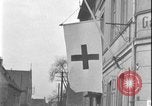
Hospitalized German soldiers at Red Cross building; liberated British soldiers receive cigarettes from US soldiers in Germany during WW2
Red Cross flag drapes in front of Gasthof zur Tanne, used as a Red Cross building, in Germany during World War 2. Hospitalized German soldiers and a nurse stand outside the Red Cross Building, watching United States tanks pass. German civilians watch United States tanks pass by the Red Cross Building, “Gasthof zur Tanne” written on the building. United States tank pass by German patients. Hospitalized German soldier, wearing glasses, smiles and talks. United States Army soldiers on top of tank. Liberated British soldiers greet United States soldiers in tank. United States soldiers give and light cigarettes to British soldiers. British soldier smokes cigarette and smiles. American soldier from top of tank lights a cigarette for British soldier. Man runs towards American tank. United States tanks pass by people on the road.
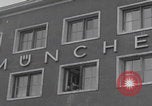
Refugees from the 1956 Hungarian Revolution fly out of Munich, Germany
View of Munich-Riem Airport building (now former Munich-Riem Airport 81829 Munich, Germany 81829 ) Building sign reads “München”. Four United States Army Douglas C–118 Liftmaster airplanes on the tarmac of Munich-Riem Airport. Hungarian refugees exit buses on the tarmac, including excited girls carrying dolls. Hungarian refugees wave at United States soldiers and journalists greeting them as they climb the airstair. A boy holding two “United States Escapee Program” bags. Airstair reads “München”. Airplane engine propeller starts up. A pilot waves from cockpit of aircraft (USAF BUAER- C 118A). A United States Army Douglas C–118 Liftmaster takes off from Munich-Riem airport. Hungarian refugees inside the flight to the United States. The Douglas C–118 Liftmaster interior refitted as a passenger plane. A woman and her daughter looking out a plane window. A United States Air Force flight stewardess kisses the cheeks of a sleeping child. A man talking to his granddaughter while in flight. A male United States Air Force flight attendant serves coffee. A man eating a meal served during flight. A girl dressing her doll. A sleeping elderly woman leans on adult son. A young boy asleep.
Vietnamese soldiers jump out of helicopters and fire at enemy positions (Vietnam War)
United States helicopters on airfield during the Vietnam War. United States Army advisors talk to one another. They share maps, papers and discuss plans. U.S. and South Vietnamese soldiers board United States helicopters...including a CH-21C Shawnee. A Sikorsky UH-34D Seahorse takes off from airfield. South Vietnamese soldiers onboard helicopter holding rifle and machine gun. A group of helicopters in flight. Point of view from helicopter as it flies down a river. Piasecki H-21 helicopter in flight. A South Vietnamese soldier looks out of window. South Vietnamese soldiers jump out of helicopters and cross rice field after landing. Aerial view showing some soldiers using a field telephone in the middle of a dense jungle. Two United States soldiers shout at each other. An injured U.S. soldier lies on a stretcher and loaded on helicopter. A South Vietnamese soldier in helicopter. The helicopter flies away. A South Vietnamese Navy captain shows his United States counterpart enemy positions after looking through binoculars. Swift boats shooting at Vietcong forces. South Vietnamese soldiers carrying weapons and landing on beachhead. A South Vietnamese soldier gives signal to fire. An explosion on beachhead. South Vietnamese soldiers load shells into mortar and fires them. An injured South Vietnamese soldier with saline tube attached to him lying on a stretcher. The injured soldier cries in pain. Vietnamese women watch medics clean another soldier. A Vietnamese soldier prays for the dead, incense burns in front of him.
CRITICALPAST.COM: About Us | Contact Us | FAQs - How to Order | License Agreement | My Account | My Lightboxes | Shopping Cart | Advanced Search | Featured Collections | Website Terms & Conditions | Privacy Policy ©2026 CriticalPast LLC.
License Agreement |
Terms & Conditions |
Privacy Policy
©2026 CriticalPast LLC.