


 Francais
 Deutsch
 Italiano
Refine Your Search
Nevada United States 1936 stock footage and images
- Showing 21007 to 21012 of 27248 results more
more Hide
Hide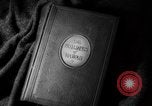
Glimpses into a book entitled "builders of Hawaii." Highlights in Hawaiian history. Portrait of Sanford Ballard Dole.
View of a book entitled "Builders of Hawaii." A hand opens it to several different places, revealing photos of persons who played roles in the early development of Hawaii. Also revealed are pages from the newspaper "Commercial Advertiser" reporting that flags changed as "Hawaii becomes the first outpost of Greater America" and "Old Glory is the new flag of the Hawaiian Islands." (This refers to the establishment of the Territory of Hawaii, under the U.S. Hawaiian Organic Act of 1900.) A portrait of Sanford Ballard Dole is shown. (He was the President of the Republic of Hawaii, 1894-1900, and its first Territorial Governor, 1900-1903.) Views of the Hawaiian State Archives Building, on the grounds of the Iolani Palace, in Honolulu. A plaque honoring Captain James Cook. Views of visitors inside an exhibit that includes a reproduction of an early Hawaiian cottage.
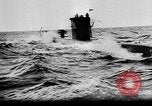
Period before U.S. formal entry into World War II. German submarines torpedo American ships and Japanese attack Pearl Harbor
Preface to U.S. in World War 2. German U-boat on surface. Crew climbing down into submarine and at duty stations while submerged. Torpedo trails bubbles underwater. Ship hit and explodes. Newspaper headlines report torpedoing of American ships: SS Robin Moor, SS Lehigh, SS Sessa, SS Steelfarer, and SS Montana, by German U-boats. Secretary of War, Henry L. Stimson calls on U.S. Navy to secure sea lanes. Wendell Wilkie agrees. U.S. Congress repeals Neutrality Act, November 17, 1941. Deck guns being placed on U.S. Merchantmen. Japanese warships docked and troops entering Indochina, as local people watch.Japanese troops by Dong Dang, near Chinese border. Situation described by animated illustrations.Japanese Special Envoy, Saburo Kurusu, is dispatched to Washington. Pan American Boeing 314 flying boat taking off. Japanese Naval Task Force of warships underway. Kurusu arriving in San Francisco, on November 14, 1941. He steps from the aircraft and makes statement to reporters. Japanese Ambassador, Kichisaburo Nomura, and Special Envoy Kurusu escorted into the White House by Secretary of State Cordell Hull, on November 17, 1941. Japanese troops in China bombarding Chinese city with artillery. November 26, 1941, View of Executive Office Building with statue of Victory atop U.S. Army First Division Monument. Secretary Hull announcing proposal to Japan.The Japanese representatives leaving the White House. Japanese aircraft carriers steaming toward Pearl Harbor. Japanese flight crews getting briefed on December 7,1941. Nakajima B5N (Kate) torpedo bombers taking off and in formation. Secretary Hull at his desk. The aloha tower and aerial view of Honolulu. Sailors at outdoor Sunday service, and relaxing at Pearl Harbor. Vehicle entering Hickam Field. Japanese airplanes bombing Pearl Harbor. Explosions on U.S. warships. USS Arizona (BB-39) suffers direct hit and explosion, as filmed from the deck of U.S. Navy Hospital Ship, USS Solace (AH-5). Shots of pilots and point of view from pilots inside Japanese bomber and attack aircraft, through a mix of dramatized segments from Japanese propaganda films about the Pearl Harbor attack, and real footage from the Pearl Harbor attack. View from Japanese planes bombing and strafing Ford Island. U.S. sailors firing antiaircraft and machine guns down Japanese planes. Secretary Hull describes memorandum from Japanese.
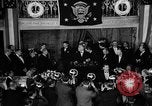
U.S. President Franklin Roosevelt delivers his address at Mayflower Hotel in Washington D.C. during the Navy Day Dinner.
U.S. President Franklin Roosevelt at Mayflower Hotel in Washington DC for the Navy Day Dinner. President delivers his address. People seated at tables. The President on the podium. Cameramen recording the event. The President talks about the state of emergency, U.S. Naval contribution to the country's defense. He mentions Hitler's attack on U.S. destroyers, killing of American soldiers, and Hitler's purpose. He discusses Hitler's plan to invade and divide South America. He voices his decision to stop Hitler and his people. He talks about America's defense and the Navy's contribution to the same. The crowd applauds. The President leaves the podium. Note: The President prefaces his remarks by acknowledging the presence of General William Donovan, who shares the stage with him. Donovan headed the Office of the Coordinator of Information (COI), later renamed the Office of Strategic Services (OSS). (World War II period).
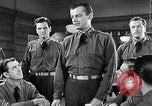
An officer with the help of a model explains when is the Skirmish Line formation used during a battle (WW2)
The advantages of the different Platoon formations during World War II. The Sergeants seated on a desk. A Rifle Squad officer uses a model to explain when is the Skirmish Line used. He starts from the approach march. The model shows the squad breaking into small platoon columns after firing of an artillery. The Sergeants listen to him. He also speaks that the troops are in squad column formation until they reach the particular range of the rifles. He focuses on two things first not to fire from more than 400 yards and do not deploy skirmish until we are forced to fire. He speaks about when and why to deploy skirmishes. He also states three reason for delaying the deployment of skirmishes.
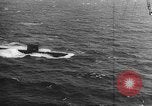
News stories of 1958 including polar cruise of USS Nautilus and statehood of Alaska
Aerial view of the USS Nautilus (SSN-571), world's first operational nuclear-powered submarine, underway on the surface and then submerging. View of helmsman below in the Nautilus. Aerial view of frozen arctic ocean with deep crevasses, as narrator mentions the Nautilus traveling submerged, beneath the North Pole on August 3, 1958. The boat's Captain, Commander William R. Anderson, is seen in uniform. More views of the Nautilus moving on the surface, including one with crew members standing on deck. Next, a newspaper headline is shown, announcing Alaska's statehood. Small boy and girl sitting in the grass holding a flag displaying map of Alaska and reading: "Alaska 49th State." Automobile traffic driving into Anchorage, Alaska. Banner stretched across the road reads: "Anchorage. All-America City." Pedestrians jam the sidewalks as the city celebrates its new statehood. A float displaying a huge moose has sign on its side reading: "49th. Hey Texas. Now I'm the biggest Bull..." Young Alaskans ride in a convertible automobile. A huge 48-star American flag covers the front of a building. It has a large extra star appended to it. Closeup of the flag.
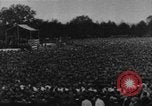
Theodore Roosevelt addresses a gathering; U.S. Forestry operations influenced by Roosevelt's conservation efforts
Rise of America as a nation and President Theodore Roosevelt's efforts to the cause. President Roosevelt addresses a large gathering (This appears to be at the Kansas State Fair in Hutchinson, Kansas on September 22, 1912, during his campaign for the Bull Moose Party nomination.) Narrator describes Roosevelt's programs for conservation of natural resources. Scenes of logging and forestry operations. Men chopping trees with axes. Timber felled. Logs in a waterway being readied for saw mill.
CRITICALPAST.COM: About Us | Contact Us | FAQs - How to Order | License Agreement | My Account | My Lightboxes | Shopping Cart | Advanced Search | Featured Collections | Website Terms & Conditions | Privacy Policy ©2026 CriticalPast LLC.
License Agreement |
Terms & Conditions |
Privacy Policy
©2026 CriticalPast LLC.