


 Francais
 Deutsch
 Italiano
Refine Your Search
Nevada United States 1936 stock footage and images
- Showing 21019 to 21024 of 27248 results more
more Hide
Hide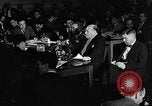
HUAC testimony of "Hollywood Ten" member Samuel Ornitz during investigations into Communist affiliations in Hollywood
Meeting of the House Un-American Activities Committee, or HUAC, in October 1947, under J. Parnell Thomas (the so-called "Thomas Hearings."). Hollywood screenwriter Samuel Ornitz is questioned and asked if he is a member of the Screen Writer's Guild. Ornitz begins his response and expresses that his response is a matter of conscience. He speaks out against the intimidation tactics of the committee chairman. The Committee members continue to cut-off the response from Ornitz and push for a rapid answer to the question. Ornitz continues to give a longer answer and states his belief that the Committee is asking him to violate the Constitution. Robert Stripling is directed to ask the next question. Ornitz is asked "are you now or have you ever been a member of the Communist Party." Ornitz continues to protest the line of questioning and likens his affiliation with any party to be like his affiliation with any religion and thus protected by the Constitution. The Committee asks if his party affiliations are directed by a foreign government. Ornitz is told to stand away and the next witness is called.
Beginnings of successful powered heavier-than-air flight. Wright Brothers flights in U.S. and Europe. General Hap Arnold
History of aviation. A balloon in flight. Historic glider such as that which interested U.S. War Department as early as 1898. In 1903, a crew of men moving a Wright Flyer into position. Two men turn over propellers on a Wright Flyer, and the engine starts. View of the Wright-designed water-cooled engine. View of Orville Wright. The famous first powered flight, at Kitty Hawk, North Carolina, with Orville Wright at controls. Animation shows that 120 foot flight juxtaposed against a B-36 wing. Wilbur Wright in Europe, in 1908, gesturing as he converses with interested parties. A gallery of spectators including the President of France, King of England, King of Spain, and King of Italy. Wilbur Wright places a wheel under the right wing of a Wright Flyer and lashes it to the strut. A team of horses pulls the plane across the field. Men maneuver the plane onto a monorail on the ground. Men pull on a heavy rope to raise a weight in a tower, for a catapult. Two men spin the propellers and the Wright Brothers airplane motor starts. Wilbur Wright and his passenger, a French journalist, board the plane. The catapult weight drops, launching the aircraft which flies low over the field. U.S. President Theodore Roosevelt speaking (He is seen on a podium campaigning for the Bull Moose Party nomination at the Kansas State Fair in Hutchinson, Kansas on September 22, 1912.) War department issues specifications for a heavier-than-air craft. Reenactment of a Wright brother signing a bid contract. A Wright Flyer airborne at Fort Myer, Virginia, as the Wrights meet the Army specifications and sell, U.S. Army airplane number 1, to the War Department, in 1908. Gold Aviator wings being pinned on the uniform of a U.S. Army pilot. Photograph of Army Air Forces Chief, General Henry (Hap) Arnold, wearing his original aviator wings on his service uniform. A Glenn Curtis training airplane starting up and taking off. View of a DH-4 airplane and a Wright Flyer taking off together.
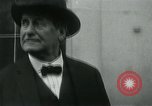
Montage of scenes with William Jennings Bryan
Some restrospective scenes with William Jennings Bryan, assembled after his sudden death in Dayton, Ohio, shortly after the celebtrated "Scopes" trial in 1925. Bryan speaking in front of a residence. (Slate notes he ran for Presidency three times, and was Secretary of State in cabinet of President Woodrow Wilson.) Bryan wearing a cloak and hat, walking on a rainy day, in a city. Automobiles parked at the curb in the background. He smiles, stops and removes his hat to pose for the camera. Next, a closeup of Bryan, bareheaded. Scene shifts to New York City, in 1924, where Bryan stands with his brother, Charles W. Bryan, former Governor of Nebraska, who was nominated as Vice-Presidential candidate during the Democratic Party Convention. William Jennings Bryan conducting one of his weekly Bible classes and Sunday Sermon, to a large outdoor audience, from a stage, in Royal Palm Park, Miami, Florida. Closeup of him gesticulating as he speaks. Bryan and members of his family standing on the bayfront balcony of his residence,“Villa Serena," on the occasion of a visit by former U.S. President Warren G. Harding, who stands behind several Bryan grandchildren
Audio only. Executive Morton T Jones talks about his role as a businessman and his belief in God on a radio program in the U.S.
Audio only. 'This I Believe', Radio Network Program. Essay on an insurance executive, Morton T Jones. He was in the insurance business all his life. After graduating from the University of Missouri and serving in World War I, he joined his father and brothers at the RB Jones and Sons Insurance firm. He then became the managing director of the same firm. In 1929, with other businessmen he organized the Kansas City Fire and Marine Insurance Company. Morton also served as President of the Kansas City Chamber of Commerce. He talks about his role as a businessman and a church song that helps him deal with his daily problems. He states his firm belief in God and how that faith and wisdom guides him. He also talks about the importance of the human element in companies and quotes Winston Churchill.
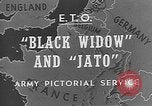
World War II. USAAF P-61 'Black Widow' night fighters in Europe. U.S. Navy testing of JATO on several aircraft in the USA
A short U.S. Army feature entitled,"Black Widow" AND "Jato." Introduction is overlayed on map of Europe. Opening sequence features P-61 Black Widows of the 422nd Night Fighter Squadron, stationed at Florennes/Juzaine (A-78), Belgium, during World War 2, Some of the aircraft are identifiable: P-61A 42-5577 (later nicknamed "Tactless Texan") and "Wandering Wench" (P-61A 42-5590). Narrator states their mission is to intercept German "flying bombs." Mixed footage of P-61s at various places and times, includes some with D-Day invasion stripes. Separate JATO-related footage features USN personnel fitting jet-assisted takeoff bottles on a Grumman F6F-3, possibly at NAS Patuxent River facility, Maryland. Later sequences show a JATO takeoffs by a Douglas SBD, and an F6F-3; and normal takeoff by a Grumman TBF, and a JATO takeoff by a Grumman F4F.
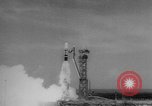
NASA Gemini program achievements in 1966, including astronauts walking in space.
NASA Lunar Orbiter 2 takes off to photograph areas of the moon, on November 6, 1966.The space ship in space. Scientists work reviewing film and photos of potential landing zones for man's future attempt to land on the moon (stated as a 1970 goal by the narrator), as part of the Apollo program. Next part of clip shows scenes from NASA Gemini missions in 1966. Space walk by astronauts tied with a tether to the space ship. Astronauts docking with Agena Target Vehicles. Astronauts David Scott and Neil Armstrong welcomed after their return from space at conclusion of Gemini VIII (Gemini 8) mission. They emerge from a helicopter and walk on a deck. Narrator mentions that in same year a U.S.-Russian space treaty was signed for disarmament of space.
CRITICALPAST.COM: About Us | Contact Us | FAQs - How to Order | License Agreement | My Account | My Lightboxes | Shopping Cart | Advanced Search | Featured Collections | Website Terms & Conditions | Privacy Policy ©2026 CriticalPast LLC.
License Agreement |
Terms & Conditions |
Privacy Policy
©2026 CriticalPast LLC.