


 Francais
 Deutsch
 Italiano
Refine Your Search
Nevada United States 1936 stock footage and images
- Showing 21025 to 21030 of 27248 results more
more Hide
Hide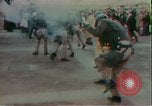
U.S. President Richard Nixon works to solve several domestic and international problems during his tenure as the President.
From a pro-Nixon "documentary" called "The Nixon Years: Change Without Chaos" covering President Richard Nixon's first four years in office. Released during his 1972 reelection campaign. U.S. Police clash with demonstrators at an anti-Vietnam war protest. A U.S. soldier in Vietnam firing a machine gun into the jungle overgrowth. People burning Vietnam draft cards. Ground and aerial views of riots in Washington DC with burning buildings and smoke rising in neighborhoods beyond the U.S. Capitol. A middle aged American woman yells "What nerve! This is America?" Nixon speaking at a campaign rally of Richard Nixon during Presidential elections of 1968. Nixon with his family stands on a stage at a public meeting. He addresses and large crowd of spectators applaud. Nixon walks on the ramp of U.S. Air Force One aircraft (which he called The Spirit of 76) after being elected as the President. Nixon confers to settle the cold war situation aboard. U.S. soldiers march during an operation in Vietnam war. Nixon works in his office to bring down the cost of living and inflation. U.S. Secretary of State Dr. Kissinger and others meet at Paris Peace Conference to talk about the Vietnam war. While addressing the Congress Nixon proposes his initiatives for betterment of civilians. Nixon signs a bill in Congress. He visits the U.S. troops involved in Vietnam. A large number of troops withdrawn from Vietnam. Friends and relatives of American soldiers and sailors receive them with warmth as they return from Vietnam. Happy friends and family at a port kiss and hug soldiers returning from Vietnam.
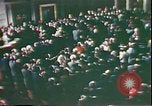
U.S. First Lady Patricia with her daughters Julie and Tricia at the U.S. Congress and walks on a beach with President Nixon.
U.S. First Lady Patricia Nixon as a public figure and as a companion of President Richard Nixon. Pat Nixon with her family watches a session of U.S. Congress in process (A State of the Union address). Nixon daughters, Julie and Tricia sitting in the stands watch the proceedings of the Congress. She walks on a beach with her husband President Richard Nixon.
American invasion of French Africa during World War 2
General Dwight D. Eisenhower, Secretary of State George Marshal and other officers prepare the strategy for American invasion during World War II. America invades French African territories. Bombs dropped over the area.
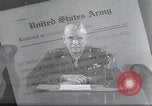
U.S Army Lieutenant General Brehon Somervell urges all Americans to contribute to war effort during World War II.
U.S Army Lieutenant General Brehon Somervell gives radio address to all Americans early during World War 2. He cites the early defeats being suffered by America and its allies in the struggle against the Axis Powers worldwide. He emphasizes the importance of Americans devoting all their efforts to work for the war effort, and exhorts everyone to avoid anything in their civilian life and pursuits that might impede the Nation's war efforts. He states that if things go unchanged, it will be too late to save ourselves and America and civilization. He notes there is no room for any interest groups whose interests and actions might weaken America's war efforts. He appeals to all Americans to back up their fighting men.
Member of the U.S. Army Parachute Team demonstrates free-fall (sky diving)
A U.S. Army AT-19 aircraft seen in flight, as viewed from another airplane. Scene shifts to cabin of the AT-19, where a soldier in helmet and parachute leans out of the doorway. He steps from the aircraft and begins a long free-fall, photographed from several different viewpoints. Narrator states such free-fall activity is routine for members of the U.S. Army Parachute team. The parachutist opens his chute and maneuvers skillfully. View, from camera on the parachutist, shows rapid approach of the ground.
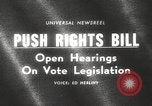
U.S. President Johnson and A.G. Katzenbach present Voting Rights Act draft bill; scenes from third Selma to Montgomery march.
Exterior view of White House in Washington DC with a light covering of snow on the ground. Interior view of White House with U.S. President Lyndon Baines Johnson as he signs a letter to legislators urging quick passage of the Voting Rights Bill in Washington DC. U.S. President Lyndon Baines Johnson and U.S. Attorney General Nicholas deBelleville Katzenbach seated at a desk. The Attorney General briefs the press about the bill. Journalists take notes about the proposed bill. Scenes from the third Selma to Montgomery Civil Rights March, beginning on March 21, 1965. African American civil rights leader Dr. Martin Luther King Jr. and other activists, including John Lewis seen marching arm-in-arm at different parts of the parade route, including past the state house in Montgomery, Alabama. Martin Luther King Jr. prepares to address marchers in Montgomery regarding a meeting he had to plan future marches. John Lewis also on the scene.
CRITICALPAST.COM: About Us | Contact Us | FAQs - How to Order | License Agreement | My Account | My Lightboxes | Shopping Cart | Advanced Search | Featured Collections | Website Terms & Conditions | Privacy Policy ©2026 CriticalPast LLC.
License Agreement |
Terms & Conditions |
Privacy Policy
©2026 CriticalPast LLC.