


 Francais
 Deutsch
 Italiano
Refine Your Search
Nevada United States 1936 stock footage and images
- Showing 21037 to 21042 of 27248 results more
more Hide
Hide
Various American activities enumerated and tracked by Census Bureau
Pedestrians walking in a city where Cranes and high rise buildings are under construction. Sign announces sidewalk temporarily closed. Children playing in a school yard. Temporary additional classrooms at a school. A college campus. Aerial view of large scale development and construction activity in a Southern State. A large boring machine working. A construction machine at a tunnel entrance. A BART (Bay Area Rapid transit) train in San Francisco.

U.S. Navy Dr. Walt Miner discusses the harmful effects and brain damage caused by LSD (Lysergic acid diethylamide) drug.
Harmful effects of illegal drug LSD (Lysergic acid diethylamide) on human body. U.S. Navy Doctor Walt Miner explains the immediate effects of LSD drug abise on human body. He states that intake of LSD by a person can change his way of thinking, his goal, his judgment and his brain. He speaks that a person who has taken one dose of LSD can not make a major decision for at least three months. Dr. Miner explains how LSD damages human brain and results in abnormal genes. He also speaks about LSD takers giving birth to abnormal child.

U.S. Navy Dr. Walt Miner discusses harmful effects of LSD (Lysergic acid diethylamide) drug from navy's point of view.
Details harmful effects of illegal drug LSD (Lysergic acid diethylamide) on human body. U.S. Navy Doctor Walt Miner speaks about mental symptoms of LSD from navy's point of view. He states that after one dose of LSD, a person can have full intensity recurrence of all LSD symptoms without taking anymore LSD. He speaks about documented cases when LSD recurrences happened. He summarizes the causes for these recurrences. Dr. Miner says that a man in navy who takes LSD can not be considered reliable.

U.S. recruits being classified for assignments and being informed about the progress of World War II and why they fight.
New U.S. army recruits seated at benches in the classification center, taking notes, as an instructor at a blackboard tells them how to fill out their classification questionnaires, during World War 2. View of machines processing the questionnaires. Hollerith 88 column punch cards being sorted by machine. Newspaper article about the Air Force efforts to improve classification and assignments of new airmen. A recruit being counseled. An Airmen in barracks, filling out a post card form to complain about his assignment. Servicemen working with sewing machines and at long cobbler's benches repairing shoes. U.S. soldiers in pith helmets, laying communications cable from a truck. A soldier recording information about a shipment of supplies. Soldiers filling 5-gallon "jerry cans" with fuel from a hose. Others serving at a communications center in woods. A soldier fastening a cable to a tank. Soldier standing on a truck. Large group of soldiers gathered to listen to a lecture about explosives. Army draftsmen at their work tables. Soldiers using information and training materials.(Narrator states these materials are often ignored.) An army newsmap for Monday, August 31, 1942 posted on an Army office wall. A sergeant points to July, 1943, on a current calendar next to it, illustrating that the newsmap is long out-of-date. View of another news map and narrator notes they are produced weekly. An officer speaking to an auditorium of soldiers. A soldier arranging his personal gear. Infantry on field maneuvers, firing rifles as they advance across a field. Soldiers firing a Browning water-cooled machine gun; a mortar; and a 105mm M101A1 howitzer. The sergeant using a newsmap to brief his staff about the progress of the war. Opening frames of a War Department Film Bulletin, and soldiers in a theater, watching the film. Opening frames of the film,"Why We Fight," that goes on to show animated map of the German advance across Europe in World War 2. Scenes of German forces on the move, towing artillery, riding on tanks, and entering towns as they invade countries of Europe. Women and children running in streets under bombardment, and civilians fleeing from their homes during aerial bombing. A Bombed out city and civilian corpses lying on the ground. Women in Poland, identifying their dead and grieving over them. German Heinkel He 111 aircraft dropping bombs. Norwegians evacuating the city in trucks, and other vehicles and on foot, during the German invasion. A squadron of German Messerschmitt Bf-109 aircraft in flight. German Ju-87, Stuka dive bombers diving on targets. Civilians rushing to a bomb shelter, and other refugees boarding a truck to evacuate. More He-111 bombers dropping bombs. A Ju-52 trimotor transport (type used to transport German paratroopers). Buildings ablaze in a town. Large formations of German aircraft of various types flying overhead. Building destroyed and burning from bombing. Ju-87s flying close past the camera.
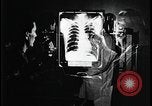
Enactment: Physician tells Native American Indian youth that he has tuberculosis (TB) and must visit sanitorium to recover
Native American Indian actor, playing role of a youth at a boarding school, reviews his chest X-ray with the physician who points out a spot on his long due to tuberculosis. The boy objects, stating that he feels well. The doctor tells him he should go to a sanitorium to recover. The next scene shows the boy sitting in a bed at the sanitorium, having his dinner tray brought by a nurse.
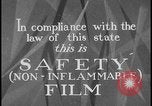
Slate announcing that a movie is printed on Safety Film
Brief view of a slate at start of a movie film that reads: "In compliance with the law of this state, this is SAFETY (NON-INFLAMMABLE) FILM."
CRITICALPAST.COM: About Us | Contact Us | FAQs - How to Order | License Agreement | My Account | My Lightboxes | Shopping Cart | Advanced Search | Featured Collections | Website Terms & Conditions | Privacy Policy ©2026 CriticalPast LLC.
License Agreement |
Terms & Conditions |
Privacy Policy
©2026 CriticalPast LLC.