


 Francais
 Deutsch
 Italiano

Refine Your Search
Nevada United States 1936 stock footage and images
- Showing 21043 to 21048 of 35682 results more
 Hide
Color Sound

Diplomats from many nations at the Embassy of Saudi Arabia meet King Saud in Washington DC.
King Saud during a visit to Washington DC. U.S. Vice President Richard Nixon hosts a luncheon for the King, at the Washington Hay- Adams hotel (800 16th St NW, Washington, DC 20006, United States). United States Under Secretary of State Herbert Hoover Jr. is in the receiving line. Reception in the Saudi Arabia Embassy. Vice President Nixon and Mrs. Pat Nixon meet the king. Diplomats also meet King Saud at the Saudi Arabian embassy. Photographers take pictures. An Arab staff member holds a sword. Mrs. Janet Dulles, wife of Secretary of State John Foster Dulles, shakes hand with the King. United States Ambassador to Saudi Arabia, George Wadsworth talks to the King. A friend from the United States Air Force shakes hands with him. Sam Rayburn, Speaker of the United States House of Representatives, shakes hands with the king. Children of Saudi Ambassador, Sheik Abdullah al-Khayyal, are brought in to meet their monarch. The King holds a child.
Allied forces commence operations crossing the Ruhr River in Germany during World War II
On February 23, 1945, Allies commence operations to cross the Ruhr River in Germany, during World War 2. U.S. artillery soldiers fire 155mm guns from West bank of Ruhr River, against German lines on the East bank. Troops of Allied 1st and 9th Armies await signal to follow advance platoons that crossed the Ruhr earlier. Compelling close-up views of serious expressions on faces of U.S. Army soldiers as they prepare to move forward. M4 Sherman tanks fire guns at the river edge. Through misty conditions, troops of 104th Infantry Division, 415th Regiment, carry assault craft and begin crossing the river and attacking the industrial area of North Duren. U.S. soldiers are seen running across fields near large factory buildings and firing from them. Troops walk along street in Duren, after its capture. U.S. troops seen entrenched. A medic adjusts his personal flotation belt. Two U.S. Army soldiers smoking cigarettes while standing in a ditch with flotation devices around their waists as they wait the moment for the river crossing. They leave their positions and move along a road to cross the river at Linnich. All soldiers are wearing personal flotation belts as they paddle small assault boats across the swift moving river under enemy fire. One assault boat is overturned. Drenched soldiers make it to land and continue their advance. Army engineers construct a floating footbridge, under enemy fire. A soldier runs across the bridge as an American light airplane flies low overhead, surveying the operation. U.S. troops move through destroyed towns and villages. Large column of captured German prisoners of war is marched toward the rear, with arms held above their heads, passing by giant piles of debris and wreckage from bombing of the town.
The Battle of Iwo Jima in World War II
Scenes filmed by Navy and Marine combat photographers, of the Battle for Iwo Jima, in February and March, 1944, during World War 2. View from a boat offshore, of Mount Suribachi, on the Island of Iwo Jima. Warships of the U.S. 5th Fleet attack with naval gunfire, as landing craft manuever near shore. U.S. Marines aboard Landing Vehicles Tracked (LVTs) head for the beach, with the heavy cruiser, USS Baltimore (CA-68) in the background. U.S. Carrier-based Grumman TBF Avenger aircraft drops bombs on Mount Suribachi. Landing craft arriving at a fairly level area of beach. U.S. marines moving cautiously on the beachhead. The USS Baltimore and a Fletcher class destroyer offshore in background. Marines hunkered down with smoke rising near them, and then moving forward again, through the black sands. Closeup of a marine with flame thrower. Several U.S. Chance Vought F4U Corsair aircraft fly overhead, dropping bombs on the mountain. Marines continue to move forward, under constant fire from Japanese small arms. A heavy landing craft Infantry, LCI(H) moves toward shore in background. A DUKW ("Duck") coming ashore. Marines using a crane to offload a 105mm howitzer from a landing craft. As they raise the gun, the landing craft moves away and marines Hook the howitzer to a DUKW to help move it. Next, marines are seen setting up two 105s on the beachhead and firing them. Marines with more artillery pieces stacked on the beachhead. A gunboat, LCI (G), firing from close to the shore behind them. Marines digging in sand that the narrator calls the floor of an active volcano. Smoking sulphur gases are seen rising behind them. The USS Baltimore firing her guns from close to shore. Machine gun tracer rounds crossing the beachhead, as Naval gunfire resumes from offshore. Marines crawling and then occasionally sprinting forward across the sand dunes. (One carries a stretcher.) Four marines carrying one wounded back to the beachhead, on a stretcher. Two marines carry another between them. Marines scrambling over brush and rough ground. View from hillside of marines climbing up from below, as shell bursts only a few yards away. Scene shifts to later in the battle for Iwo Jima. A catapillar tractor is parked near bodies of Japanese soldiers strewn across the landscape. (Narrator notes that more than 14 thousand such dead had been counted by March 6, 1944.) Finally, the iconic moving images of U.S. marines raising the American flag over Mount Suribachi.
Scenes of American forces in France at conclusion of World War I, Christmas gifts, and immediate postwar period
Several u.S. Army soldiers of the American Expeditionary Forces (AEF) stand near three French children, outside a church building in France, during World War 1. A large relief of Christ on crucifix is displayed on the wall behind them. One soldier kneels down next to the children and gives them some chocolates. He talks with them. Closeup of the children eating their candy. A boy wipes his hands on his sweater. The children make circles on their tummies, indicating that the food tasted good. New sequence shows American Army of occupation troops celebrating Christmas, 1918, at Montabaur, Germany. They are assembled at a hillside, around a platform holding a monument and statue. A large decorated Christmas tree is set up on one side of the monument, and an Army brass band stands on the other side. Captain William A. Turner, of the Salvation Army, dressed as Santa Claus, hands out gifts to some of the soldiers, assembled in the foreground. There also appear to be some local German people gathered to the far right, of the brass band. Next, "Santa Claus" is seen throwing gifts out to the gathered soldiers. Scene shifts, again, this time to several U.S. Navy dreadnought battleships that might be returning troops from Europe back to the United States. The first seen is a two-stacker, Florida-class; the second is the USS Pennsylvania (BB-38) and the third is the two-stacker USS New York (BB-34). Final sequence shows U.S. Secretary of the Navy, Josephus Daniels, and Secretary of War, Newton D. Baker, in top hats, stand on deck of a ship with with its Captain (a U.S. Navy Commander) to review U.S. Battleships returning from service with the British fleet in World War 1. The dim image of a battleship is seen in the background. (World War I; World War 1; WWI; WW1)
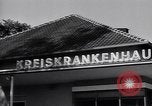
US Army soldiers in Germany after World War 2 and participation in German culture
Sign on German hospital building reads 'Kreiskrankenhaus' (Town Hospital). United States Army blood donors in the German hospital. Nurse in hospital examining room greets soldiers. American soldiers play with homeless or orphaned German children. A German Porsche car in a car race with obstacles, attended by Americans and Germans. A Center for German youth in Stuttgart sponsored by U.S. Seventh Army and VII Corps. Army Soldiers supervise German youths in handicrafts; table tennis (ping pong); baseball, with players wearing "Phillies" uniforms; miniature car racing (Soap Box Derby). American Major General visits Boy Scout encampment. (General wears 11th Airborne patch on his uniform.) Scout leader wears Tyrolean hat. Boy Scouts cooking and eating food. Rural Town of Kirnbach, Germany, invites U.S. Army soldiers as guests. U.S. Army soldiers including an African American soldier exiting a bus on arrival in town. Musicians in band playing at a gathering. Views of groups of German citizens, including children and elderly, men and women, in the town. The U.S. soldiers share in various local cultural activities and dine with local people. View of plate of food and glasses of beer. View of poster promotion Berlin Philharmonic Orchestra concert in February 1949 under the baton of Paul Hindemith. U.S. Army musicians join in rehearsal of an orchestra (possibly the Berlin Philharmonic Orchestra?), with an unidentified conductor (possibly a young Herbert von Karajan?), playing instruments and rehearsing a Mozart composition.
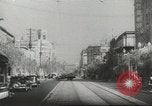
Japan in final mobilization on the home front during World War II
Street scene in Japan, as Allied Forces make progress toward Japan in World War 2. Cartoons posted to remind Japanese citizens to avoid talking about military matters. Government leader speaking to citizens about the "oratorical conquest of the foe." Camera pans across his outdoor audience. Next, tickets sold in a State Lottery to help pay for the war, are dumped into a tumbler, turned with hand cranks by two men. View of spectators waiting for the outcome as winning tickets are drawn. A man and a women saying farewell to their respective sailor sons, as they prepares to depart for duty. A troop train leaving a station as loved ones wave goodbye to departing servicemen. Next, large crowd of well-wishers wave from shore as the Japanese battleship Aki steams away. Closeup of crew members aboard the ship. Closeup of women pointing and waving from the shore. Views from a boat full of civilians, of the Aki making way in the harbor behind another three-funnel warship. Change of scene shows Emperor Hirohito with officers on horseback, reviewing and saluting Japanese army troops. Views of many Japanese soldiers marching in formations. Change of scene to U.S. Iowa class battleship viewed from overhead, and then to several U.S. battleships heading past the Golden Gate Bridge in California, on their way into the Pacific ocean. Aerial view of the battleships underway in single line formation. The U.S. Destroyer USS Porter (DD-356) passing several other U.S. warships. A Douglas Dauntless dive bombers brought up on the deck of a U.S. Yorktown class aircraft carrier. Navy armorers working on the deck of the carrier, moving bombs and machine gun ammunition. Tail view of the carrier from an aircraft taking off. Aerial view of a U.S. armada of warships and aircraft underway over the ocean. Aerial view of Mount Fuji in Japan.
CRITICALPAST.COM: About Us | Contact Us | FAQs - How to Order | License Agreement | My Account | My Lightboxes | Shopping Cart | Advanced Search | Featured Collections | Website Terms & Conditions | Privacy Policy ©2026 CriticalPast LLC.
License Agreement |
Terms & Conditions |
Privacy Policy
©2026 CriticalPast LLC.