


 Francais
 Deutsch
 Italiano
Refine Your Search
Nevada United States 1936 stock footage and images
- Showing 21073 to 21078 of 27248 results more
more Hide
Hide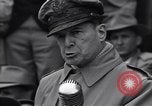
Douglas MacArthur, General of the Army, criticizes U.S. Government post-World War 2 policies, during a speech in Mississippi
General of Army, Douglas MacArthur, speaking on the steps of the Mississippi State Legislature, addresses a joint assembly of the Mississippi State Legislature, and citizens, in Jackson, Mississippi. MacArthur emphasizes that charity begins at home. He questions the merits of America spending billions to fight communism abroad. Further, he questions the commitment of European nations to fight against communism. He notes that the U.S.A. had spiritual leadership of the world, backed by the greatest military power in history, at the end of World War 2. But he claims the U.S. dissipated that power, by betraying Nationalist China; and permitting the Soviet Union to expand into Eastern European countries; while American disarmed and demobilized.
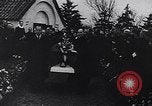
Denmark under German martial law during World War II
Film made by Danes, after increasing tensions between them and German occupation forces that invaded Denmark in 1940, boiled over in August 1943, and the Germans placed Denmark under martial law. It covers the period 1943 and 1944, after which the film was smuggled out of the country. Opening scene shows pallbearers at the funeral of Kaj Harald Leininger Munk (aka Kaj Munk) a Danish playwright and Lutheran pastor, who was assassinated by Nazi Gestapo agents, on 4 January, 1944. Narrator states that Nazi murder leagues assassinated some of Denmark's greatest leaders to intimidate the Danes and quell any rebellions. The coffin of Pastor Munk is lowered into its grave. Memorial stone and flowers are shown. Smoke rising and then a large conflagration are seen, from Danish acts of sabotage. Damaged buildings and more fires, from Danish resistance, are seen. In response, the "Schalburg Corps," a Danish volunteer branch of the Nazi SS, began counter-sabotage (called Shalbotage by the Danes). Film shows fireman on ladders at the building of the Paramount Movie Company, Ltd. where smoke is coming from the windows. (Narrator says film companies that refused every form of collaboration were blown up.) View of severely damaged Nordisk film studio at Helerup. Windows shattered in department stores and in all shops along a street. Illums Bolighus (famous store of Scandinavian design) and many others are wrecked. Camera pans up the side of damaged building with bird painted on its side and the words: "mod lysere Dage.." (Brighter Days). Views of the destroyed Royal Yacht Club pavilion, in Copenhagen harbor. Destruction in Tivoli Gardens. Its concert hall completely destroyed. Fire burning at the Syndicate, Denmark's largest armaments factory, from bombing by saboteurs, in June, 1944. Danes walking in Copenhagen, on a summer evening, flaunting the Nazi curfew from 8PM to 6AM and then lighting bonfires after dark. Abandoned wheel barrows and empty streets are shown when residents of Copenhagen all go home in a general strike. Several German soldiers are seen in otherwise empty street, as the German Commander in Chief declares the city of Copenhagen under siege. A German tank parked in the street amidst pedestrians. Barricades set up by strikers in a street. The American flag flying high over a street. The "Bulldog" a department store in flames. A car serving as an ambulance drives down a street displaying a white flag. A long line of Danes wait at a street corner shop for self-rationed food. Danes drawing fresh water from lakes to be brought to hospitals, where needed. View from above of strikers at a barricade. Narrator states that after 5 days, the Germans gave in and agreed to Danish terms. View of open area in the city, where people stand in silence to commemorate those who lost their lives in the struggle. Danish man looking through chain link fence. More scenes of continued sabotage by Danes.
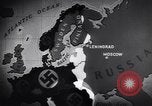
German Operation Barbarossa on the Eastern front in World War II
Animated map shows extent of German controlled areas in Europe following their conquest of the Balkans in World War 2. Norway is under their control and German forces threaten Leningrad and Moscow. A soviet defense line is shown on the map. The German attack is shown to come from 5 directions on June 22, 1941, with the launch of German Operation Barbarossa. A sky filled with German Heinkel He 111 bombers is shown. German Panzer III tanks with 75 mm guns. Army trucks carry German troops into battle. German soldiers on motor cycles and infantry advance under fire. Animated map shows principal German targets as Leningrad, Moscow, and Kiev. It then shows beginning a drive from the North to encircle Leningrad. Arrows show where German Marshal Fedor von Bock's forces drove 480 miles into Soviet territory. Slates identify cities being overrun by German invaders, including: Pskov, Novgorod, Brest-litovsk, Minsk,Mogilev, and Vitebsk. On July 17, 1941, a German tank is seen entering Smolensk, past the Dnieper River threatening Moscow, itself. To the south, German forces, under Marshal Gerd von Rundstedt, cut deep into the Ukraine. Newspapers world-wide consider the Soviet forces close to defeat. Slate shows communique from the German High Command stating: "The issue in the East is already settled. Smolensk is the last halt on the road to Moscow." German infantry marching. Scene shifts to heavy artillery being fired by Soviet forces in a snowy scene clearly later in the year. Animated map shows German forces very close to Moscow on October 15, 1941, forcing the Soviet Government and all foreign missions to move to Kuibyshev, 700 miles to the east. Adolf Hitler, in a speech on October 3, 1941, states that the enemy is broken and will never rise again. Animated map shows 500 thousand square miles of Soviet territory occupied by German forces. Views of fires burning in Russia. Damaged and abandoned Soviet industrial plants. A German guard atop a hill looks down on thousands of Soviet people in the occupied areas of Russia. Damaged and abandoned Soviet T-26 tanks. Glimpse of damaged Soviet aircraft and field artillery. Headline in New York World Telegram newspaper reads: "Berlin Admits Russ War May Last Winter." Another headline reads: "Red Army Holds Push On Moscow." Weary German soldiers traveling in horse-drawn wagons, pulling field artillery. Soviet and German war planners are seen at work. Slate quotes Adolf Hitler saying: "A single blow must destroy the enemy, without regard for losses... A gigantic all-destroying blow." German armor moving along a road. Animated map shows this technique in the German invasions of Poland, France, the Balkans, and Yugoslavia. In contrast, the Soviet planners are seen, as map illustrates how they intend to take advantage of the vast area of their land by holding lines of defense an falling back as necessary to keep engaging the invaders across interior of the Soviet Union. Soviet infantry are seen marching along a road. German troops riding atop their tanks. Soviet troops forcing German invaders into close combat in her cities. Soviet soldiers running in a city and firing heavy machine guns. Bomb damage and rubble inhibit German armor mobility in cities. Cities where this kind of Soviet resistance prevailed were: Rostov, Kharkov, Kiev, Kursk, Smolensk. German troops leaving a city with heavy black smoke rising in the background. More views of cities where Soviet troops are engaged German forces in House-to-house battles, including: Odessa, where the Old Opera Theater building is shown sandbagged and relatively undamaged. The Odessa NI tank, created from an STZ-3 agricultural tractor.
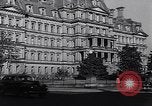
British, Soviet and U.S. officials meet and discuss industrial, agricultural and civil rebuilding of Germany after World War II.
Industrial, agricultural and civil rebuilding of Germany after World War II. State Department building in Washington DC. Secretory of States, James F. Byrnes dictates to secretary. General Luicius D Clay speaks to the members of British Occupational government. Ernest Bevin, Vyacheslav Molotov and James F. Byrnes pose for a group photograph. German farmers in an agricultural field. Men and woman plow farm by horse cart. Worker watches a factory kiln with molten metal. Cavaliers of American Military Police on horse back patrol on the streets in Germany with a destroyed cathedral in the background. They cross a bridge with sign Herkules Bridge. German workers make farm equipment and a German family with young children eats a meal.
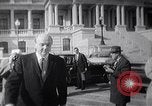
President John Kennedy addresses citizens of America about the Soviet military buildup and Soviet missiles on island of Cuba.
Early in Cuban Missile Crisis. Secretary of State, Dean Rusk, Vice President Lyndon Johnson, and other of President John Kennedy's advisors arrive at White House. Americans buying newspapers with headlines about the upcoming speech by the President. President Kennedy addresses citizens of America on television, explaining what has been happening in Cuba. U.S. citizens commenting in different manners on the situation. Civil defense shelters shown. Cuban blockade. Supermarket shelves stripped and queues at check outs. Governor Rossolini and Governor Rockefeller at White House to coordinate state civil defense activities. Comments by the governors to the press, talking about civil defense procedures and instructions for sheltering in place with food, water, geiger counter, radio.
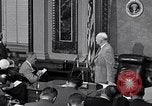
Press Conference at White House where President Dwight Eisenhower answers questions regarding segregation disputes.
During Civil Rights movement in America. Press corp taking notes. A reporter asks President Eisenhower to comment on aspects of State-Federal responsibility in the segregation disputes relating to incident just a day before in Texarkana when the town did not allow two African American students into the school where they had registered. The reporter asks if the President thinks that is a case where the federal government would become involved. President says that Federal District Court can call in Justice Department to bring evidence, review the case, and determine if a party is in contempt of a federal circuit court order regarding integration. The President also decries the violence that occurred in Texarkana in the case. He implores the states to ensure the laws are followed and to follow rulings of the courts. He praises the integration work by school Superintendent Omer Carmichael in Louisville, Kentucky, over two years. Close up view of hand of a reporter writing notes in a notebook during press conference. A reporter from National African American Press asks question to President regarding segregation and regarding the President's statement that changing of traditions and the hearts of men will unfortunately take a long time, is not the solution of the present disorder in many parts of the south over desegregation, that citizens must be restrained from expressing their prejudices in public actions when such public actions are in violation of the law. President Eisenhower says that the local court must determine if someone is in contempt of that court.
CRITICALPAST.COM: About Us | Contact Us | FAQs - How to Order | License Agreement | My Account | My Lightboxes | Shopping Cart | Advanced Search | Featured Collections | Website Terms & Conditions | Privacy Policy ©2026 CriticalPast LLC.
License Agreement |
Terms & Conditions |
Privacy Policy
©2026 CriticalPast LLC.