


 Francais
 Deutsch
 Italiano

Refine Your Search
Nevada United States 1936 stock footage and images
- Showing 21067 to 21072 of 35682 results more
 Hide
Color Sound
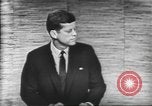
During a presidential election debate in Washington DC, Kennedy comments that its proper to express regrets to nations.
The second Kennedy-Nixon Presidential Debate in Washington DC, United States . Edward P. Morgan of ABC News asks Democratic candidate Senator John F Kennedy about sending apologies or regrets to General Secretary of the Communist Party of the Soviet Union Nikita S Khrushchev over the U-2 reconnaissance aircraft incident. Kennedy answers that if it could save the summit conference it would have been proper to express regrets. He speaks that the U-2 flights were proper from the point of view of protecting their security. But they were not in accordance with the international law. He speaks about the regrets expressed to Castro, to Southern Russia and to Eastern Germany under the Eisenhower Administration during the past years. He mentions the regrets expressed by the Soviet Union and the Chinese Communists to the U.S. over incidents. He states about they should have a stronger military force and should increase their strength all over the world. Republican candidate U.S. Vice President Richard M. Nixon presents his views and states that Senator Kennedy is wrong in thinking that Khrushchev might have continued with the summit conference if the U.S. had expressed regrets. He disagrees with Kennedy's analogies that the U.S. is a strong country and can express regrets for any wrong doings. He also disagrees in expressing regrets to anybody for doing things which has the support of the Congress and which is right from point of view to protect the security of the U.S. (This 4 part debate is sometimes called the Great Debate)
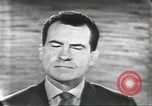
Nixon and Kennedy comment on the Cold War and Communist prestige during a presidential election debate in Washington DC.
The second Kennedy-Nixon Presidential Debate in Washington DC, United States. Edward P. Morgan of ABC News asks Republican candidate U.S. Vice President Richard M. Nixon to comment on whether the United States was doing well in the Cold War. Nixon states that they were not doing as well as they should have in the Cold War because of the presence of the Communists on the international scene. He says that the Communist prestige in the world is lower than the American prestige. He comments on cost cuttings on programs like mutual security and defense by the Democratic Congresses. Democratic candidate Senator John F Kennedy disagrees with Nixon's statement that the Congress has not provided funds for national defense. He also disagrees on the question of U.S. position in the United Nations. He mentions that various reports of Congressional committees indicate that the relative strength of the U.S. compared to that of the Soviet Union and the Chinese Communists together has deteriorated in the past years. Alvin Spivak of United Press International asks Kennedy how the losing prestige can be regained, and programs accomplished without damaging economy. Kennedy talks about the breaking off of the sugar quota with Cuba, passing of an authorization, and the development of the Inter-American Bank. He states that the U.S. has looked at the needs of Latin America. He states that instead of concentrating aid on surplus military equipment in Laos, the aid should have been concentrated in long-term loans. He concludes that Americans should identify themselves not only with the anti-Communist fight but also with the fight against poverty and hunger. Nixon presents his views and states that along with the necessity for economic assistance, the need for technical assistance should also be developed. Americans should not only think in terms of fighting Communism but also in terms of the interests of these countries. He concludes and mentions American ideals of independence, right of freedom and right of progress.
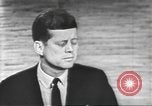
Kennedy and Nixon talk on drawing the defense line in the Far East during a presidential election debate in Washington DC.
The second Kennedy-Nixon Presidential Debate in Washington DC, United States. Edward P. Morgan of ABC asks Democratic candidate Senator John F. Kennedy to comment on whether Quemoy (Kinmen) and Matsu Islands were unwise places to draw U.S. defense line in the Far East. Kennedy states that he believes strongly in the defense of Formosa (Republic of China or Taiwan) and says that the U.S. will defend Quemoy (Kinmen) and Matsu if it is a part of a general attack on Formosa (Taiwan). He says that the U.S. should consult with the Nationalists. He states that the Americans should protect their commitments. Republican candidate U.S. Vice President Richard M Nixon states that he disagrees completely with Senator Kennedy on this point and states the example of the Korean War. Regarding Quemoy (Kinmen) and Matsu he says that these two islands are in the area of freedom and under the control of the Nationalists. He states that the U.S. should not force the Nationalist allies to get off of them and give them to the Communists because the Communists aren't after Quemoy (Kinmen) and Matsu, but after Formosa (Taiwan).
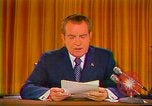
President Nixon speaks about reduction in defense budget while addressing the nation from the White House in Washington DC.
Television broadcast of U.S. President Richard Nixon's speech from the White House in Washington DC, United States on withdrawal of the remaining U.S. troops from Vietnam on 29th March 1973 during the Vietnam War. President Nixon speaks about progress that the U.S. has made towards peace and the end of the Vietnam War. He says that the United States should not reduce its defense budget. He speaks about negotiations with the Soviet Union regarding elimination of nuclear arms. He says that cutting down defense budget before the negotiations would increase the danger of war and there should be mutual reduction in defense. President Nixon says that the U.S. should maintain its strength.

Lt. Gen. Simpson escorts Robert P. Patterson and Amon Carter during a tour of XIX Corps area in Weilheim, Germany.
U.S. Army Lieutenant General William Hood Simpson escorts U.S. Under Secretary of War Robert P. Patterson in Weilheim, Germany towards the end of World War II in Europe. Forth Worth Texas newspaperman Mr. Amon Carter talks to his son Lieutenant Amon Carter, Jr., recently liberated from a German prison camp. U.S. Lieutenant General William Hood Simpson escorts U.S. Under Secretary of War Robert P. Patterson and Mr. Carter to U.S. XIX Corps area where they visit U.S. Army General Raymond S. McLain. Officers stand next to a sign : 'Truman Bridge leads to Berlin'.
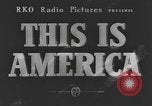
Scenes of Washington DC, and people working inside various Federal buildings and government offices in Washington DC (WW2)
A World War II documentary titled 'Boomtown DC', a part of 'This is America' series, compares Washington DC to an industrial boomtown where the big business is government. 1930's and 1940's cars parked along a tree-lined street in a Washington DC neighborhood with homes visible. A cat jumps down from a wall behind a neighborhood home, with the U.S. Capitol seen in the background. Scene changes to U.S. Capitol building exterior close up. Close up views of souvenir stand trinkets in Washington DC, including banners, snow globes, and postcards of buildings and monuments of the city. View on the National Mall in Washington DC toward the Lincoln Memorial, interrupted by temporary wartime elevated walkways erected between buildings of the rapidly expanding Navy Department on either side of the National Mall. Smoke stacks from the chimneys of a factory superimposed over various images of buildings in the city. A woman exiting a voting booth, followed by a man entering the same voting booth and closing the curtain. A US Army guard standing outside the White House. Exterior view of the newly completed Department of State building (then called "Main State" and later known as the Harry S. Truman building housing the State Department.) Exterior of the newly built Pentagon War Department building in Arlington Virginia. Sign "War Department" on the War Department building at 21st and Virginia Avenues. Exterior view of a Navy Department building, then exterior view of the Treasury Department building. Close up view of hands holding and flipping through a stack of IRS individual tax return documents, then of hands sorting through a stack of U.S. government bonds. View of the Justice Department, and then view of sign on the Federal Bureau of Investigation. Scientists in a laboratory operate various equipment and run tests. A scientist near some beakers and test tubes in the lab. Scientists look through microscopes. View of underground rifle range in the FBI building as personnel practice marksmanship. View toward shooters on the range during firing, and toward targets. US Army guard in front of the Executive Office Building (also housing some State Department functions at that time). Exterior view of the Department of Labor building and sign. View of the U.S. Office of War Information building (OWI) with sign "US Information" inscribed in large letters on the top of the building (possibly the "Temporary V Building" of the OWI?) Exterior view of the Supreme Court Building. View of Declaration of Independence document on display. Exterior view of U.S. Capitol, then view of House of Representatives in session. U.S. President Franklin Delano Roosevelt seated at a desk signs a document. Citizens and workers walking on streets of Washington DC. Some people enter the Department of Agriculture building. Men and women enter the Office of War Information. Civilian and military hats being hung on a hat rack. Hand reaches for a 1940's era telephone. Women filing papers, views of filing cabinets. Close-up of 1940s era typewriters in use.
CRITICALPAST.COM: About Us | Contact Us | FAQs - How to Order | License Agreement | My Account | My Lightboxes | Shopping Cart | Advanced Search | Featured Collections | Website Terms & Conditions | Privacy Policy ©2026 CriticalPast LLC.
License Agreement |
Terms & Conditions |
Privacy Policy
©2026 CriticalPast LLC.