


 Francais
 Deutsch
 Italiano
Refine Your Search
Nevada United States 1936 stock footage and images
- Showing 21103 to 21108 of 27248 results more
more Hide
Hide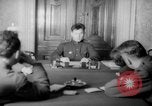
Acting Military Governor General Timofei Dudarjov is interviewed by U.S. correspondents in Germany.
Acting Military Governor General Timofei Dudarjov is interviewed in Germany. The seat of Soviet Military Government for the state of Saxony. The Acting Military Governor of the States of Saxony is interviewed by U.S. correspondents. A Russian aide and a Russian girl interpreter present. Acting Military Governor Major General Timofei Dmitrievich Dudarjov. Insignia of the Guards Regiment. His aide Colonel Ivan Feodorvitch Karnautchenko. The name of the girl interpreter is Eugenia Vasilievna. Next to the aide is Victor Bernstein of PM. Next to the interpreter is Kendall Foss of the New York Post. The General talks.
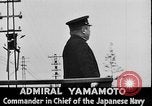
Axis powers vision for conquest at onset of World War II
Invasion plans of the Axis power in the European Theater during World War 2. Film opens, ostensibly, showing Japanese Admiral Isoroku Yamamoto speaking at a podium. (There is some question whether this is actually Yamamoto.) The U.S. Capitol and the Pennsylvania Avenue in Washington DC, with marching Axis troops superimposed as if marching in conquest. Axis troops parade in Berlin, Germany. Animated diagram shows 'divide and rule' ambitions of the Axis powers. Animation showing radio signals emanating from radio towers with propaganda and "LIES". A German speaker delivers a propaganda message from a broadcast studio in Germany. Young women are seen gathering in groups. A woman in Italy receives an award for having many sons. Group of young men and women in Italy walking arm in arm which narrator describes as an effort to boost marriages and encourage having children. Cover of "Der Hammer" magazine in which German Dr. Willband Hentschel writes: "Round up a thousand German girls. Isolate them in a camp. Then let them be joined by a hundred German men. If a hundred such camps were set up, you would have 100,000 thoroughbred children in one stroke." Next scene shows a maternity ward with many (perhaps 30 or more) newborn infants laying on a large surface and being powdered, diapered, and swaddled by a team of German nurses. Narrator states: "Of course the children from this assembly line belong to the State, to be scientifically claimed for conquest."
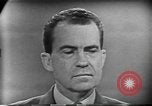
During a debate in Chicago, Illinois Nixon talks about his major recommendations which were adopted by the administration.
The first Kennedy-Nixon Presidential Debate in Chicago, Illinois. Stuart Novins from CBS News asks Republican candidate U.S. Vice President Richard M. Nixon about his major proposals in last eight years that have been adopted by the administration. Nixon answers and states that his major recommendations and proposals that have being adopted by the administration include: increase in the exchange programs like exchange of persons of leaders in the labor and information field. He further talks about his proposals like setting up of separate inter-American lending agency, his recommendations for the Hungarian refugee situation and price stability and economic growth that had been adopted. Democratic candidate Senator John F. Kennedy states his points on that question. He says that he disagrees with progress figures used by Nixon in his speech regarding the Truman Administration. He disagrees with the recommendations made by Nixon like price stability, exchange of students and labor unions being adopted by the administration.
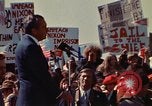
U.S. President Richard Nixon delivers a speech on important issues at Tri-City Airport in Saginaw, Michigan.
U.S. President Richard Nixon delivers a speech at Tri-City Airport in Saginaw, Michigan. Placards held by a crowd display welcome messages for President Nixon. President Nixon speaks from a podium. He summarizes problems which the people are facing in Saginaw Bay City and Michigan. He states that there is one way to keep down the cost of living and that is to keep down the cost of government. President Nixon says that only high production can cut down prices. He further talks about a health program which would provide health insurance to the citizens of the U.S. and that the program would not require new taxes. He also speaks about progress to be made in the field of education. Regarding welfare programs, he states that the country needs a welfare program where it is never more profitable for a person to go on welfare than to go to work. President Nixon says that people can always choose the right congressman.

Dramatization depicts: Angry mob outside school waiting to attack African American children in Lamar, South Carolina USA
Excerpt from a film based on the 1970 Lamar High School Bus Attack. African-American students chatting inside a school bus. School bus passing on a road. A gathering of militant white American parents in front of Lamar High School in Lamar, South Carolina (216 N Darlington Ave, Lamar, SC 29069). One African-American student looking agitated inside the school bus. The crowd angrily talk about how letting African-Americans study in the school impedes their rights. “not here, not now, not ever!” said a woman with disgust. A sign saying “Welcome to Lamar” prompts boy to say, "do you think they mean welcome?" “He ain’t gonna be in my grandson’s class!” a man says, pertaining to the possibility of African-American students studying alongside White students. African-American students become agitated as they approach Lamar. Woman wearing a headscarf and sunglasses talks about the arrival of the African-American students with indignation. Man menacingly holds a bat and say “They’ll gonna wish they was never born”. Lamar High School with state troopers guarding the front of the school. The school bus approach. Angry mob member holding baton behind his back, another mob member holding a brick. Angry mob crowd the school bus. African American students, scared, get down on the floor to avoid being hit with projectiles and broken glass from angry mob. The angry mob breaks the school bus windows. Image of state troopers outside Lamar High School. Title sequence of “The Color of Justice” with the overturned school bus in Lamar as the background.
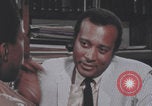
Dramatization depicts: African-American students on their way to school and aftermath of Lamar High School Bus attack in South Carolina
African-American lawyer, Frank Jackson, talks to “Cliff”, one of the victims of the Lamar High School Bus Attack in 1970. African-American children lining up in school. Dramatization depicts a mob of angry white residents, one holding a stick in his hand as a club. White woman, wearing headscarf and shades, brandishes a frying pan. Dramatization shows Lamar High School with state troopers guarding the front of the school (216 N Darlington Ave, Lamar, SC 29069). Dramatization shows some of the mob being apprehended by state troopers. African-American students laugh inside the bus. Image of Robert Evander McNair, the Governor of South Carolina from 1965-1971. Attorney Jackson speaks to Cliff about Governor McNair’s dedication to protect African-American children’s rights to go to any school. Images of Governor McNair and Chief Justice Roger B. Taney. “ Only when the rights of the constitution are surely in the hands of poor men, as well as rich men, black, brown, red, and yellow men, as well as white men, can the constitution promise justice to share its equal place in law and order,” Attorney Frank Jackson says. Closing Credits.
CRITICALPAST.COM: About Us | Contact Us | FAQs - How to Order | License Agreement | My Account | My Lightboxes | Shopping Cart | Advanced Search | Featured Collections | Website Terms & Conditions | Privacy Policy ©2026 CriticalPast LLC.
License Agreement |
Terms & Conditions |
Privacy Policy
©2026 CriticalPast LLC.