


 Francais
 Deutsch
 Italiano
Refine Your Search
Nevada United States 1936 stock footage and images
- Showing 21097 to 21102 of 27248 results more
more Hide
Hide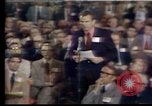
President Nixon talks about approval of entries to the Ellsberg Project during a news conference in Orlando, Florida.
A journalist questions U.S. President Richard Nixon about the Ellsberg Project during a press conference in Orlando, Florida. The journalist asks the President about the legal code of approval granted by him to the American military analyst Dr. Daniel Ellsberg's project. The President responds that he had not approved or ordered any entries in Dr. Ellsberg's office. He himself came to know about these entries on March 17th and he has also mentioned this in his statements as well. He states that he finds this not only illegal but stupid as well. He states that all these leaks are seriously damaging the national security.
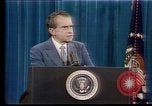
President Nixon responds to questions of journalists during a news conference in Orlando, Florida.
U.S. President Richard Nixon responds to journalists question during a press conference in Orlando, Florida. A journalist asks him whether the telephone of his brother Donald Nixon's was tapped by the secret service. The President responds that the secret service did maintain a surveillance. He states that they did it for security reasons and his brother was aware of this. Another journalist asks him whether his brother was aware of the surveillance. The President states that his brother was aware of the fact as he was asked and told about it. A journalist questions upon conducting a surveillance. The President responds that a surveillance involves other people also.
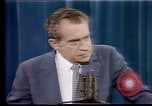
President Nixon answers to a journalist's questions during a news conference in Orlando, Florida.
U.S. President Richard Nixon responds to a journalist's questions during a press conference in Orlando, Florida. A journalist asks him whether a story will come out on submission of more facts. The President agrees to this. He states that editors had not raised questions on milk prices and the International Telephone and Telegraph Corporation. He thinks they need to be answer either through the medium of a television conference like this or by sending facts to all the editors of the nation's newspapers. He states that if editors need more information they can write to him.
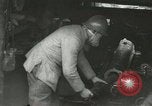
French Army troops, in Artois, France, training to use artillery against aircraft
French soldiers training in Artois, France, shortly before World War I. French artillerymen wearing gas masks, are seen inside a bunker. One loads a powder charge into a Cannon de 75 modèle 1897 field gun (So-called French 75). Slate states (in Swedish): Calculating the distance to an airship or airplane is often a very tricky task. View of French soldier, in a field, looking through a telescope, and another, nearby, looking through binoculars. The latter raises a large horn (or megaphone) and sounds it. Camera pans to two soldiers using a range finder. Closeup of aiming adjustments on a French 75 field gun. Next, gun crewmen remove shells from a protected storage caisson, buried in the side of a deep trench and other gunners load a nearby gun. Slate states that Automobile cannons constitute a very practical and effective weapon in the battle against airships. An artillery piece is shown mounted on a vehicle chassis, being maneuvered by gunners. A brief glimpse of mirror specially designed to signal to aviators.
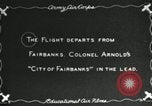
YB-10s of the U.S. Army Air Corps 1934 Alaska Flight return to Bolling Field in Washington, DC after flying more than 7000 miles.
The U.S. Army Air Corps (USAAC) Alaska Flight of 1934 departing Fairbanks Alaska on flight back to Washington, DC. Their YB-10 aircraft are seen in a line on the airfield. Spectators are at the edge of the field to see them off. Next, the aircraft are seen taxiing out for takeoff, with their Commander, Lieutenant Colonel Henry Arnold, piloting the lead aircraft, the "City of Fairbanks." Other aircraft follow in succession. Colonel Arnold's airplane takes off and proceeds in a shallow climb. Slate tells first leg is 640 miles to Juneau in 3 hours and 55 minutes. Map shows North America with outbound course to Alaska from Washington, DC, traversing the Great Lakes, Edmonton, Prince George, and White Horse, to Fairbanks. But a moving arrow shows return route via Juneau. Snow-covered mountains seen from a YB-10 on this return leg. Aerial shots of several YB-10s in formation. Slate announces next leg as 940 miles and 5 hours and 40 minutes to Seattle, Washington State. Aircraft and crews of the returning Alaska Flight, seen on a grass field in Seattle. Lieutenant Colonel Henry Arnold, expedition commander, leads his fliers across the field. Slate states remaining distance to Washington, DC, as 2700 miles and 14 hours. More shots of YB-10s in formation aloft. Shot of a YB-10 with farmland below. Ten YB-10s seen in formation, and the animated map completes the journey to Washington, DC. Aerial view from above of several YB-10s below, flying over the Potomac River, in Washington, DC, with the Lincoln Memorial, and Arlington Memorial bridge visible below. The formation of 10 planes barely visible above the Capitol building. The YB-10 named Juneau, taxiing across Bolling Field, after landing. (This segment of film is reversed, so the name and Alaska Flight logo are mirror-reversed.) The last of the 10 aircraft pulls into position on the flightline. Lieutenant Colonel Henry (Hap) Arnold stands in front of his fliers who hold a large totem pole souvenir. Secretary of War, George H. Dern, greets the returning aviators and poses next to Colonel Arnold.
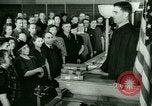
A judge administers an oath of citizenship of the U.S. to a group of people in a courtroom in Bridgeport, Connecticut.
Opening scene is in a courthouse, where a judge asks a group about taking an oath of citizenship. Members of the group raise their hands and then lower them. The judge then proceeds to have them raise their right hands and administers the oath. They repeat the words as he states them. Closeup of the judge as he administers the oath. Closeup of the persons assembled for the ceremony, raising their hands as the judge speaks, and saying "I do,"before lowering their hands. Camera in exclusive closeup of one woman as she has hand raised and states, "I Do." This last scene is repeated three times.
CRITICALPAST.COM: About Us | Contact Us | FAQs - How to Order | License Agreement | My Account | My Lightboxes | Shopping Cart | Advanced Search | Featured Collections | Website Terms & Conditions | Privacy Policy ©2026 CriticalPast LLC.
License Agreement |
Terms & Conditions |
Privacy Policy
©2026 CriticalPast LLC.