


 Francais
 Deutsch
 Italiano
Refine Your Search
Nevada United States 1936 stock footage and images
- Showing 21157 to 21162 of 27248 results more
more Hide
Hide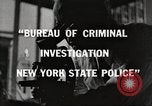
The Works Progress Administration assists New York Police to find a robber in New York.
The WPA (Works Progress Administration) project in New York. The Bureau of Criminal Investigation, New York State Police, in the Great Depression. Scientists and technicians work in a laboratory. A scientist using a microscope. A man shoots at a mannequin or dummy. A demonstration of a thief opening a safe. A sergeant and a police officer speak about the robbery. The officer speaks to a doctor about a report. The police sergeant goes to a house and interrogates a woman and a man. The man is taken to a police station for a couple of tests. Material from his fingernail is sent to the laboratory for examination. A scientist looks through a microscope. Stains on the thief's clothes checked in the laboratory. Views of vials and beakers and experiments underway in the laboratory. Newspaper headlines read 'Tom Brown found guilty'.
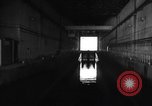
Post-World War II views of submarine pens in France. Views of New York City and harbor
Retrospective view inside a former German submarine pen in France, as narrator mentions its former use in World War 2. View from outside the structure. An American Airlines Douglas DC-4 passenger plane flying over Manhattan Island, New York City, with Empire State Building visible among other skyscrapers below. Aerial view of New York harbor, with ocean-going ships docked at terminals below. Traffic moving in the harbor, including barges, tugboats, and ships, displaying various national flags.
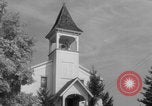
Citizens enter a church and children’s choir singing in upstate New York
People attend a church service in upstate New York. Churchgoers enter a white church building in a rural area. A man leads a children’s choir. Choir singing inside Christian church. A river in New York. Aerial view of the river, hills, and farmlands in New York state. A boat is seen sailing on a river.
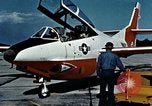
Air impingement and pre taxi check of a U.S. Navy T2J-1 Buckeye trainer aircraft.
Pre-flight inspection and pre taxi check of a U.S. Navy T2J-1 Buckeye trainer aircraft. The plane captain near the plane. Pilot in cockpit. The pilot gives the thumbs up plug in signal for air impingement. The captain takes the hose and attaches it to the plane. He checks the starting unit and returns the thumbs up signal when ready. The pilot checks and adjusts the fuel shut off valve, engine master switch, engine start switch, tachometers, advance power control lever, and the oil pressure gauge. He gives the captain the unplug signal. The captain removes the hose. The pilot now performs the pre-taxi check: radio equipment, captain removes the 3 landing gear safety pins, flaps extended, speed brakes opened, take off trim, circuit breakers and the altometer. He then conducts the inverter check, operates controls to check freedom of movement, retracts flaps and speed brakes, and closes the canopy. He calls for taxi clearance, gives the captain the signal, adjusts friction on power and control lever. The captain gives clearance, the pilot releases brakes and taxis maintaining steady speed. He completes the take off checklist before getting onto the duty runway. Receives clearance, aligns the plane and taxis. He checks the exhaust gas temperature, rpm, fuel flow and oil pressure. Raises nose of the plane off ground, raises landing gear when airborne, raises flaps, levels off and accelerates.
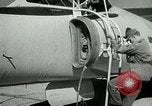
Pre-flight inspection of the U.S. Air Force F-102A Delta Dagger interceptor aircraft.
Pre-flight inspection of the U.S. Air Force F-102A Delta Dagger interceptor aircraft. The crew chief checks the air intake surfaces, nose boom, dome and holes in the tip. He inspects the forward electronic compartment, fluid tank, filler cap and access door. He checks the landing gear including tires, nose steering unit, taxi light and nose gear door. Inspection of the battery, ground safety pins, circuit breaker panel, armament door, turbine blades, hydraulic reservoirs and gauges. Inspection of the wing surfaces, wing tips and position light. The tail inspection includes the skin, navigation light, vertical stabilizer and rudder, speed brake area, tail pipe nozzle and drag chute area. The crew chief climbs onto the plane and inspects the upper surface, dorsal fin, fuselage panels, fuel intake covers and the fuse. He then climbs back down.
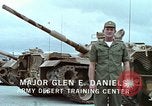
U.S. troops, armored vehicles, tanks and helicopters transported by U.S. Air Force Military Airlift Command aircraft.
Major Glen E Daniels of the Army Desert Training Centre in California. He stands in front of U.S. tanks and talks about movement of large units to combat zones by C-5 Galaxy aircraft of the U.S. Air Force Military Airlift Command. Soldiers load Cobra helicopters into a C-5. MAC C-5 Galaxy aircraft Interior of a C-5 showing two rows of M113 armored personnel carriers stowed inside. The troops accompanying them are seen climbing stairs to an upper deck of the C-5 where they will travel. Quick closeup view of a C-5 headed toward the camera during landing. Paratroopers jumping from MAC C-141 and C-130 aircraft. First Sergeant William Lawrence Jr, of the U.S. Army 82nd Airborne Division, stands in front of a camouflaged C-130 aircraft and talks about his experience in 20 years of parachute jumping. He extols MAC's efficiency in transporting paratroopers and comments on resulting improvement of drop zone times.
CRITICALPAST.COM: About Us | Contact Us | FAQs - How to Order | License Agreement | My Account | My Lightboxes | Shopping Cart | Advanced Search | Featured Collections | Website Terms & Conditions | Privacy Policy ©2026 CriticalPast LLC.
License Agreement |
Terms & Conditions |
Privacy Policy
©2026 CriticalPast LLC.