


 Francais
 Deutsch
 Italiano
Refine Your Search
Nevada United States 1936 stock footage and images
- Showing 21163 to 21168 of 27248 results more
more Hide
Hide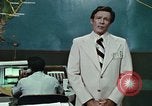
How the Civil Reserve Air Fleet, contract carriers, and U.S. Reserve and National Guard augment active U.S. military airlift capability.
Views of civilian airlines and examples of how they and U.S. Air Force Reserve and National Guard aircraft augment the active U.S. military airlift Command capability in time of emergency. Civilian narrator speaks from inside the U.S. Air Force Military Airlift Command (MAC) Headquarters Command Center, at Scott Air Force Base, Illinois. Next scene shows U.S. commercial airline passenger airplanes parked on a ramp. United Airlines, Delta Airlines, American Airlines, and Pan American aircraft are seen, some taxi, some parked, some taking off. A Boeing 727 jet taxis on the ramp. A Western Airlines 727 taxis behind a set of baggage carts being pulled by a tractor. The Narrator is discussing the Civil Reserve Air Fleet (CRAF) to which most U.S. airlines belong, and which can be activated by the Secretary of Defense, for airlift support in the event of a national defense emergency. The Western 727 aircraft takes off. A TWA 727 aircraft takes off. U.S. military personnel and dependent women and children are seen descending a stairway from a commercial airliner contracted by the Department of Defense. Military supplies are seen being offloaded by U.S. Airmen, onto a traveling cargo carrier, from a Flying Tigers Boeing 707 aircraft. Refugees from Southeast Asia are gathered and processed at an airport and then board an American Airlines Boeing 747 aircraft. Refugees from Vietnam and Cambodia boarding an Overseas National Airways Boeing 747. An American Airlines 747 taking off. A glimpse of the narrator in MAC headquarters, at Scott Air Force Base, is followed by a mix of private and military aircraft on a parking ramp, including a, presumably privately owned, Japanese Nakajima B5N Navy Type 97 Carrier Attack Bomber (Kate) with Japanese markings. U.S.Air National Guard C-130 and C-123 aircraft are seen taxiing, and taking off from this civilian airfield.
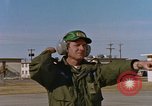
AF pilot narrator explains ground handling operations of C-5 Aircraft.
Pilot narrator explains ground handling operations of C-5 Aircraft. Ground crewman gives hand signals as aircraft turns. Crew member disembarks from the aircraft and hooks up communications wire. Airmen wearing ear protection place safety pins in landing gear and chock the wheels. Board reads 'Warning Stand clear APU Exhaust'. Narrator warns of noise hazard from sounds of engines,and auxiliary power units running at same time. Ground crewman attaches static ground wire from aircraft to fixture on tarmac.
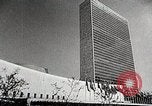
Celebration of the Liberation of Paris, and Americans returning to college, farms, and work after World War 2
Exterior views of United Nations headquarters building in New York City. World map showing NATO member countries shaded dark. Series of shots of American voting in elections, with views of American citizens entering voting booths and placing ballots in voting boxes. Distant view of U.S. Capitol building in Washington DC with an American flag flying in the foreground. Following Presidential election of 1952, Dwight D Eisenhower takes oath of office as President in January 1953, surrounded by other dignitaries at Eisenhower's inauguration. Scenes from end of World War 2 with U.S. Army forces in Paris and happy celebrating French people welcoming the U.S. military and other Allied forces. Close up view of faces of U.S. Army troops marching beside Arc de Triomphe in Paris. Parisians cheer and smile. A French woman kisses an American soldier. Aerial view of Statue of Liberty in New York as a troop ship is arriving in New York Harbor with soldiers returning from World War 2. Soldiers disembark the troop carrier ship. Cunard sign on gang plank. Young American men enrolled in American colleges. A college square area. Inside, a professor instructs college students in class. American students work in a University science laboratory with beakers, vials, burners, and microscope. Young veterans of the war who have returned to be farmers are seen on their farms working. American farmer works in field with a tractor. Views of various church buildings and church spires in American towns and cities. American men,women and children in church and clergy at altar circa 1950.
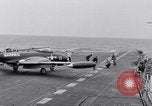
Deck crews aboard a U.S. Aircraft Carrier handle aircraft and prepare them for catapulting.
U.S. Marine Corps McDonnell F2H Banshee jet airplane being guided by a Yellow shirt. Scene shifts to animated diagrams interspersed with actual pictures. They show narrower tires used on jets giving lower braking friction and less lateral stability. One is shown in sketch, being blown over by jet blast. Sketch illustrates jet intake suction and reward blast. Deck crewman removing loose tools from pockets and fastening chin strap and goggles on his helmet, to avoid loose items being sucked up or blown about on deck and protect himself from jet blast. A Marine Corps Captain, pilot, climbs aboard his F2H airplane and deck crewman moves out of line of fire from plane's weapons. Next, a Navy F2H of Attack Squadron 12 (VA-12), Carrier Wing One (Tail code "T") is seen being readied to depart. Deck crew has already pulled the duct covers and pilot is in the cockpit. A 3-wheeled starting "jeep" containing an auxiliary power unit provides power for engine start and then pulls away. Fire fighter standing by in protective gear is seen. Deck crew pull chocks and aircraft taxis guided by yellow shirt who gives signals to spread wings and lower flaps. Yellow shirts guide jets to catapults for takeoff. Yellow shirt Plane Director uses various hand signals to guide pilot. Deck crew scramble underneath the aircraft an set it on the catapult.
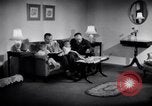
Four British labor exchange visitors return home after several weeks visiting war plants and labor organizations in America (WW2)
A British guest on labor exchange program visit spends his last day as a house guest of his counterpart American's family, in Los Angeles, California. He is seen with the father in their living room with two children, while the mother prepares dinner in the kitchen. The children are sent to bed and the men and the wife, named Ellen sits down to dinner with the two men. The British guest waves goodbye to the family at their doorstep. Scene shifts to another of the British labor exchange visitors leaving the family where he had been hosted in a different city. Next, the four British labor exchange visitors are seen seated opposite representatives of American labor organizations including the American federation of Labor (AFL), the Congress of industrial Organizations (CIO) and the Railroad Brotherhood. They had met them a few weeks ago when they first arrived in the U.S. One of the labor representatives asks them about their impressions of America. They uniformly praise the effectiveness of the U.S war effort, extolling the efficiency and productivity of her war plants. One of the commenters calls for more international unity in the labor union movement. A spokesman for the American labor representatives expresses need to support the United Nations movement. Film closes showing the four British exchange visitors boarding a U.S. Army Air Corps C-54 transport plane to fly them home to England. They are checked in by an airman who wears a leather jacket with the Air Transport Command logo on it. The aircraft is seen taking off and climbing out over hangars at the airfield. (World War II period)
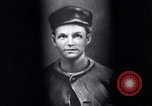
Henry Ford and Ford Model-T's motorcade.
Portrait of Henry Ford as young man. Henry Ford talks with another man. Motorcade of Ford Model-T's leave large building in United Sates. Model-Ts on a street.
CRITICALPAST.COM: About Us | Contact Us | FAQs - How to Order | License Agreement | My Account | My Lightboxes | Shopping Cart | Advanced Search | Featured Collections | Website Terms & Conditions | Privacy Policy ©2026 CriticalPast LLC.
License Agreement |
Terms & Conditions |
Privacy Policy
©2026 CriticalPast LLC.