


 Francais
 Deutsch
 Italiano
Refine Your Search
Nevada United States 1936 stock footage and images
- Showing 21523 to 21528 of 27248 results more
more Hide
Hide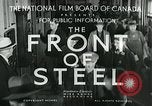
War machinery prepared in Canadian factories. Adolf Hitler's army parades honoring his 50th birthday in Berlin, Germany.
Machine power in Canada and Germany in World War 2. Canadian Industry workers walk into a war production plant punching time cards as they enter. Men welding. Steel worker checking heat of hot steel with temperature-reading glasses. Workers in Canadian factory prepare machinery for war. 20th April 1939: Adolf Hitler in Berlin, Germany reviews German army in parade on his 50th birthday (Narrator incorrectly states the year as 1938, but Hitler's 50th birthday was in 1939 and these images are from the 1939 parade). Heavy breakthrough tanks roll by, followed by Army division assault tanks. Motorized troops march followed by Infantry and then parachute troops. Stuka Dive bombers fly overhead with Berlin Victory Column (Siegessäule) in the foreground. Hitler and others watch the flight.
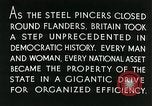
Guns, trucks and submarines developed and tested in Canada, during World War II.
British and Canadian preparations for World War II. Britain converts personal properties into State properties. Men and women work in factory. A banner with the phrase 'Go to it' coined by the Britisher Morrison. Workers construct buildings in Canada. White smoke comes out of factory. Workers at gun factory. Worker checks barrel alignment of a gun. Man checks firing capacity of gun. Workers at shipyard work on submarine. Steel plates used to lessen the weight. Trucks, tractors and ambulances made in factory. Testing and standardization of truck by National Research Council. They use X-Ray for testing of parts of machinery. A Canadian Pacific railroad train moves on tracks carrying train cars loaded with weapons and war supplies. Aircraft, trucks, tanks and ships as weapons of Canada. Industrial workers work in steel factories to make these machines.
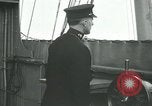
President Woodrow Wilson and other dignitaries aboard USS George Washington bound for Paris Peace Conference
Liner USS George Washington on the Atlantic Ocean after its departure from Hoboken, New Jersey, bound for the Paris Peace Conference after World War 1. One of the ship's officers looks through binoculars. Two ships in the background (one is likely the USS Pennsylvania BB-38 which accompanied the flotilla). President Woodrow Wilson looks through binoculars. Standing behind him is Rear Admiral Cary Grayson, who was also the President's physician, Two women talk to a man on ship. John W Davis looks through binoculars, a woman stands beside him. The woman looks through binoculars. Robert Lansing, U.S. Secretary of State stands on ship wearing a hat and bowtie and looks around. French Ambassador Jean Aderian Antoine Jules Jusserand sits and talks with two women. (World War I; World War 1; WWI; WW1)
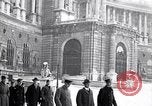
Professor Archibald Cary Coolidge and members of his staff in Vienna, Austria, in 1919
Professor Archibald Cary Coolidge of Harvard University, special assistant to the Department of State, assigned to the American Commission to negotiate peace after World War 1. He is seen in this sequence, with members of his staff, headquartered in Vienna, Austria, from where they assessed postwar political conditions in Austria-Hungary and neighborhood countries, and made recommendations for the U.S. participants at the Paris Peace Conference, 1919. The sequence begins with staff members walking from the Hofburg (Hofburg, Michaelerkuppel 1010 Wien). It is January, and snow is on the ground. Professor Coolidge holds gloves in his left hand and warms his right hand inside his coat in Napoleonic manner, as he chats with others. Staff members are predominantly military officers and include both U.S. Army and Navy personnel.

Soviet President Nikolai Podgorny arrives from aircraft and welcomed at airport in Rome, Italy.
Chairman of the Presidium of the Supreme Soviet (Soviet Union President) Nikolai Podgorny official state visit to Italy. President Podgorny disembarks from a Soviet Union CCCP aircraft in Rome Ciampino Airport (Via Appia Nuova, 1651, 00040 Ciampino RM, Italy). Italian Cuirassiers Regiment (Reggimento corazzieri) honor guards stand besides stairs of plane while saluting. President Giuseppe Saragat, Prime Minister Aldo Moro and other ministers welcome President Nikolai Podgorny. A soldier holds a flag. President is greeted by ministers in Rome. He shakes hand with cabinet ministers and leaves.

USAF firefighters battle flames engulfing a crashed RF-4C jet reconnaissance plane at Bergstrom AFB, Austin, Texas
U.S. Air Force Firefighters spray foam on burning McDonnell-Douglas RF-4C-30-MC Phantom Reconnaissance jet aircraft, serial number 66-0411, that crashed during attempted landing at Bergstrom Air Force Base, Austin Texas. The aircraft on a routine night mission hit a power line and crashed into a house during its landing approach. The house can be seen in background behind the flaming wreckage of the RF-4C. Although the two aircrew were killed, the narrator states the eight residents of the house were miraculously unhurt.
CRITICALPAST.COM: About Us | Contact Us | FAQs - How to Order | License Agreement | My Account | My Lightboxes | Shopping Cart | Advanced Search | Featured Collections | Website Terms & Conditions | Privacy Policy ©2026 CriticalPast LLC.
License Agreement |
Terms & Conditions |
Privacy Policy
©2026 CriticalPast LLC.