


 Francais
 Deutsch
 Italiano
Refine Your Search
Nevada United States 1936 stock footage and images
- Showing 21529 to 21534 of 27248 results more
more Hide
Hide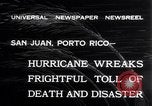
Havana Cuba harbor scene; Hurricane scenes and damage in San Juan, Puerto Rico from 1932 San Ciprian hurricane
Vintage slate states that the scenes are from San Juan, Puerto Rico. However, it opens with pre-hurricane views not of San Juan, but of Havana, Cuba, as seen from its harbor. Buildings of Havana Cuba seen, including El Capitolio, the National Capitol Building in Havana. Seen shifts to a covered market area filled with people (possibly still Havana, or possibly now in Puerto Rico. Aerial view of homes and buildings in the city of San Juan in 1932. Scene changes to view of hurricane winds blowing palm trees at 120 mile speed during San Ciprian hurricane. Palm trees on shore blown by wind. Sea water floods city. View after storm of wreckage of houses. People combing through the ruins. Cloth spread on ruins. Women and children walk among ruins. View again of storm in progress with water flooding the area and hurricane force winds.
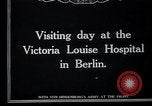
Visiting day at the Victoria Louise Hospital in Berlin, during World War I.
Relatives and friends visit wounded German soldiers at the Victoria Louise Hospital in Berlin, during World War 1. A large number of people are gathered outside the hospital. A young woman offers cigarettes to wounded soldiers who are outside in wheel chairs. A nurse passes out flowers to them. Another woman also seen walking along a line of wounded, giving them flowers. A civilian talking with several ambulatory wounded soldiers. He asks one about the wound to his head. Two recuperating soldiers watch as two others play chess. A group of recuperating soldiers pose as they gather around one who is bedridden. Some play cards on the lap of a soldier in a wheel chair. Scene shifts to inside the hospital. A bedridden soldier poses with nurse, for the camera. Some comrades stand behind his bed. She puts his military cap on his head. (Slate states that he died 20 minutes later.) More recuperating soldiers playing card games with those in beds in the ward. Doctor and nurses and staff seen in the ward. A soldier of short stature, with arm in a sling steps into the camera view as it pans along the ward, showing several of the recuperating soldiers. A hospital orderly wheels a patient towards the operating room.
President Eisenhower at the "Freedom Day" celebration in Charlotte, North Carolina
President Eisenhower visits Charlotte to celebrate "Freedom Day" commemorating the signing of Mecklenburg County's Declaration of Independence; President Eisenhower exits Columbine II aircraft (the first Air Force One) and is greeted by the Governor of the state and other dignitaries. President meets people at the airbase and shakes hands with him. Soldier salutes him. President talks to the dignitaries as they make their way across a stream. Many people gathered to celebrate the "Freedom Day". President sits eats along with other dignitaries at the Freedom Shrine. He sits in the car and many people stand with placards and boards, with welcome notes written on them to greet him.
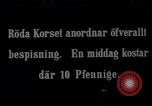
Red Cross provides meals for persons in Berlin, Germany during World War I
Opening slate, in Swedish, states: "Röda Korset anordnar öfverallt bespisning en middag kostar det 10 pfennige." (The Red Cross organizes all-inclusive dining a dinner costs 10 pfennige.) A variety of persons, from all walks of life, are seen at an outdoor dining facility. They line up for a meal provided by the Red Cross. A woman dressed in white directs persons to the food line. Another, gives the people utensils as they carry their plates of food to tables. View of chefs serving food to persons in the line. Numerous views of these activities as more persons come into the facility. View from back away show many persons seated at tables eating, and several women in white dresses near empty tables in the background. View of sidewalk and pedestrians in front of the outdoor dining area.
Red Cross activities in Berlin Germany during World War I
Opening slate, in Swedish, states: "Ett af Roda Korsets ambulerande lasarett." (One of Red Cross's ambulatory hospitals.) Men are seen carrying large panels (ostensibly pertaining to an ambulatory hospital) from a house among trees. Next is a brief glimpse of Red Cross women preparing food in an urban setting. A Berlin policeman stands nearby, watching them. Some persons are seen seated at tables in the background.
Some ruins and downed bridge in Galitz, Galicia, reoccupied by Russians in World War I
Opening slate, in English, identifies location. Views from window of a railroad train moving quickly past countryside in Galicia during World War 1. Orchards and country cottages are seen. A small stream runs beside the railroad. A seemingly abandoned and overgrown castle on small hill close to the railroad, is seen as the train passes. There is little evidence of war. Change of scene shows Russian soldier walking through ruins of what was once a stately building, in Galicz (aka Halicz; Halych;or Galich). Remains of a destroyed steel bridge over the Dniester River. A narrow pontoon bridge has been erected next to it. A Russian river gunboat is stationary in the river, near the pontoon bridge. View from underneath of the destroyed steel bridge. A Russian officer on horseback seen after crossing the pontoon bridge.
CRITICALPAST.COM: About Us | Contact Us | FAQs - How to Order | License Agreement | My Account | My Lightboxes | Shopping Cart | Advanced Search | Featured Collections | Website Terms & Conditions | Privacy Policy ©2026 CriticalPast LLC.
License Agreement |
Terms & Conditions |
Privacy Policy
©2026 CriticalPast LLC.