


 Francais
 Deutsch
 Italiano
Refine Your Search
Nevada United States 1936 stock footage and images
- Showing 26731 to 26736 of 27247 results more
more Hide
Hide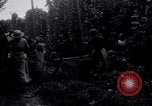
Hoppers harvest hops in Kent England during World War I
Men, women, and children gathered at a hops farm in World War 1. The happy workers, possibly from Kent, or migrant "hoppers" from London on a "hopping holiday" work together to harvest hops. The row is filled with busy hoppers of all ages. Bin men with long poles pluck hop-laden vines from the high-growing plants. Children and women separate hop cone flowers from plants, gathered over bushel baskets. A woman pulls a hand cart between rows of hop plants.
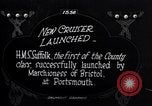
British Cruiser, HMS Suffolk, launched by Marchioness of Bristol at Portsmouth in England.
HMS Suffolk, the first of the County Class cruisers of the Royal Navy launched by Marchioness of Bristol at Portsmouth in England. The cruiser leaves the shipyard into the water. Cruiser underway in the harbor. British Flag flutters on the ship.
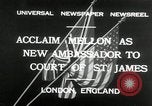
Former U.S. Secretary of Treasury Andrew W Mellon takes charge as new U.S. ambassador to England
Andrew W Mellon former U.S. Secretary of Treasury leaves a ship and arrives at Waterloo railway station in London England. Steam locomotive pulling passenger cars pulls into the railroad station. People welcome Secretary Mellon in the station. Mellon is escorted by the guards. He proceeds in a car to the American Embassy where he greets British dignitaries including Sir Patrick Duff. Mellon takes charge as U.S. new ambassador to the nation.
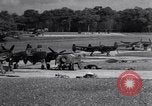
P-38 aircraft of the U.S. 55th Fighter Group at British airfield Nuthampstead, England
U.S. 55th Fighter Group P-38 planes at Nuthampstead Airfield (Station 131) in England in World War 2. Mechanics prepare P-38 planes prior to the 55th Fighter Group's first combat mission on 15th October 1943. Some of the mechanics work on the .50 Browning machine guns mounted in the nose of the plane. One of them checks fuel lines and the interior of the plane. 38th Fighter Squadron pilots gather in front of their Commander, prior to the mission. Pilots include the Group's first P-38 "Ace," Gerald Brown, and fellow 38th pilots, Jerry Leinweber and Jo Myers. Visual and Audio of 55th Fighter Group Commander, Lt. Colonel, Frank James (Group CO), briefing pilots and emphasizing their bomber escort mission. He tells them not to break off to pursue individual German aircraft. The crews disperse to their respective aircraft for take off. View of Lt Col. Jack Jenkins' P-38H "Texas Ranger" readies for take-off with assistance from his crew chief Sgt. Donald Maloney
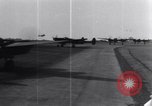
P-38 planes fly over B-17 planes in European Theatre of Operations
38th and 338th Fighter Squadron P-38H's taxi round perimeter track at Nuthampstead and take-off down main runway. Some of the planes take off in pairs and others singly. Among those seen are , Lt. Jerry Ayers' P-38H coded CG-Q and Lt. Stanley Richardson's P-38H coded CL-X. Views of 55th Fighter Group P-38H planes escorting 91st Bomb Group B-17Fs in European Theater of Operations. Flights of P-38 planes position themselves to protect B-17 formations. Crew officers (including Capt. Hancock of the 38th FS) observe the activities from ground. The P-38s return to land. One P-38 releases drop tank over the airfield before landing. (World War II period).
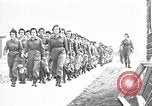
Women's Army Corps(WAC) at 8th Air Force Replacement center in Stafford, England.
8th Air Force Replacement Center in Stafford, England. Women's Army Corps (WAC) walking in queue with eating utensils. One of the WAC member seen with bugler as others entering in the mess. Various messages stenciled on backs of some of the women's uniforms, including, "Top Kick Lets Go On the Double" and "I dood it". WAC women serving themselves and eating at the tables. Three WAC women cleaning the mess utensils in the garden while one is seen at the window. One at the window talking with the other in the ground and polishing a shoe. WAC marching towards the air force base in uniforms while band is seen in the background. WAC enters the ground and band players are also seen. WAC salutes the senior officers.
CRITICALPAST.COM: About Us | Contact Us | FAQs - How to Order | License Agreement | My Account | My Lightboxes | Shopping Cart | Advanced Search | Featured Collections | Website Terms & Conditions | Privacy Policy ©2026 CriticalPast LLC.
License Agreement |
Terms & Conditions |
Privacy Policy
©2026 CriticalPast LLC.