


 Francais
 Deutsch
 Italiano
Refine Your Search
Nevada United States 1936 stock footage and images
- Showing 27013 to 27018 of 27248 results more
more Hide
Hide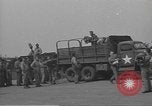
U.S. 507th Regiment, 82nd Division paratroopers receive parachutes and sham attack in Camp Tollerton, England.
Paratroopers of U.S. 507th Parachute Infantry Regiment, 82nd Airborne Division in England during World War II. The paratroopers pass a truck to receive two parachutes. A man inspects a reserve parachute. The paratroopers march on a road. They race across a field and sham attack to see how the equipment rests while running. After the tryout the men return to the camp.
Loading of a U.S. LST (Landing Ship, Tank) with army vehicles at Falmouth, England during World War II.
Loading of a U.S. LST (Landing Ship, Tank) at Falmouth, England during World War II. An M3 half track pulls a trailer aboard the LST at the dock. An M-8 Light Armored Car moves up the ramp of the LST. U.S. jeeps move along a road.
The upper deck of a U.S. LST (Landing Ship, Tank) is loaded with army vehicles at Falmouth, England during World War II.
Loading of a U.S. LST (Landing Ship, Tank) at Polgwidden (A.K.A Trebah) beach , Helford River, near Falmouth, Cornwall, England during World War 2. (From the superstructure visible this is probably LST 532, USS Chase County.) A jeep pulls a trailer aboard the LST. Two jeeps on the elevator of the LST as it rises to upper deck. The upper deck of the LST shows a truck backing up on a ramp. (Note:This footage was taken on June 1, 1944, as the troops and equipment embarked for the D-Day invasion of Normandy. They spent the next 5 days very uncomfortably aboard due to stormy weather that delayed the landings until June 6th.)
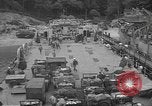
U.S. Military Vehicles loading into positions on upper deck of a Landing Ship Tank, in England, during World War II
Loading of USS Burnett County (LST-512) at Polgwidden (a.k.a. Trebah) beach, Helford River, near Falmouth, England during World War 2. View from top deck of the LST, as vehicles drive up a ramp and into positions on the deck. An M3 half track pulls up a trailer on the ramp of the LST. View from antiaircraft gun emplacement overlooking embarkation point. A sailor aboard the LST signals. Army vehicles are seen moving down a road and assembling at the embarkation wharf. (Note: Although these troops and equipment embarked on June 1, 1944, they remained aboard 5 days as foul weather delayed the actual D-Day landings until June 6, 1944)
The USS Chase County (LST 532) on the Helford River, heading for Polgwidden, near Falmouth, England, during World War II
Landing Ship, Tank No. 532, The USS Chase County, at Polgwidden (AKA Trebah) on the Helford River, near Falmouth, Cornwall, England during World War 2. The LST moves up the river at Trebah. The USS Chase County is seen docked and ready for troops and equipment to embark. (Note: Later this same day, Allied troops and equipment did embark on the USS Chase County for the D-Day invasion of Normandy. However, they spent the next 5 very uncomfortable days afloat in bad weather that actually delayed the operation.)
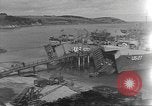
Army vehicles being loaded aboard LSTs (Landing Ship, Tank) near Falmouth, England, during World War II
Loading of U.S. LSTs (Landing Ship, Tank) at Polgwidden (a.k.a. Trebah) Beach, Helford River, near Falmouth, Cornwall, England, on 1st June 1944.in World War 2. U.S. LST 27, operated by the U.S. Coast Guard and U.S. Navy LST 533 are loading vehicles in readiness for the invasion of Normandy. A truck pulls a trailer up the ramp of LST 27. A jeep enters the LST. Some sailors and troops seen on the deck of the LST. A barrage balloon in the sky. U.S.Army vehicles travel through the village of Mawnan Smith on their way to embarkation at Trebah (Polgwidden).
CRITICALPAST.COM: About Us | Contact Us | FAQs - How to Order | License Agreement | My Account | My Lightboxes | Shopping Cart | Advanced Search | Featured Collections | Website Terms & Conditions | Privacy Policy ©2026 CriticalPast LLC.
License Agreement |
Terms & Conditions |
Privacy Policy
©2026 CriticalPast LLC.