


 Francais
 Deutsch
 Italiano

Refine Your Search
Nevada United States 1936 stock footage and images
- Showing 31507 to 31512 of 35684 results more
 Hide
Color Sound

High speed motion picture of a bullet penetrating a container of water
high speed images used to examine behavior of munitions. Film showe a bullet fired into a container of water. The projectile penetrates the side of the container and continues through the liquid water, creating bubbles and voids. Water spews out of the hole in the container. (World War II period).

Paintings depicting a journey by mountain men to the animal fur-traders' rendezvous of 1837.
A film includes accounts of the Lewis and Clark Expedition (1803–1806) and a journey to animal fur-traders' rendezvous in the Green River Valley, Wyoming in 1837. The Missouri River Basin and the Rocky Mountains in the area. Interiors of a house showing beads, fur clothing, North West Indian guns of the Fur Trade Era. Drawing of a mountain man who roamed the North American rocky mountains. A painting by American painter Alfred Jacob Miller depicts a journey to the animal fur-traders' rendezvous in the Green River Valley, Wyoming in 1837. Paintings depict that the rendezvous was organized by American fur company and provided mountain men and Native American Indians with an opportunity to come together to exchange their furs for supplies that would sustain them through the winter. Paintings depicting buffalo hunts by men.

A still picture of Wilbur Wright Memorial in Le Mans, France which was dedicated on July 17th, 1920.
A picture of Wilbur Wright Memorial in Le Mans, France. A still picture of Wilbur Wright Memorial in Le Mans, France which was dedicated on July 17th, 1920.

News media military analysts discuss the problems of Allies invading Europe to defeat Germany in World War II
Map of Europe and label "Invasion." Westbrook Van Voorhis leading a panel discussion about the problems arising from the Allied invasion of Europe in World War 2. He introduces panelists: Hanson Baldwin (military editor of the New York Times) Dewitt MacKenzie (Associated Press military analyst), and Paul Schubert (of Mutual Radio Network). He asks Mr. Baldwin about the importance of aerial bombing campaigns. Baldwin also stresses importance of a land invasion of Europe. Relief map of Europe highlighting major German cities. Asked about the merit of invading Italy on the way to Germany, Mr. Schubert cites the problem of the Alps and suggests other more effective invasion routes. Van Voorhis asks Mr. MacKenzie about best route into fortress Germany. He considers the criterion of ease of supply as most important, and suggests the Atlantic coast, near a good port and not far from England. Animated map shows this idea. When asked about this, Mr. Baldwin agrees completely, calling the conflict "a quartermaster's war." He adds, "The problem of victory is the problem of supply."

The Engineer replacement center trainees being trained by the instructors during World War II.
A film titled: 'Engineers in Combat' depicts the training of the Engineer replacement center trainees during World War II. Engineers working on a field. They march in formation. Buildings along a side of the street. Training of the engineers. They are instructed to use rifles, demolition charges, power tools and railroad building machinery. Engineers lay land mines and detect the enemy land mines.
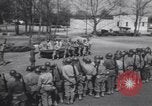
The Engineer replacement center trainees learning the use of assault boats during World War II.
A film depicts the training of the Engineer replacement center trainees during World War II. Engineers gather on a field during their training. They are being demonstrated the use of assault boats. Some of the engineers aboard a boat. The boat gets underway. The engineers are being instructed the use of various tools and equipment. They are instructed to erect bridges. Engineers walking on a pontoon bridge.
CRITICALPAST.COM: About Us | Contact Us | FAQs - How to Order | License Agreement | My Account | My Lightboxes | Shopping Cart | Advanced Search | Featured Collections | Website Terms & Conditions | Privacy Policy ©2026 CriticalPast LLC.
License Agreement |
Terms & Conditions |
Privacy Policy
©2026 CriticalPast LLC.