


 Francais
 Deutsch
 Italiano

Refine Your Search
Nevada United States 1936 stock footage and images
- Showing 31999 to 32004 of 35683 results more
 Hide
Color Sound
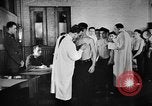
New recruits, for the Civilian Conservation Corps, commence training at Army Camp.
New Civilian Conservation Corps (CCC) recruits from urban areas are examined by doctors at Army processing center during the Great Depression. Men stand on city sidewalk, with their luggage, waiting for bus to take them to the CCC processing center. One man stands in front of a large tent. Several men in civilian clothes, with luggage, line up at a discharge office, after completing their term of service. Army supervisor reads from a list as recruits respond by raising their hands. Recruits run from their tents, carrying their mess gear, as mess call is sounded. Recruits walk through a mess line and receive hot food. They sit and eat at large tables in a mess hall. Recruits are issued blankets, clothing, and personal items from Army quartermasters. Scenes of recruits making beds. A cot with a recruits belongings laid out upon it. Several recruits pose in their civilian clothes, and then in their uniforms. CCC men march, carrying shovels, and commence work on a construction project. Men, with wheelbarrows, work on the project.
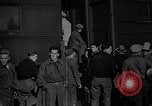
Members of Civilian Conservation Corps work at Camps and Parks in mountainous areas.
Civilian Conservation Corps men leave basic training camp by railroad train. At their destination, they step from the train, unload their supplies and equipment from baggage car into a truck, and board Army trucks that carry them through a town and out to a rustic camp in a pine forest, where tents are set up and buildings are under construction.They commence work on the unfinished structures. Views of completed barracks buildings and smooth dirt roads. View of white tents pitched in neat rows on hillside. Trucks loaded with CCC workers leaves a camp. View of a CCC camp out west, with large cactus ,and rugged mountain landscape. CCC men setting up picnic tables and benches at a park, by a lake surrounded by mountains. an encampment with row of tents and several utility buildings, in a canyon surrounded by beautiful mountains. (Great Depression period)
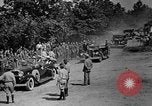
President Franklin D Roosevelt visits a Civilian Conservation Corps Camp
Cars carrying President Franklin D Roosevelt and his party arrive at a Civilian Conservation Corps (CCC) Camp in the Great Depression. Members of the CCC line the dirt road and watch as the local Army supervisor speaks with the President. Roosevelt sits at a table and speaks to the assembled CCC members.
American industry focuses on defense and war materiel production during World War II
Film opens showing smoke pouring from industrial smoke stacks in American manufacturing plants, during World War 2. Sparks fly from crucible of molten steel. Steel workers silhouetted against fog as they leave on a shift change. Men tapping an open hearth furnace in a steel mill. Hot steel being poured in Crucibles and then into steel containers on rails. Huge overhead cranes moving in a mill. A Bessemer converter furnace tilted and blowing with flames extended from its mouth. (A smoke ring leaves the converter.) Various views of activities in steel mills with flaming steel involved and processing such as extrusion and forging taking place. Closeups of hardworking steel workers handling white hot steel ingots. Sheets of aluminum being processed in rolling mills and then inspected. Scene shifts to an oil field with numerous derricks and then to a refinery, with 10 tall smoke stacks, where crude oil is made into gasoline. Views of Grand Coulee Dam, Bonneville, Boulder, and the Tennessee Valley, where hydroelectric power is produced. Churning waters being discharged through dam spillways. Huge number of men and women war factory workers seen in a shift change at a war production plant. Closeup of machines producing small arms and ammunition. A woman war production worker assembling an M1 Garand rifle. Others working on Browning 30 caliber M1919 machine guns and Browning Model 1917A1 water-cooled machine guns. Belts of machine gun ammunition being boxed in ammunition boxes for shipment. Thousands of bullet rounds pouring through funnel machinery. Shops where torpedoes, shells and bombs are manufactured and seen in piles and stacks. A worker checking out movement of a Anti-aircraft 40-mm Automatic Gun M1. Field artillery pieces covered outside a war plant. A 14 inch barrel, for a coastal gun or Navy ship gun, seen suspended from an overhead crane in a factory. Views of various such barrels including a view through one. Elements of mobile weapons being assembled. Jeeps being assembled and driven out of a factory at the rate of one per minute and temporarily stored in a yard. Special machinery grinding gears and other parts. Arc welders at work on weapons. M4A1 Sherman medium tanks being manufactured. View in factory of M3 Lee medium tanks being assembled. Rear view of one being fitted with its treads. Others are seen suspended from overhead crane.
Celebrities help promote American Red Cross blood donor programs and War bond drives during World War II.
Film opens showing a huge crowd gathered in New York’s Madison Square Garden for a rally in support of the American Red Cross, during World War 2. Eleanor Roosevelt, the First Lady welcomes and introduces Princess Martha of Norway. The audience applauds. Scene then shifts for Red Cross activities on the home front. Two Red Cross women remove items from a station wagon in preparation for a local Blood drive. A panel truck parked next to them is marked: “American Red Cross Blood Donor Service.” More Red Cross volunteer women remove items from the panel truck to set up the blood donor activity. View of many persons in beds at a blood donor center. Nurses and Red Cross volunteers working at the center with donors. One of the donors is an active duty sailor in uniform. Complete change of scene to California, where Hollywood stars are seen involved in a war bond drive. Closeup of several, including Irene Dunn, Ronald Coleman, Hedy Lamarr, and Greer Garson. Glimpse of crowd at the bond drive.

Hollywood actor Dick Powell composes and sings "The Road is Open Again" for the National Recovery Administration
Framed photographs of Presidents George Washington, Abraham Lincoln and Woodrow Wilson on a wall. A song writer writes a song on behalf of the National Recovery Administration (NRA). He falls asleep while writing the song. As he "dreams" actors portraying Washington, Lincoln and Wilson appear in his room asking him why he wants to write such a song and they're reassuring him that Franklin D Roosevelt is the right way. When he starts singing his new song, he finds himself alone, but he knows that Franklin Delano Roosevelt will lead the USA back on the road to prosperity. He sings "The Road is Open Again". Film is a National Recovery Administration and New Deal propaganda piece during the Great Depression.
CRITICALPAST.COM: About Us | Contact Us | FAQs - How to Order | License Agreement | My Account | My Lightboxes | Shopping Cart | Advanced Search | Featured Collections | Website Terms & Conditions | Privacy Policy ©2026 CriticalPast LLC.
License Agreement |
Terms & Conditions |
Privacy Policy
©2026 CriticalPast LLC.