


 Francais
 Deutsch
 Italiano
Refine Your Search
Nevada United States 1936 stock footage and images
- Showing 5365 to 5370 of 27250 results more
more Hide
Hide
A crowd watches as a United States soldier climbs a fence and puts a helmet on a statue in London, England.
Victory in Europe Day celebrated in London, England towards the end of World War II. United States soldiers gather around a statue. A U.S. soldier climbs a fence to reach the statue. He puts a helmet on the statue. The soldier climbs on the statue and sits on the top of it and hangs his gun around the statue. The soldier drinks on the top of the statue. The civilians watch the soldier.
United States infantry march to landing barges; Allied convoy English Channel on D-Day (WW2)
United States Army infantry troops march to landing barges in England the day before D-Day in World War II. The troops march past a bus stop and board a landing barge. The landing barge sails away. A convoy of vessels set out for the rendezvous. Allied ships sail in the English Channel, with barrage balloons flying above in the background.
United States Curtiss P-40 aircraft of the 8th Pursuit Group take off and land after a short flight in the United States.
A flight of three Curtiss P-40 aircraft, from the U.S. Army Air Corps 8th Pursuit Group, make a formation takeoff at Mitchel Field, Long Island, New York. Next, two flights of three aircraft each, take off in a formation of six P-40s. Scene shifts to a formation of 15 P-40s in flight overhead. The aircraft return and land by flights of three, in formation. Closeup of several taxiing, with canopies open, after landing. A flight of three with landing gears down, flying on a downwind leg in formation. Closeup of two P-40s touching down on the runway. All three squadrons of the Group (33rd, 35th & 36th) appear to be represented.
U.S. President Franklin Roosevelt addresses citizens of Chicago; scenes from 2nd Italo-Ethiopian War and Spanish Civil War
U.S. President Franklin D Roosevelt warns of an increasing danger of armed conflict (increasing danger of war leading up to World War 2). Roosevelt's motorcade on the streets of Chicago. A large crowd gathered to get a glimpse of the President. Confetti rained on the motorcade. Soldiers salute as the motorcade passes by. Policemen on motorbikes lead the motorcade. People gathered at the venue to hear the President's speech. A board advertises candy bars 'Baby Ruth, Butterfinger" in the background. President Roosevelt with officials on stage. He addresses the crowd. Excerpts from his speech are interspersed with scenes of war and conflict elsewhere in the world during the late 1930's. Roosevelt speaks of recent events of "international lawlessness" including in the last few years "unjustified interference in the internal affairs of other nations." Scenes that follow include aerial bombings, naval attacks, and war: Scenes of war carnage during the Second Italo-Ethiopian War of 1935-1936: Ethiopian soldiers on horseback cross a bridge, Italian forces fire artillery from a hill, aerial view as aircraft drop bombs. Italian soldiers pass a burning, smoldering building and overtake an Ethiopian position, with many Ethiopian soldiers lying dead. Ethiopian citizens in area of a war torn village. Bomb damage and war casualties on the street. Italian soldiers collect dead bodies and load them onto a truck. A ship quickly sinking after attack by a submarine. Scenes from battle during the Spanish Civil War in 1936 or 1937. Spanish nationalist and rebel soldiers engage in a battle in a village. Spanish prisoners are marched. Nationalist soldier fires machine gun from a balcony emplacement. Dead body on a road. Soldiers behind a barricade fire at opposition and carry wounded on stretchers. President Roosevelt concludes his speech with, "America hates war. America hopes for peace. Therefore, America actively engages in the search for peace." People applaud.
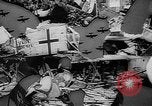
Scenes of Germany during period from 1919 to 1938 showing military resurgence and territorial expansion
Germany's military resurgence from the end of World War I through its reoccupation of the Rhineland in 1936 and union with Austria in 1938. German war materiel piled up in scrap yards and aircraft engines being destroyed in accordance with the Treaty of Versailles after World War 1. Smoke stacks of war plants being toppled, aircraft hangars being destroyed, and warships being scuttled. German postwar armored cars for training. A soldier flexes the rubber gun barrel on one of them. French forces, including Colonials, occupying Coblenz (Koblenz) in accordance with the Treaty of Versailles, after World War I. French soldiers on guard at the railroad station as a train pulls in. French colonial troops tending to their horses. A British soldier standing guard in front of a building displaying a placard with the Union Jack and word:"General Headquarters, British Army of the Rhine, No.1 Building." French troops stationed in front of their headquarters and patrolling fences across railroad tracks at their occupational boundary. A large film slate announcing that the Rheinland is again free, followed by scenes of German troops re-occupying the Rhineland in 1936. Local citizens cheer the troops, who parade through a city and along the banks of the Rhein River. German sentries posted at The "Deutsche Eck" in Koblenz beside the monument of Kaiser Wilhelm I. Sign demarking boundary of Austria. Border guards opening the gates and German troops entering as crowds cheer. Adolf Hitler speaking before a huge crowd,immediately following the Anschluss (union of Germany with Austria) on 12 March 1938.
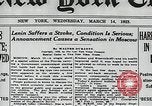
Stalinism after Lenin's death and several people are purged after Moscow Trials and the Great Purge in Russia.
Scenes in the Soviet Union from 1923 to 1938, including the Great Purge in Russia. On March 14, 1923 : A newspaper headline reads 'Lenin Suffers a stroke, Condition is Serious; Announcement Causes a Sensation in Moscow'. On January 21, 1924 : Another newspaper headline reads 'Lenin is Dead'. Bolshevik leader Lenin laid in a coffin. Senior Soviet officials carrying the body of Lenin in a funeral procession through the snow. People watch the funeral procession. Joseph Stalin with an officer. Stalin comes into power after Bolshevik revolutionary Leon Trotsky is forced into an exile. Views of workers pursuing 5-year plan goals: At a railroad train siding building rail infrastructure, with shovels; in logging operations in the snow; in a steel plant. View of coal being transported on conveyer. View of mining operations, with steam shovels filling rail cars. Views of chemical and petroleum facilities. View of hydroelectric power plant turbines and electrical distribution towers and wires. Workers in agriculture, with a truck in a field. Construction workers at large building site. Young machinist working on a lathe in a factory or manufacturing plant. Tailors working in a shop with pictures of Lenin and Stalin on the wall. Steam locomotive pushing train cars including boxcars up a mountain side in Siberia. Time frame of the "Great Executions" during the Great Purge: Soviet "executioner" Nikolai Yezhov and other officers inside a building and footage from the Moscow Trials or sometimes called Moscow Show Trials from 1936 - 1938. Stalin with Bolshevik revolutionaries Lev Kamenev and Grigory Zinoviev who were disposed off during the Great Purge. Scenes of Moscow Trial proceedings, with participants wearing earphones during a trial dealing with alleged conspiracy with Trotsky at the Hotel Bristol in Copenhagen in 1936. Picture of Nikolai Yezhov, who was also purged.
CRITICALPAST.COM: About Us | Contact Us | FAQs - How to Order | License Agreement | My Account | My Lightboxes | Shopping Cart | Advanced Search | Featured Collections | Website Terms & Conditions | Privacy Policy ©2026 CriticalPast LLC.
License Agreement |
Terms & Conditions |
Privacy Policy
©2026 CriticalPast LLC.