


 Francais
 Deutsch
 Italiano
Refine Your Search
Nevada United States 1936 stock footage and images
- Showing 5371 to 5376 of 27250 results more
more Hide
Hide
German Chancellor Adolf Hitler re militarizes the Rhineland, Germany and denounces the Locarno Pact.
German Chancellor Adolf Hitler reoccupies the Rhineland and denounces the Locarno Pact in 1936. The signing of the Locarno Treaties in London, England in 1925. Officials arrive at the building where the Locarno Treaties are to be signed. Chancellor Hans Luther of Germany affixes his signature to the Locarno Treaty assuring peace to all the principal countries of Europe. At the head of the table in the center are Stanley Baldwin and Sir Austin Chamberlain, leaders of the British Delegation. German Chancellor Adolf Hitler violates the Treaty of Versailles on 7th March 1936 by sending German military forces into the Rhineland demilitarized zone along the Rhine River in western Germany. Mobilized German troops march over the Hohenzollern bridge in Cologne, Germany. The troops march along a road. Cologne Cathedral in the background. A German crowd cheers as the German soldiers parade. Swastika banners hang from buildings. German troops parading in Dusseldorf. The troops on horseback and horse-carriages pass along narrow streets of Dusseldorf. Parading troops are cheered by a crowd in Frankfurt am Main. German troops parade in front of a building during a wreath laying ceremony followed by Chancellor Hitler and other Nazi officials. Newspaper headlines about Hitler denouncing the Locarno Pact. A government minister with press. French Prime Minister Albert Sarraut at a microphone reassures the security of France. Belgium soldiers march along a street.

Demonstrators in Trafalgar Square, London, protest British support for the United States' actions in Vietnam.
Peace Demonstration at the Trafalgar square in London, England organized by the "Campaign for Nuclear Disarmament." Large crowd of anti-war demonstrators gather at Trafalgar Square (Trafalgar Sq, London WC2N 5DN, United Kingdom). City of London Police in scuffle with protesters at Trafalgar Square. Demonstrators protest and show opposition to British support for the United States' actions in the Vietnam War. They hold banners. Military policemen control and stop the protesters from approaching Prime minister's home.
United States troops create a Shanty town made of glider crates in the United Kingdom (WW2)
Bomber towing a glider over an air base in the United Kingdom during World War II. Aerial view of a glider assembly field. Glider crates in assembly field. A soldier stands on the balcony of a “shanty” house made from glider crates. Sign reads “Shanty Town”. Soldiers open a glider crate. Men remove the glider carefully from the crate. Two men take a metal bed frame to the crate. A man stands by the door of a shanty house. “Vine and Hollywood” is written beside the door. Soldiers relaxing inside Shanty houses. Soldier sitting on bunk bed polishes his shoes while another writes letters. A soldier with headset listens to his homemade crystal set radio and reads a magazine. Specially constructed blinds of glider crate tiny house open. Troops lined outside a glider crate barber shop. A sign detailing the rates for a haircut. A barber shop made from scrap. A barber cuts the hair of a soldier inside makeshift barber shop.
Dr. Hugo Eckener, commander of German Zeppelin Hindenburg, (LZ-129) talks to journalists about his voyage to the United States.
Dr. Hugo Eckener (1868-1954) who commanded the German Zeppelin Hindenburg (LZ-129), describes the maiden voyage of the airship over the North Atlantic, and states his opinion that even in bad weather the Zeppelin would be able to successfully make regular transatlantic flights.
WPA laborers work at various development programs in New York City, United States.
Works Progress Administration (WPA) projects in New York City during the Great Depression. Aerial view of New York City as a plane flies by and clouds part to show Manhattan island below. Buildings and skyscrapers of New York City as seen from river and harbor views, with some ships and tugboats seen. Trucks on roads of Governor's Island at tip of Manhattan. An older home seen under renovation and reconstruction. View of the Brooklyn Navy Yard with WPA workers busy building and improving new roads and shops and warehouses near the docks. A bulkhead construction project is shown at Sheepshead Bay in Brooklyn, to reclaim land from the waters of the Bay. The work includes construction of a new Boulevard and sanitary and sewer system improvements. View of the front entrance of the Beaux Arts style Alexander Hamilton U.S. Custom House on Bowling Green at the tip of Manhattan. Pedestrians and WPA workers are seen in front of the building. WPA laborers on an unidentified Manhattan street (with elevated railway running in background) are busy removing old street car rail lines from the streets, in sections, and loading them into truck beds to haul away. Large public swimming pool and bath house construction projects are shown, influenced by city planner and avid swimmer Robert Moses (scene possibly shows McCarren Park pool - note archway seen under construction). WPA workers are seen building the new East River Drive, including highways, walks, and flanking parks. Construction workers seen building the roadway, with the Williamsburg Bridge in the background. A model of the project is shown with the new drive from Grand Street to 14th Street. Camera pans down from the Empire State Building to show the roof of the New York Public Library teeming with WPA workers as they remove the old corroded copper roof and replace it with a new metal roof. View of busy Manhattan streets below the workers, including a street car passing by.
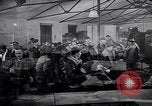
American aircrew boards United States B-24 bomber in England during World War 2
U.S. 8th Air Force crewmen place their personal belongings on a table and seal them up in pouches for safekeeping, while they are away on a mission. They draw their parachutes and other gear. Crewmen boarding a B-24 named "Big Bust." Interiors of the plane as crew settle into their stations and check their equipment. Pilots check their watches. United States B-17 and B-24 bombers taxi along the British runway. An officer on control tower balcony fires a very pistol and planes take off.
CRITICALPAST.COM: About Us | Contact Us | FAQs - How to Order | License Agreement | My Account | My Lightboxes | Shopping Cart | Advanced Search | Featured Collections | Website Terms & Conditions | Privacy Policy ©2026 CriticalPast LLC.
License Agreement |
Terms & Conditions |
Privacy Policy
©2026 CriticalPast LLC.