


 Francais
 Deutsch
 Italiano
Refine Your Search
Nevada United States 1936 stock footage and images
- Showing 5467 to 5472 of 27250 results more
more Hide
Hide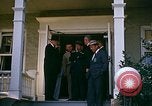
President Eisenhower and other dignitaries come out of the Summer White House at Newport in United States.
United States diplomatic, intelligence, and military officials stand on the porch of Summer White House at Newport United States. United States VIP's on the sidewalk. They depart the White House and cross the street to a large lawn. U.S. Secretary of the Navy Thomas Gates, Admiral Burke, Mr. John Foster Dulles, members of CIA and others leave the summer White House. Gates confers with two reporters. Mr Dulles and Admiral Burke on the walkway. Gates speaks with newsmen outside the White House. Dulles walks up and stops before Mr Gates. Secretary of State Christian Herter descends the steps holding crutches, stopping and speaking to Haggerty. Naval aide talks to Herter. Haggerty lights a cigarette. Herter stands alongside Limousine as crutches are given to an aide. He steps into the car. Eisenhower's naval aide confers with someone in the rear of the car. Eisenhower steps from the doorway of the Summer White House.
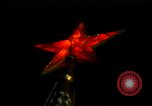
General Secretary Gorbachev of the Soviet Union extends New Year greetings to people of the United States.
Opening scene shows closeup of a large illuminated Red Star displayed during New Year holidays atop Nikolskaya Tower in the Kremlin. It is seen again, from Red Square, along with Kremlin wall. A light snow covers evergreen trees in foreground. The General Secretary of the communist party of Soviet Union Mikhail Sergeyevich Gorbachev speaks on world net telecast in Moscow, Soviet Union. He begins his remarks by saying: "Ladies and gentleman, friends, as we celebrate the New Year, I am glad to address the citizens of the United States of America and to convey to you season's greetings and best wishes from all Soviet people." He speaks of the improving interactions and relations between "our two peoples." Among other things, he states: "Human life is equally priceless, whether in the Soviet Union, the United States, or in any other country. So, let us spare no effort to affirm peace on Earth. He finishes by saying: "In concluding this New Year address to the people of the United States of America, I wish peace, happiness, and joy to every American family. A happy New Year to all of you."
Soviet foreign minister meets Secretary Dulles at his residence in Washington D.C., United States.
Soviet Foreign Minister Gromyko in Washington D.C., United States. Reporters gathered outside United States Secretary of State John Foster Dulles's house in Washington D.C., United States. Soviet Foreign Minister Gromyko arrives for a meeting with the Secretary. Gromyko and Secretary Dulles come out of the house after the meeting.
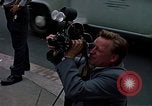
Soviet Premier Khrushchev visits the research center of United States department of agriculture in Washington D.C.
Soviet Premier Nikita Khrushchev visits Washington D.C., United States. Mrs. Khrushchev with the first Lady of United States at the White House. Soviet Premier Nikita Khrushchev with President Dwight D. Eisenhower at a state dinner. The two statesmen pose along with their wives. Premier Khrushchev makes an appearance outside the President's guest house as photographers take pictures. Khrushchev visits Research center of United States department of agriculture as U.S. Secretary of Agriculture Ezra Taft Benson welcomes him. A scientist gives demonstrations to the Premier about the weed killers, growth regulating chemicals. Premier Khrushchev visits a dairy area and looks at the cattle and turkeys. An official presents a turkey to the Soviet Premier.

President Richard Nixon delivers "Nixon Shock" speech dealing with the economic crisis in the United States.
President Richard Nixon gives a speech on the economy from the White House in the United States. Nixon addresses the nation on the need to create more jobs, stop the rise in the cost of living, control price inflation, relieve economic stagnation, and control speculation. He announces the Job Development Act of 1971. He talks of eliminating excise taxes on automobiles and speeding up availability of some exemptions in personal income taxes. He charges Congress to introduce incentives for research and development. He orders federal spending cuts including a postponement of pay raises, a 5 percent cut in government personnel, and a 10 percent cut in foreign economic aid. He notes need to open ways for the young people entering job markets. Nixon orders a freeze on all prices and all wages in the United States for 90 days, and he calls on corporations to extend the freeze to dividends. He announces a Cost of Living committee within the government. He calls for voluntary cooperation of all Americans to control price increases after the 90 day period ends. He talks of the need to protect the strength of the American dollar and prevent international money speculation. He announces that the dollar will be defended. He announces the suspension of the convertibility of the dollar to gold, except in certain circumstances. (Later this speech was called the Nixon Shock and also the speech closing the gold window.) He says he wants to "lay to rest the bugaboo of what is called devaluation." He states the goal is stability in the dollar. Regarding trade balances, he announces a temporary 10 percent tax increase on goods imported into the United States, valid until unfair exchange rates are eliminated. He reflects on success of post World War 2 relief measures offered by the U.S. to foreign countries, increased competition with those nations, and need for less U.S. relief to them. He asks the public of America to work together to crush unemployment and economic problems.
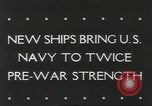
The U.S. Navy aircraft carrier Ticonderoga (CV-14) launching ceremony in the United States, during World War II.
The launching ceremony of the new warship Ticonderoga, a United States aircraft carrier of the United States during World War II. Scene at Newport News Shipbuilding and Dry Dock Company. Various United States Navy personnel at the ceremony and sponsor Miss Stephanie Sarah Pell. The USS Ticonderoga is the sixth vessel of her class to go down the ways at this yard. The guests wave their hands. (Note: the narrator erroneously states that this is the 65th new U.S. aircraft carrier to enter service in World War 2. Actually the U.S. produced about 27 new carriers during the war.)
CRITICALPAST.COM: About Us | Contact Us | FAQs - How to Order | License Agreement | My Account | My Lightboxes | Shopping Cart | Advanced Search | Featured Collections | Website Terms & Conditions | Privacy Policy ©2026 CriticalPast LLC.
License Agreement |
Terms & Conditions |
Privacy Policy
©2026 CriticalPast LLC.