


 Francais
 Deutsch
 Italiano
Refine Your Search
New Mexico United States 1946 stock footage and images
- Showing 10555 to 10560 of 30777 results more
more Hide
Hide
The Wright brothers and early models of airplanes developed and flown by them in the United States.
Depicts contribution of Wright brothers in development of airplanes. Old French bi-planes fly in parallel. Orville and Wilbur Wright brothers discuss with other man. Glider dragged of hill flies steadily. Wilbur attaches wheel beneath wing. First heavier than air plane takes off at Kitty hawk North Carolina, on December 17, 1903. Headlines of news paper about the event. Wilbur Wright prepares to fly under French Government subsidy, at La Mans in France. Orville flies with a passenger in Fort Myers, Virginia for an Army acceptance demonstration in July 1909. Men on ground watch the sustained flight of the plane. Bi plane flies close to ground in an open field. Military officials near the hanger of the plane. Wright brothers inspect catapult rails. The plane towed out and put on catapult. Two men rotate propeller to start the plane. Men pull weight to catapult the plane. Wright flyer climbs and plane takes off.
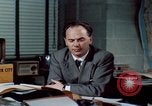
Italian influence on United States. San Francisco; Golden Gate Bridge; Presidio; Street car; Boston; Paul Revere Statue
An Italian journalist speaks in his office in New York City. A map of Manhattan on the wall in the background. Documents lay in front of him on the table. View of streets in San Francisco, California. The Golden Gate Bridge and The Presidio. Buses and street cars on road. Pedestrians cross the streets. People board Washington & Jackson Street tram of Municipal Railway of San Francisco, as it swings in circle to reverse course. Crabs being cooked in Italian market. Italian-American fisherman repairs nets at harbor in San Francisco. Statue of Paul Revere near the North Church in Boston, Massachusetts. Fishing boats of Italian-American fishermen at the dock. Fishermen unloading their catches. Sea birds snatch pieces of fish on the wharf. Views of small fishing boats named "Salvatore" and "St. Angelo". Fishermen work on their nets. Cluster of fishing boats at the pier.
Army Air Force truck extinguishes fire by carbon dioxide in United States.
New fire fighter demonstrated by Army Air Force. Tests conducted by Air Force fire truck that extinguishes fire by carbon dioxide. Long pipe on truck throws carbon dioxide on fire and extinguishes it. (World War II period).
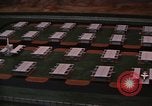
General Laurence Kuter and other official at North American Aerospace Defense Command control room in United States.
Animation shows NORAD (North American Aerospace Defense Command) using SAGE (Semi-Automatic Ground Environment) directed Bomarc IM-99B missiles to repel an attack by hostile aircraft. Animation shows Bomarc IM-99B missile on launch pad. Civilians walk on streets in Washington DC and New York City. The Texas tower. RC-121 aircraft in flight. Radars move at station. Board reads 'NORAD Operations Center' with names of Officials with their designations. Officials seated inside the NORAD center look at map on screen. They speak over phone and converse with each other. General Laurence Kuter in the NORAD control room. Animation of area defense concept and an attack by enemy bombing force. Bomarc IM-99B missile launched from launch pad.
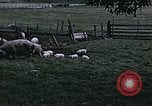
Pork, beef, and sugar crops processed at farms and factories in United States to meet war demand in World War 2
Agricultural progress in the America during World War II, with increased production to meet wartime needs. Pigs, hogs, and piglets on a farm. Trees in the background. Vehicles pass in front of a pork butcher and processing factory. Truck in front says "HH Green" on side. Sign in background of shot says "Morrell" (this is possibly the John Morrell & Co. Packing Plant in Ottumwa Iowa). Butcher workers with cleavers cut and process pork on moving assembly line. Beef cattle graze on a field. Tractor operated on a farm field. View of beef cattle stockyards at butcher and processing factories for meat. Butcher operations for beef cattle seen on moving assembly line. Farmers harvest feed crops for meat production. A feed shed filled to the top. Farmer harvests sugarcane and drives wagon filled with sugarcane, pulled by horses. Farmer on tractor on a sugarcane field. A tall harvesting machine cuts sugarcane in the field at harvest. Farmer on a sugar beet field. A mechanical seed splitting machine is shown. Farmer holding shafts with sugar beet seeds attached. Sorghum plants are shown and described as a new source of sugar. A man feeds harvested sorghum plants into a pressing machine to extract sorghum liquid for sugar.
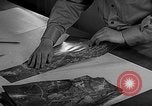
The film mosaic of T-3A camera is assembled together and interpreted in United States.
A U.S. Army training film about interpreting a camera film with aerial views. A print of T-3A camera film is developed. The mosaic prints are mounted by adhesive or staples. Completed mosaic is matched for contrast control networking. It is contrasted with U.S. geographical survey sheets and road maps. These are used to mark known places. Then these prints are pasted together. These pictures are send to an interpreter officer who translates the desired information. He uses stereoscope to find new enemy gun position, camouflage or other informations. (World War II period).
CRITICALPAST.COM: About Us | Contact Us | FAQs - How to Order | License Agreement | My Account | My Lightboxes | Shopping Cart | Advanced Search | Featured Collections | Website Terms & Conditions | Privacy Policy ©2026 CriticalPast LLC.
License Agreement |
Terms & Conditions |
Privacy Policy
©2026 CriticalPast LLC.