


 Francais
 Deutsch
 Italiano
Refine Your Search
New Mexico United States 1946 stock footage and images
- Showing 13231 to 13236 of 30777 results more
more Hide
Hide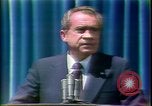
In San Clemente, California U.S. President Nixon talks about the existence of wiretaps during the Kennedy administration.
U.S. President Richard Nixon talks about the role of wiretaps in national security during a press conference in San Clemente, California. A journalist questions the President about his statement regarding the 10 additional wiretaps that could have been initiated by late U.S. Senator Robert F. Kennedy, which would have lead to the discovery of the Oswald plan and thus prevented U.S. President John F. Kennedy's assassination. The President responds that 10 more wiretaps could have found the conspiracy, if it was a conspiracy in the first place, then it would have been worth it. The President also talks about the high number of wiretaps in the National Security area during the Kennedy administration for national security purposes. The taps on news organizations, news people and civil rights leaders were all justified. The journalist then asks the President if he thought that President Kennedy's assassination threat mattered more to the national security wiretaps. The President does not agree with this and believes that the assassination was a breakdown in the President's security. He also states that he personally does not prefer to have secret service.
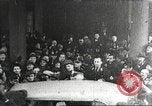
Adolf Hitler is named Chancellor of Germany
Crowds in Berlin, Germany, celebrate their new chancellor and Government, on January 30, 1933. Crowd of German people surround a car carrying Adolf Hitler in front of the Hotel Kaiserhof in Berlin. Citizens gather around the statue of General Leopold I, in Wilhelm Platz. Scene shifts to newly appointed Chancellor Hitler with his cabinet. He is seen conversing with former Chancellor, Franz von Papen, at his left and Hermann Göring, at his right. Standing behind Papen is Alfred Hugenberg, head of the German National People's Party (DNVP). Next, a slate appears stating that In the evening, the National Youth honor the aged German president (Hindenburg) and their new chancellor by a torchlight parade. View of Hitler watching from a window in the Chancellery. (Note: The torchlight parade was made up mostly of Nazi storm troopers, aka Sturmabteilung -SA, and SS troopers, with some organized youth participating.)
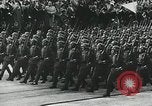
Soviet-German non-aggression pact is signed in Moscow and the Germans and the Red Army invade Poland in the European Theater.
German aggression during World War II. German troops marching in formation. A large crowd on either side of a road watches the troops. German Chancellor Adolf Hitler delivering a speech in Germany. Troops standing in formation listen to Hitler. On August 23, 1939 : People holding banners that read 'Down with War and Racism' and 'Aid the Allies'. New York Times headline reads: 'Reich and Soviet Join for Peace -- or War; No Buffer State; New Pact Warns Allies; Estonia Gives Moscow Sea and Air Bases'. Soviet politician Vyacheslav Molotov, Soviet Union leader Joseph Stalin and German Foreign Minister Friedrich Wilhelm Ribbentrop with other officers during the signing of Soviet German non-aggression pact (also called Molotov–Ribbentrop Pact) in Moscow, Russia in August, 1939. German Stuka dive bombers in action, when Germany invades Poland in a "blitzkrieg.".German Heinkel He-111 bombers in action. Buildings being totally destroyed by bombs. Red Army tanks and troops moving in snow. Victorious German troops marching in occupation. German heavy artillery batteries firing.
College students at University of California., Berkeley, during 1980 U.S. Presidential elections.
Film showing students at the University of California, Berkeley, principally in 1980. It also shows glimpses of Vietnam war era background events. Opening shows students on a college campus. Two of them sit and converse. Scene shifts to National Guard troops and police near the University of California campus, in May, 1969, when Governor Ronald Reagan declared a state of emergency and sent 2,200 National Guard troops into Berkeley, California. Next, students are seen handing out voting information from booths on the Berkeley campus during the 1980 U.S. Presidential elections. Students massed on campus and some having lively conversations with others. The entrance gates to the campus are seen in the background. Students moving about on the campus and some seated at outdoor tables having snacks and conversing. A student being interviewed who speaks about employment. Complete shift of scene to American soldiers jumping from a UH-1 Huey helicopter in Vietnam. President Richard Nixon waving enthusiastically in front of the Presidential helicopter. President Lyndon Johnson glad-handing spectators as he walks along the streets of a city. Glimpse of American hostages being taken from the embassy in Tehran, Iran, November 4, 1979 during Iran hostage crisis. U.S soldiers firing a howitzer field piece in Vietnam. Returning American hostages leaving an U.S.Air Force transport plane. A woman student being interviewed at Berkeley campus about the 1980 Presidential race between Jimmy Carter and Ronald Reagan. Students seated on a long bench in a room where a picture of motion picture star, John Wayne, is displayed on a wall. A male student says Ronald Reagan has brought a new spirit into everybody in America. A Berkeley political science professor comments on the new voters. Students speaking positively about President Reagan. More views of students and voting information on campus. (Note: film is silent except for occasional interviews.)
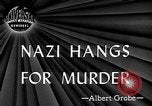
German civilian Matthias Gierens is hung until death for murdering a downed American flier in Germany in World War 2.
German civilian Matthias Gierens, a 37 year old railroad worker, is hanged in Rheinbach Germany for the August 15, 1944 murder of a downed American flyer, who was later identified as U.S. Army Air Forces 2nd Lieutenant Lester E. Reuss, from Forsythe, Montana. Reuss was the navigator on U.S. Army B-17 bomber #42-31183 which was downed by German aircraft after it attacked the Airdrome at Wiesbaden, Germany. Gierens and three other German civilian men, Peter Kohn, Peter Back, and Matthias Krein, were convicted on June 2, 1945 in Ahrweiler, Germany, for the murder of the American airman after his parachute landing near Priest, Germany. The trial was the first Allied trial in Germany of civilians charged with a war crime. Military police are seen escorting Gierens toward the gallows in a prison yard in Rheinbach. A German Catholic priest performs the rites. U.S military officer reads charges as Gierens is readied for execution (the officer is possibly Lt. Col J.V. Roddy, of San Francisco, who was in charge of the hanging). Trap door opens and Gierens is hung. The U.S. Army executioners were Master Sgt. John C. Woods, a former Texas State executioner, and Staff Sgt. Thomas Robinson, of Bronx, New York. Witnesses present included seven U.S. Lieutenant Colonels and one British officer, a number of Military Police, news correspondents, and photographers.
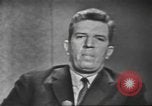
Kennedy and Nixon comment on the Indochina War, Quemoy and Matsu islands, and U-2 flights during their third debate.
Nixon and Kennedy debate questions regarding relations with Communists during the third Kennedy-Nixon Presidential Debate in the United States. Douglass Cater of Reporter magazine asks Republican candidate U.S. Vice President Richard M Nixon to comment whether there was a valid criticism of his statement of foreign policy. Nixon answers and states that the criticism is not valid. Regarding Indochina, he says that the U.S. would not have tolerated Indochina falling under Communist domination. And as a result of that the civil war there ended. He states that he supports the President's position and thinks that the President was correct in ordering the U-2 flights. Referring to Quemoy and Matsu he states that he objects to the constant reference to surrendering these islands. Democratic candidate Senator John F Kennedy disagrees with Nixon's statement on Indochina and states that reason Indochina was preserved was the Geneva Conference. On the question of the U-2 reconnaissance aircraft flights he states that he has never criticized them and never suggested stopping of espionage. On the question of keeping the Communists in doubt about the U.S. defending Quemoy and Matsu he states that the U.S. should meet its commitments to Formosa (Taiwan) and the Pescadores. He concludes by saying that he disagrees with Nixon as Nixon is extending the administration's commitment.
CRITICALPAST.COM: About Us | Contact Us | FAQs - How to Order | License Agreement | My Account | My Lightboxes | Shopping Cart | Advanced Search | Featured Collections | Website Terms & Conditions | Privacy Policy ©2026 CriticalPast LLC.
License Agreement |
Terms & Conditions |
Privacy Policy
©2026 CriticalPast LLC.