


 Francais
 Deutsch
 Italiano
Refine Your Search
New Mexico United States 1946 stock footage and images
- Showing 13471 to 13476 of 30777 results more
more Hide
Hide
General Dwight D. Eisenhower inspects troops of 320th Regiment of 35th Infantry Division in England during World War II.
U.S. General Dwight Eisenhower visits United States 35th Infantry Division troops in England during World War 2. General Eisenhower arrives at Exeter St Davids rail road station in the city of Exeter, Devon county, South West England. He gets into a car with a sign above that reads ' Great Western Railway ' General Eisenhower on a podium as he salutes to 320th Regiment troops of United States 35th Infantry. Troops lined up as General Eisenhower, along with General George S. Patton and Major General Paul W. Badde, review the soldiers. Soldiers in formation as General Eisenhower reviews them. (The 320th Regiment were based at Topsham Barracks in Exeter.)
General Dwight D. Eisenhower inspects field artillery of 35th Infantry Division in South West England during World War II.
U.S. General Dwight Eisenhower visits United States 35th Infantry Division troops in England during World War II. General Eisenhower speaks to a soldier of United States 35th Infantry Division in England. General Eisenhower along with General George S. Patton reviews firing of filed artillery. 155 mm Howitzers being fired. General Eisenhower speaks to a soldier outside a tent. Eisenhower and General Patton get into a car. General Eisenhower speaks to a soldier.
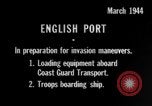
Coast Guard Troop Transport Ship. Crew and Army soldiers practice loading vehicles and equipment aboard the ship
American troops and Coast Guard ship's crew practice loading vehicles and personnel aboard Coast Guard Troop Transport ship in England, during World War II. A United States Army jeep being hoisted aboard a U.S. Coast Guard Troop Transport ship at a port in England in March, 1944. Men load jeep onto the ship. Boxes in a net being hoisted aboard ship. An officer directs the loading operations. United States Army troops board the ship. (World War II; WW II; World War 2; World War Two)

Late wave of German men recruited for Volkssturm and receiving uniforms and weapons in Germany, late in World War 2.
German Army units in action in Germany in January 1945. German troops on tanks fire artillery mounted on the tanks. Smoke due to explosions. Front of a gun barrel. A German flag. Youths and old men enlist in Volkssturm, a German military group under the Nazi party, comprised largely of youth and older men. New German soldiers assembled in outdoor square salute and taking an oath. A poster depicts national sacrifices through the Volksopfer program running from 7 - 28 January, 1945. Civilians donate clothing and equipment to the Reich to aid the German war effort and to supply the Volkssturm soldiers with material. A man pulls a trolley filled with donations. German citizens form a long queue to donate surplus clothing and equipment for the war effort. Newly minted Volkssturm soldiers receive uniforms, armbands with slogan "Deutscher Volkssturm Wehrmacht", and weapons. Men take out the uniforms from a stack. They wear their uniforms. Close ups of faces of new soldiers holding rifles. Newly drafted German soldiers receive Panzerfaust anti-tank weapons and are seen marching with rifles.
Che Guevara talks and Cubans receive Red Chinese Guns and Anti Aircraft guns in Cuba.
Che Guevara talks with his fellows. The United Nations office at New York. Brief shot of Fidel Castro greeting Soviet leader Khrushchev in New York City in 1960. Cuban man holds rifle. Cubans receive Red Chinese arms including Chinese submachine guns. Cuban soldiers receiving instruction in use of the submachine gun. Fidel Castro talks with his men. Cuban rebels soldiers on the alert by an Anti Aircraft gun (AA Gun). Cuban soldier traverse AA gun. Cuban women in a line with weapons, including one carrying a sub machine gun with a round ammunition drum mounted beneath it. Fidel Castro speaking.
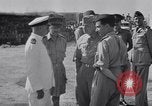
Allies force German forces almost completely out of Tunisia, North Africa, during World War II
Opens with General Dwight D. Eisenhower, Supreme Commander of Allied forces conferring with his deputy for land forces, British Field Marshal Harold Alexander, his deputy for sea forces, British Admiral Andrew Browne Cunningham, and his deputy for air operations, British air marshal Arthur William Tedder, during North African campaign in World War 2 . Map illustrates Allies military plans as analogous to internal combustion engine. General Eisenhower on an airfield consulting with his British Deputy commanders. B-17 bomber in background. Eisenhower salutes the British officers as he walks away. Lieutenant General Carl Spatz, Commander of the North West African Air Force, confers with British air marshal Tedder. Major General Jimmy Doolittle briefs airmen and smiles for camera. Strategic bombers with nose art names Pluto, Yankee Doodle, Jersey Jackass, Alice the Goon, and Fancy Pants. Picture of British Air Vice Marshal, Sir H.P. Lloyd, chief of Coastal air Force. A British Avro Anson aircraft flying air cover over a convoy of Allied ships. Diagram shows how all British and American fighter aircraft and attack bombers were placed under the command of British Air Marshal Cunningham, who is seen stepping from an airplane. British Field Marshal Harold Alexander in command of all ground forces is also seen stepping from an aircraft. Both are seen at a small camp trailer that they shared in the Tunisian mountains, where they work together, at a planning table. Marshal Cunningham is seen briefing air crews in mid March, 1943. B-24 Liberator bombers fly in formation and drop bombs on German Mareth fortifications in Tunis. German anti-aircraft guns create many black flak clouds among bomber formation. View from B-24 aircraft of the bombs exploding on the ground. British Field Marshal Harold Alexander is seen walking with a member of his staff across the sands. Diagram shows planned advance of the British 8th Army. Numerous British heavy guns fire nighttime barrages against the German positions, as British infantry advance during battle. They use scaling ladders and sappers detonate charges. Soldiers carry sticks to line trenches and set up defensive fortifications. Tanks advance. Heavy rain creates problems and some armor bogs down in mud. The next morning British troops are seen in their trenches as smoke drifts across the area. British soldiers moving cautiously under fire. German Field Marshal Rommel looks through binoculars. Additional German armored units entering the area. British gunners firing field artillery and mortars. Map illustrates how 2nd New Zealand Division under Lieutenant-General Bernard C. Freyberg, swings around behind the German line. Formation of British B-26 Marauder aircraft flying over desert. British Vickers Wellington bomber in flight. Bombardier in aircraft pressing a release button and close-up view of open bomb bay door with bombs away view as each bomb is released, followed by huge explosions on ground. British mosquito bomber flying low. Bomb explodes on ground and Mosquito aircraft pulls up and away. Another Mosquito aircraft flying low on a strafing run. Tanks of 2nd New Zealand Division welcomed into El-Hamma, Tunisia, in the Battle of the Mareth line. View of South African army engineers using caterpillar tractor to build roads for Allied forces. Glimpse from rear of three British warships underway in the Mediterranean sea. Front view of a British Queen Elizabeth Class battleship underway. The battleship firing her 15-inch guns. U.S. P-38 fighter planes in formation. Glimpse of pilot in cockpit wearing leather helmet and earphones. Formation of German Junkers Ju-52 aircraft flying low over sea, carrying German troops to reinforce those in Tunisia. View of German soldiers inside the cabin of a Ju-52. Closeup of three Ju-52 transports flying very low over water. Several U.S. P-38 fighter planes attacking the transports. Pilot in one, pressing button to fire his guns. Scenes of aerial dogfight combat between U.S. Army Air Force aircraft and German Luftwaffe aircraft. Gun camera images of P-38s shooting down German transport planes. Map shows American, British, and French forces pressing Eastward against Germans. Views of battle and U.S. Lieutenant General George Patton at the front as his forces move forward during Battle of Guettar. American patrols of light tanks meet up with British patrols from their 8th Army on April 7. Views of the U.S. and British soldiers happy to meet one another and sharing cigarettes. Map shows Allied forces pushing the Germans further. Allied infantry walking into town of Enfilaville. Local families returning to their homes with all their belongings, in carts pulled by donkeys and other animals. In the town, encouraged by British troops, a group of Jewish boys remove Jewish star of David emblems from their jackets that had been used by occupying Germans to identify them as Jewish. British army doctors tending to local women and children.
CRITICALPAST.COM: About Us | Contact Us | FAQs - How to Order | License Agreement | My Account | My Lightboxes | Shopping Cart | Advanced Search | Featured Collections | Website Terms & Conditions | Privacy Policy ©2026 CriticalPast LLC.
License Agreement |
Terms & Conditions |
Privacy Policy
©2026 CriticalPast LLC.