


 Francais
 Deutsch
 Italiano
Refine Your Search
New Mexico United States 1946 stock footage and images
- Showing 13507 to 13512 of 30777 results more
more Hide
Hide
An exercise to train combat troops in arctic warfare.
Alaskan Command paratroopers with units from other Strategic Army and U.S. Air Force units join Princess Patricias Canadian Infantry. United States Air Force plane goes aloft in Alaska. View of pilot in cockpit. Alaskan Command paratroopers in the plane. Paratroopers jumping from the planes and sky filled with parachutes. United States Army tanks moving on snowfield. View of U.S. Army helicopter. U.S. Army aircraft takes off. View of aircrafts in sky.
General Eisenhower greets King George VI at the First Army Headquarters in Verviers, Belgium (WW2)
King George VI of the United Kingdom and United States Army General Dwight D Eisenhower at the First Army Headquarters in Verviers, Belgium during World War II. Lieutenant General C. H. Hodges, General Dwight D. Eisenhower, U.S. Army Lieutenant General Omar N Bradley, and a United States Army Air Force General await the arrival of King George VI. Officers converse with each other and look up at the sky. A sedan drives up to a building. United Kingdom King George VI gets out of the car. He is greeted by General Eisenhower.
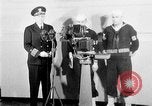
The Norden bomb sight is revealed to the U.S. public for the first time during World War II
The making of a public information film about the Norden bomb sight, during World War 2. Opening scene shows a Norden bomb sight on a pedestal, at the Museum of Science and Industry, in Radio City, Manhattan, New York City. It is flanked by U.S. Navy Captain, Irving Entwhistle and Shore Patrolman, Boatswain's Mate 2nd Class. Orville T. Payne. Another shore patrolman stands behind the bomb sight. The trio waits to begin. Then Captain Entwhistle begins to speak about the significance of the bomb sight to the war effort. The filming is interrupted and takes up again, focusing solely on Captain Entwhistle, as he continues to talk about the bomb sight, but is quickly interrupted, again, by the film director (heard, but not seen). The captain begins, repeating his scripted talk again. Scene shifts to Captain Entwhistle, now standing with hands on the bomb sight. He describes its operation as he maneuvers the sight. He notes the bomb sight's ability to take over control of the bomber's course to the precise drop point. Entwhistle, then looks up and comments: "Is that enough?" He then continues with his talk, but is interrupted, again. Next, Entwhistle picks up again, repeating part of his talk, while the camera pans over the bomb sight. Captain Entwhistle, states that, the instrument "is an automatic pilot, as well as a sight." He rotates the sight various ways for the camera, and asks: "'Want some more?" Scene changes, now showing Harold Barth, President of the Norden company, standing with Captain Entwhistle, who rotates the sight around on its pedestal, while chatting with him. (Microphones do not pick up the conversation.) Mr. Barth leans forward and peers through the sight. Next, in a closeup, the Captain manipulates the sight, while talking to Barth (sound not recorded). Mr. Barth and Captain Entwhistle, take turns looking through the sight. Closeup of the Captain looking through the sight, and manipulating its controls.
American women in military service during World War II
U.S. Navy commissioned Women officer nurses stand in formation, dressed in summer white uniforms, as they are inspected by senior officers during World War 2. Closeups of several nurses. Several women nurses, in uniforms of various armed services, pose for the camera. Closeups of some of them. Scene shifts to the first director of the Women's Army Corps (WAC), Colonel Oveta Culp Hobby, seen standing in front of an Army recruiting poster, and at her desk in Washington, DC. Women volunteers seen in a recruiting station, applying to join the new WAC. Colonel Hobby walking along sidewalk of the Arlington Memorial Bridge, across the Potomac River, in Washington, DC. She stops and poses for the camera. Next she is seen approaching two army officers on the bridge, who both come to attention and salute as she comes close enough for them to see the Colonel's eagles on her uniform shoulders. She returns their salute, smartly, and continues on her way. Next, four armed WAC members in field garb, stand on the side of a mountain as two of them consult a map and the others use binoculars. Below them, on a dirt path, women of a WAC motorcycle corps unit ride their Harley Davidson motorcycles. They also ford a stream on their motorcycles.

Montage of scenes depicting U.S. military weapons in the Korean War era.
Segment of U.S. Army public information television program called, "The Big Picture." Army cameraman records firing of a Nike missile. Atomic cannon fires shell creating atomic explosion and classic mushroom cloud. Army troops exit Sikorsky YH-19 helicopters. Infantrymen climb a hill while firing rifles in unison. Animated rotating world globe. Sergeant Stuart Queen emphasizes that, in spite of new weapon systems, the individual soldier is the essential element of the Army. Technicians in missile launch control blockhouse observe launch of a missile from steel tower. View from inside the structure of missile rising, and then of smoke as it heads skyward. Radar units and cameras tracking the missile. Views from a missile, of the ground below, as it accelerates upwards. More tracking cameras. A Matador missile being launched. A Viking missile being launched. Test of anti-aircraft missile launched horizontally, striking nearby target with explosion. A thermonuclear weapon test explosion. A Corporal missile being launched. Sophisticated electronic tracking equipment employed at desert test site. Convair experimental XFY Pogo seen in vertical takeoff during trials. Anti-aircraft missile, fired from Navy ship, strikes drone target aircraft, which falls in flames. Technician stands before a virtual wall of electronic equipment. Army Signal Corps television cameraman captures field maneuvers of Landing Vehicles Tracked (LVTs) and an M4 Sherman tank. A High-flying warplane fires an air-to-air missile destroying a drone aircraft target that falls in flames. Aerial view of the Pentagon, Arlington, Virginia. America's top military leaders sit around a table. At the head, is Chairman of the Joint Chiefs of Staff, Admiral Arthur William Radford. To his right are: General Nathan F. Twining, USAF, and Admiral Robert B. Carney, Chief of Naval Operations (back to camera). To Radford's left are General Lyman Lemnitzer, Army chief of Staff, and General Lemuel C. Shepherd, Jr. Commandant of the Marine Corps. Views of U.S. Navy warships firing heavy guns. A South Dakota Class Battleship firing her 16-inch guns. Navy aircraft being catapulted from the USS Ranger (CV-61). Gun camera view from aircraft firing guns. A USAF B-52 bomber in flight. Bombs falling from open bomb bay of bomber in flight and carpeting the ground with explosions. Low flying USAF aircraft demonstrating ground-support bombing techniques, dropping napalm and explosive bombs.
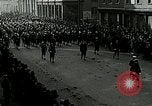
A crowd gathers as the Great Lakes Naval Reserve Band under the direction American composer John Philip Sousa marches by.
John Philip Sousa's U.S.Navy Band of the Great Lakes Naval Training Station leading a World War I Liberty Loan parade on a city street (possibly in Chicago, Illinois). Behind them two cars are seen and other marchers carrying signs. One sign reads: "Chip In." Numerous spectators line the sidewalks. View from above of the band in formation for a concert. John Philip Sousa and his wife, Jane, pose in front of a residence. He wears the uniform of a Lieutenant in the Naval Reserve. (Note: During World War I, the Navy asked Sousa to train bandsmen at the Great Lakes Naval Training Center. On May 31, 1917, at the age of 62, he accepted a commission as a Lieutenant, in the U.S.Naval Reserve and organized a new band at the Great Lakes Center. His fame attracted so many band recruits that he was able to form several Navy bands for other Navy bases and units.)
CRITICALPAST.COM: About Us | Contact Us | FAQs - How to Order | License Agreement | My Account | My Lightboxes | Shopping Cart | Advanced Search | Featured Collections | Website Terms & Conditions | Privacy Policy ©2026 CriticalPast LLC.
License Agreement |
Terms & Conditions |
Privacy Policy
©2026 CriticalPast LLC.