


 Francais
 Deutsch
 Italiano
Refine Your Search
New Mexico United States 1946 stock footage and images
- Showing 13501 to 13506 of 30777 results more
more Hide
Hide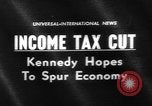
President John F. Kennedy addresses the U.S. on its economy, advocating a cut in income taxes in the near future
President of the United States John F. Kennedy addresses the nation in Washington D.C. President Kennedy outlines the existing state of affairs of the economy of the United States. He talks about the steps to be taken to prevent recession, the family budget and the national budget. He talks about increasing the revenue by increasing the number of jobs. He states about the cut in the corporate and personal income taxes in early 1963.
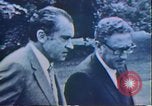
Dr. Henry Kissinger and Pat Buchanan speak about steps taken by U.S. President Richard Nixon to bring world peace
United States President Richard M. Nixon after being elected President of the United States. Special consultants, counselors and advisors to the President speak about Richard Nixon as the President. Richard Nixon and U.S. Secretary of State, Dr. Henry Kissinger discuss while walking in the White House. Dr. Kissinger talks about his role, assigned by President Nixon, in the U.S. Air Force One plane. Patrick Buchanan talks about Nixon's efforts to bring peace in Vietnam, Middle East and People's Republic of China. President Nixon with Chinese Premier Zhou Enlai and other Chinese leaders during a state dinner in Beijing, China. The Chinese band playing "Home on the Range." From a pro-Nixon "documentary" called "Portrait of a President" about President Richard Nixon. Released during his 1972 reelection campaign. (Vietnam War period)

John F Dulles and Alexander Wiley along with other officials at the Foreign relations committee meeting in Washington D.C.
A Foreign relations committee meeting in Washington D.C., United States. An official enters the committee room. A sign on the door reads 'Executive Session Admittance to members of committee only'. Delegates seated during the conference. U.S. Secretary of State John Foster Dulles looks at a map. Robert Alphonso Taft, Republican United States Senator and Joseph T Ferguson discuss. Chairman of the Senate Foreign Relations Committee Alexander Wiley sits with an official. He addresses the conference. He states that the military decisions will rest on the President
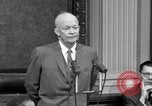
U.S. President Dwight Eisenhower answers queries of newsmen during his 130th press conference in Washington DC, U.S.
U.S. President Dwight Eisenhower during his 130th press conference in Washington DC, United States. Donald J. Gonzales, a newsman, says that when the President said he was unaware of the possibility of a Soviet statement on ending nuclear weapon tests, the U.S. Secretary of State John Foster Dulles said just on the previous day that this has been discussed in the previous days. The pressman asks the President for his reaction to the Soviet announcement. The President replies that he did not say that he was unaware of anything about it but did not have any proof that it was going to occur. He says that he cannot say anything more than what the Secretary said after complete discussions. The President further says that they had discussed this as a possibility on their own side, that is unilateral abandonment of tests and decided that it was not good for the United States at that time. Pressmen seated during the conference. Another pressman, Henry N. Taylor, gets up and puts forward a query to the President. He asks that last week the President had told them that he was convinced any nuclear test could be detected if there was a test ban. Yet the President, in the response to Russia, says test bans could be evaded in secrecy. The pressman asks the President if he could clear it. President Eisenhower says that the U.S. Secretary of State Dulles might have said that they are not certain there have not been tests, particularly underground tests or so small and in remote regions where there would not be debris and instruments would not be sensitive enough to pick them up. The President says he does not believe that explosions can happen in huge megaton character and not have evidence of it. Cameramen taking pictures. The President shakes hands with the officials and meets the pressmen.
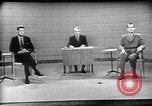
Senator John F. Kennedy and Vice President Richard Nixon face off in their first Presidential debate, in Chicago Illinois.
The first Kennedy-Nixon Presidential Debate in Chicago, Illinois. Moderator Howard K. Smith introduces the candidates-- Republican candidate U.S. Vice President Richard M. Nixon and Democratic candidate Senator John F. Kennedy. He talks about the opening and the closing statements to be given by the candidates. He talks about the questions which the panel of correspondents would ask the candidates. Senator Kennedy begins his statement. Kennedy talks about the direction of freedom for the Americans. He discusses domestic issues and the kind of society people live in. He talks about the strengths and the progress rate of the Americans. He urges people to make their country more powerful in every field. He feels disappointed about the unused steel-mill capacity, low rate of economic growth and poor educational system. He says he's not satisfied when he sees men like Jimmy Hoffa in charge of the largest union in the United States, and still free. He insists on overall infrastructural development and improvement of hydro power production where he says the Soviet Union has a lead. He states that every American should enjoy his full constitutional rights and they should meet their responsibilities. He says African American and Puerto Rican babies have much lower chances in education, work ,and advancement in the United States, and that this needs to change. He states that the government should provide effective programs and social security system for its citizens.
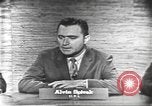
Richard Nixon and John Kennedy answer reporters' questions during a presidential election debate in Washington DC, U.S.
The second Kennedy-Nixon Presidential Debate in Washington DC, United States. Alvin Spivak of United Press International asks Republican candidate U.S. Vice President Richard M. Nixon to comment on his intentions in the field of civil rights. Nixon answers and states that progress is to be made in the field of employment by giving statutory authority to the Committee on Government Contracts. He states that in the field of schools, provisions should be laid whereby the federal government would give assistance to districts who want to integrate their schools. He speaks about presidential leadership. He concludes and says that the civil rights of the Americans should be recognized in order to protect the country from communist rule. Democratic candidate Senator John F Kennedy points that Nixon hasn't discussed what would be his policy on implementing the Supreme Court decision of 1954 and what would he do and what would be his leadership in providing fair employment, housing and education. He concludes by saying that the president must establish a moral leadership. Harold R. Levy of Newsday asks Kennedy to comment on what the President should do in racial discrimination events such as Little Rock Nine or the lunch-counter sit-ins. Kennedy says that he thinks that a president operates in different areas as a legislative leader, an executive leader and a moral leader and his functions differ in each area. He talks about the government contracts. He speaks about the standards set by the Americans which the Communists don't set. He comments on the case of Little Rock and says the U.S. President should go with the Supreme Court's decision. Nixon comments on the matter of the Committee on Government Contracts being mentioned by Kennedy. He talks about the functions of the Democratic Congress. He states that actions are required along with hopes. He concludes and says that in the field of executive leadership, U.S. president must lead and act as he talks.
CRITICALPAST.COM: About Us | Contact Us | FAQs - How to Order | License Agreement | My Account | My Lightboxes | Shopping Cart | Advanced Search | Featured Collections | Website Terms & Conditions | Privacy Policy ©2026 CriticalPast LLC.
License Agreement |
Terms & Conditions |
Privacy Policy
©2026 CriticalPast LLC.