


 Francais
 Deutsch
 Italiano
Refine Your Search
New Mexico United States 1946 stock footage and images
- Showing 1375 to 1380 of 30776 results more
more Hide
Hide
Caskets carrying victims of Hindenburg disaster being loaded aboard a German ship Hamburg for shipment to Germany in New York.
Dead bodies of victims of Hindenburg disaster in New York, United States. People lined up on the pier to attend the funeral ceremonies of victims who lost their lives in the explosion of German airship Hindenburg in New York, United States. Nazi flags fly at half mast after the Hindenburg disaster. A Nazi General salutes as caskets wrapped in Nazi flags lined up on the pier. United States military officers at the ceremony. A casket wrapped in Nazi flag being hoisted aboard the German ship Hamburg for shipment to Germany.
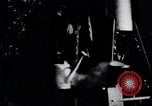
Liquid rocket research and development, led by Robert H. Goddard, in America
Robert H. Goddard with the first flight of a liquid fuel rocket on March 16, 1926, in Auburn, Massachussets. He stands next to the rocket perched high on a launching frame. Goddard uses a long pole and can of benzene to fuel the rocket. Photogaph of his camera and barograph used on July 17, 1929. An 18 meter tower being prepared. A 6 meter high test stand. The barrel could be filled with water and serve as ballast. Picture of a Performance recording device. A man in a protective bunker 15 meters from the launch point for tests in New Mexico. A man using a telescope to observe from a shed 900 meters from the launch point. Another with a telescope and recording device on a tripod. Pictures from the first gyro-controlled rocket flight on April 19, 1932
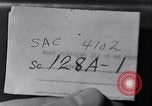
C-124 Globemaster cargo aircraft supporting SAC operations
An eight day clock on aircraft instrument panel. U.S. Air Force flight crew member packing gear, including cold weather clothing into his A-3 flight bag. Cargo being by means of the elevator into the cargo compartment of a Second Strategic Support Squadron C-124 Globemaster tail # 49-244, at Walker Air Force Base, New Mexico. B-36 strategic bomber seen in background. The men and equipment are headed to the Strategic Air Command's 509th Bomb Wing Forward Detachments at RAF Stations Mildenhall and Lakenheath, in England. (Note: This same aircraft, performing the same mission, successfully ditched in the North Atlantic on 23 Mar 1951, but no passengers or crew were ever recovered.).

U.S. Army Public affairs film to explain idea of Universal Military Training (UMT) as a Plan for Peace, in 1947
The Universal Military Training Plan for Peace, 1947. A civilian spokesperson stands before a briefing chart entitled "Plan for Peace." He explains the concepts for the program, involving military training for young men immediately after they complete high school.He explains how young men would register and be screened, assigned, and trained under the program. Two college students discuss a requirement to join the Reserve Officer Training Corps (ROTC) under the program. Scene shifts to a U.S. Army officer talking with a civilian about the cost of World War 2. As scens of wartime military production are shown, Narrator interjects that "a full year of Universal Military Training will cost less than three days of war." Scene shifts to Separation Center, Fort Douglas, Utah. U.S. soldiers are seen mustering out. One holds his Honorable discharge certificate. View of marching German soldiers is inserted at this point. Contents of the U.S. Constitution are displayed in plain print, higlighting the part: "...provide for the common defense..." View of college students on a campus. Closeup of Dexter Gate at Harvard College, and three men walking through it into Harvard Yard. ROTC cadet talking with acquaintances about studying rockets. ROTC cadet talking with two middle aged men about unique sounds of airplanes. A B-17 bomber in flight. A C-119 (flying boxcar) aircraft in flight. A formation of B-17s viewed from above with clouds beneath. The XP-84 jet in flight. A V2 rocket being test fired at White Sands, New Mexico.
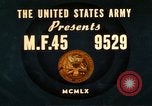
Film 'Milestone in Missilry' shows historic sequence of defensive missiles in operation in the U.S.A.
Film 'Milestone in Missilry' shows outdoor static display of many missiles near museum at White Sands Missile Range, New Mexico. A V-2 rocket on launch pad and then firing and launching. Nike Ajax antiaircraft missile is launched and destroys a QB-17 drone target aircraft. Technicians look through telescopic machine. Camera records the missile flight. Several more missile launches and strikes are recorded, including a couple targeting T-33 jet fighter drones. Nike Hercules missile strikes T-33 drone. All of the tests were monitored, tracked and filmed by elaborate machine.

Diplomats and officials attend ceremony to celebrate creation of new State of Manchukuo.
Several men stroll along a path in the park, on a warm day, in Harbin china. A pavilion is seen, decorated with small flags of many nations, including, among others: Japan; Turkey; the United states; Egypt; Greece; and Great Britain. (Although the United States and most other nations did not ever formally recognize the independent State of Manchukuo, the U.S. and others maintained consulates in Harbin and had a number of their citizens residing there.) Attendees walk to seats in an open theater in the park. It contains seats and benches. A formation of Japanese bi-wing bombers flies overhead. Tables for Manchukuo officials and special guests are on a raised platform. The backdrop is decorated with two crossed flags of the new Manchukuo, flanking a picture of its new leader, Manchurian former emperor of China, Aisin-Gioro Pu-Yi, also known as "Henry Pu-Yi" (or Puyi). The event proceeds with speeches and applause from the attendees. Two large Manchukuo flags are stretched out from the gateway of the park. A tram (street car) passes along tracks and powered by overhead electric wires. The tram is decorated with numerous small flags. Local people are seen going about their routine business on the streets. The flag of Manchuckuo flying on a flag pole.
CRITICALPAST.COM: About Us | Contact Us | FAQs - How to Order | License Agreement | My Account | My Lightboxes | Shopping Cart | Advanced Search | Featured Collections | Website Terms & Conditions | Privacy Policy ©2026 CriticalPast LLC.
License Agreement |
Terms & Conditions |
Privacy Policy
©2026 CriticalPast LLC.