


 Francais
 Deutsch
 Italiano
Refine Your Search
New Mexico United States 1946 stock footage and images
- Showing 1495 to 1500 of 30776 results more
more Hide
Hide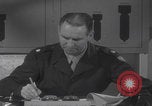
Incendiary bombs moved from United States to England during WW2.
Chemical Warfare Service (CWS) handles the distribution of incendiary bombs in Europe during World War II. Lieutenant Colonel R. N. Isbell of the Chemical Warfare Service (CWS) makes calculations from his desk. An incendiary order addressed to the Commanding General is typed on a typewriter. Buses arrive at the motor pool of the United States War Department, now known as the Pentagon. Women disembark from the buses and head to the War Department. Employees working in the office inside the War Department. Men prepare bombs at an arsenal. Men hauling carts with large incendiary bombs in warehouse. A man stencils labels onto bomb that read, "PT-1 Incendiary," and "Bomb Burster." The United States flag waving on a ship. Ships carry a shipment of incendiary bombs to the United Kingdom. Incendiary bombs inside wooden crates are unloaded from ships. Steam locomotive train running on track as railroad signal activates. Incendiary bombs are removed from train cars. Two munitions are suspended on a crane. Trucks loaded with bombs drive out of the depot, passing past village cemetery. An Air Division Chemical Officer receives new shipment information. The Air Division Chemical Officer reads the document and updates bomb listings on chalkboard.
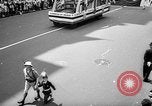
War bond parade on Fifth Avenue in New York City includes many floats, including from USSR, Belgium, Norway, and South America .
World War 2 war bond parade on Fifth Avenue, in New York City, United States. Soldier, in pith helmet, walks with a young boy in uniform.A float with beauty queens from South and Central American countries. A dinosaur-dragon float, representing the Axis powers. A float portraying the devastation and suffering at Bataan and Corregidor. A float showing George Washington rolling up his sleeves, and lined all around with soldiers, sailors,Marines, air raid wardens, and the like. An open car, surrounded by motorcycle policemen, carrying Parade Grand Marshal, Lieutenant General Hugh A. Drum, and a New York City official. A float of the Union of Soviet Socialist Republics, depicting Stalin on a white horse, and a sign saying: "Victory in 1942." A float with Soldiers,Sailors, Marines, American flags, and pretty women, with sign reading: " Sign Your War Bond Pledge June 14-24." United States flags fly on the buildings. A contingent of Norwegian Air Force, followed by Norwegian sailors and a large float of a ship, with sign reading: "Norway's Seamen, Norway's Front Line Soldiers, 3rd Largest Fleet in United Nations." A float of Belgium. Contingent of Greeks, led by one dressed as ancient Athenian warrior, followed by group carrying a small replica of the Parthenon.They are followed by Greek women in traditional costumes of Amalia and men in traditional uniforms of Evzone. A huge crowd gathered on the sidewalk. Marchers carry placards 'Destroy Hitlerism'.
Busy street scenes in Manhattan, New York City; also views inside a power plant and operating an electric draw bridge.
An electric power generating plant in the United States. Various views of 1940s New York City: The city at dawn, with Manhattan skyscraper buildings and the sun rising in the background. River traffic moving under the Brooklyn Bridge and buildings in the background. Manhattan streets with no traffic because it is dawn. Lion in front of the New York Public Library on 5th avenue, in silhouette. East River with Manhattan skyline behind. Shows people in houses busy with their morning routine. A milkman delivering by horse and wagon, to homes. Morning newspaper on door step. Man using electric shaver. Children leaving for school. A commuter train arrives at a railroad station. Trams, trolleys, buses, traffic and pedestrians along a street of New York City. Elevated view of Times Square filled with morning traffic of cars, trucks, buses and pedestrians. Turbine deck of an electric power plant. Men in a control room. A ship in a river. A man operates a bascule bridge (draw bridge), allowing ship to pass without delay. Operators, at controls of electric power plant, increase output to meet extra demands. Numerous dials, needles and gauges. View of turbine generator in power plant.
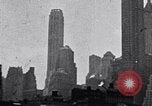
Dignitaries including Mrs Harmon at Spanish African American art painting exhibition by Pastor Argudin y Pedroso in United States.
Various buildings of New York City seen as camera pans from left to right and also shows a sailing boat at port in New York City United States. Palmer Hayden paints at New York waterfront. Dignitaries and arts supporters including Mrs Harmon at Spanish African American art painting exhibition by Pastor Argudin y Pedroso. James L Allen in his photography studio. A woman prepares a sculpture.
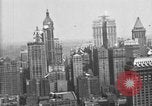
Oil products are used as a fuel for transporting goods and for cooking food in the United States.
Oil and petroleum products being used for different purposes in the United States. Low flying aerial view of skyscrapers in New York City. The Statue of Liberty. Aerial view of skyscrapers of Manhattan Island, New York City, including the Woolworth Building and the New York Municipal Building. A part of a wing of an aircraft seen in the aerial shots. Various uses of petroleum for transportation: A black locomotive train which uses petroleum as fuel is seen approaching camera at high speed, pulling train cars. A natural gas storage tank. Steam comes out of a kettle atop a vintage 1920's stove and oven, depicting use of natural gas as a fuel in homes.
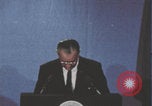
United States President Lyndon B. Johnson announcing his appointment of Thurgood Marshall to the Supreme Court of the United States.
United States President Lyndon B. Johnson announcing his appointment of Thurgood Marshall as the first African American to become a justice in the United States Supreme Court. Johnson notes that, "the senate willing, he will become associate justice to succeed justice Clark." Various still images of Thurgood Marshall's career in court. An African American man notes, "now, a new generation of Thurgood Marshalls must struggle to make the constitution live."
CRITICALPAST.COM: About Us | Contact Us | FAQs - How to Order | License Agreement | My Account | My Lightboxes | Shopping Cart | Advanced Search | Featured Collections | Website Terms & Conditions | Privacy Policy ©2026 CriticalPast LLC.
License Agreement |
Terms & Conditions |
Privacy Policy
©2026 CriticalPast LLC.