


 Francais
 Deutsch
 Italiano
Refine Your Search
New Mexico United States 1946 stock footage and images
- Showing 1579 to 1584 of 30776 results more
more Hide
Hide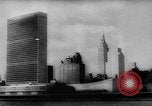
The United Nations Secretary General Dag Hammarskjold killed in a plane crash during a peace mission to Congo, Africa.
The United Nations Secretary General Dag Hammarskjöld killed in a plane crash during a peace mission to Congo, Africa. Dag Hammarskjöld disembarks from a plane for the peace mission. He reviews honor guard of the UN peace keeping forces. The Former Secretary General U-Thant administers the oath taking of Dag Hammarskjöld during a ceremony at the United Nations Headquarters (405 E 45th St, New York, NY 10017, United States) in New York City.
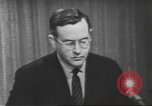
Vice President Nixon and Senator Kennedy debate over Quemoy and Matsu issue prior to presidential elections in the U.S.
The fourth presidential election debate held between Democratic nominee Senator John F. Kennedy and Republican nominee U.S. Vice President Richard Nixon in New York, United States on 21st October 1960. ABC News correspondent Quincy Howe speaks during the debate and allows NBC correspondent John Chancellor to pose a question to Richard Nixon a . Correspondent Chancellor asks a question about Quemoy and Matsu issue. Vice President Nixon points out inconsistency of Senator Kennedy. He further explains it by saying that Senator Kennedy signed a resolution in 1955 which gave the president the power to use United States forces to defend Formosa (Taiwan) and offshore islands. But he also voted for an amendment which was lost, an amendment which would have drawn a line and left out those islands. Vice President Nixon supports President Eisenhower's position. Correspondent Howe asks Senator Kennedy to comment on the topic. He speaks about President Eisenhower sending a mission to persuade Chiang Kai-shek in the spring of 1955 to withdraw from Quemoy and Matsu because they were exposed. The President was unsuccessful. He refers to the fact that in 1958, as a member of the Senate Foreign Relations Committee, he was very familiar with the position that the United States took in negotiating with Communist China (PRC) on these two islands. He further that the U.S. was unable to persuade China's Chiang Kai-Shek to withdraw and thus it was decided by the U.S. to defend the islands.
During a presidential election debate in the US, John F Kennedy and Richard Nixon comment on the necessity to defend Berlin.
The third Kennedy-Nixon Presidential Debate in the United States. Moderator Bill Shadel introduces the candidates and tells that candidates will not share the same platform. Republican candidate U.S. Vice President Richard M Nixon is in a Los Angeles studio and Democratic candidate Senator John F Kennedy is in New York. He also introduces the panel of correspondents who will question the candidates. The panel includes Frank McGee from NBC News, Charles Van Fremd from CBS News, Douglass Cater from Reporter magazine and Roscoe Drummond from New York Herald Tribune. Frank McGee asks Kennedy whether he would take military action to defend Berlin. Kennedy answers and says that the U.S. has contractual right to be in Berlin coming out of the conversations at Potsdam and of World War II. He states that the United States must meet its commitment on Berlin in order protect the security of Western Europe. He concludes by saying that the U.S. will meet its commitments to maintain the freedom and independence of West Berlin. Nixon disagrees with Kennedy's statement that the Republicans are trigger-happy and lead the nation into wars. He talks about the Democratic presidents who led the U.S. into wars. He concludes and states that he thinks there isn't any question about the necessity of defending Berlin.
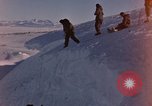
A New Zealand climber moves down a cliff during a U.S. Antarctica Research Program (Operation Deep Freeze) in Antarctica.
Operation Deep Freeze of the United States being carried on in Antarctica. A VX-6 parachute rescue team man and a New Zealand climber on the top of an ice shelf near Scott Base as they practice rescue methods. A man with a line wrapped around his body and leg tries to descend backwards on an ice cliff. The man climbs down a rope and moves down the ice cliff. He coils up the rope at the base of the cliff. A VX-6 parachute rescue team man and the New Zealand trainer walk off the mountain. A view of the ice covered mountains near New Zealand's Scott Base. United States Antarctica Research Program participants from Mcmurdo Station, and sleds, ready to leave on a trip with an American flag flying from the snow vehicle. Two sleds tied to the rear of a traveler. The snow traveler pulls two sleds down a ravine. Mount Erebus in the back ground
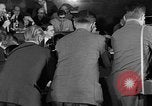
US Army Colonel Ferry testifies before officials during Army Signal Corps hearings in New York, led by Senator McCarthy.
McCarthy hearings in New York City, United States, investigating alleged Communist infiltration of the United States Army Signal Corps laboratory at Fort Monmouth. (Senate subcommittee investigating Army Signal Corps Subversion and Espionage.) United States Army Colonel Ferry takes his seat and begins testimony. Photographers take photos. Officials seated in hearing room including Joseph McCarthy and Roy Cohn. View of other elected officials present. Officials stand at end of testimony and talk informally together during a break in proceedings.
People offer prayers on 1966 Easter all over the world.
A film titled 'Holiday Highlights: World marks Easter with prayer and fete’. Interdenominational Christian group offering prayers in California. Yosemite falls also seen. Large crowds gather at Hollywood Bowl (2301 N Highland Ave, Los Angeles, CA 90068, United States) to offer prayers on Easter. Pope Paul VI addresses the people at St. Peter’s Square in Vatican City. People enter St. Thomas Church (1 W 53rd St, New York, NY 10019, United States) and St. Patrick's Cathedral (5th Ave, New York, NY 10022, United States) in New York to offer prayers.
CRITICALPAST.COM: About Us | Contact Us | FAQs - How to Order | License Agreement | My Account | My Lightboxes | Shopping Cart | Advanced Search | Featured Collections | Website Terms & Conditions | Privacy Policy ©2026 CriticalPast LLC.
License Agreement |
Terms & Conditions |
Privacy Policy
©2026 CriticalPast LLC.